How to Spot Fake Egyptian Cotton Sheets
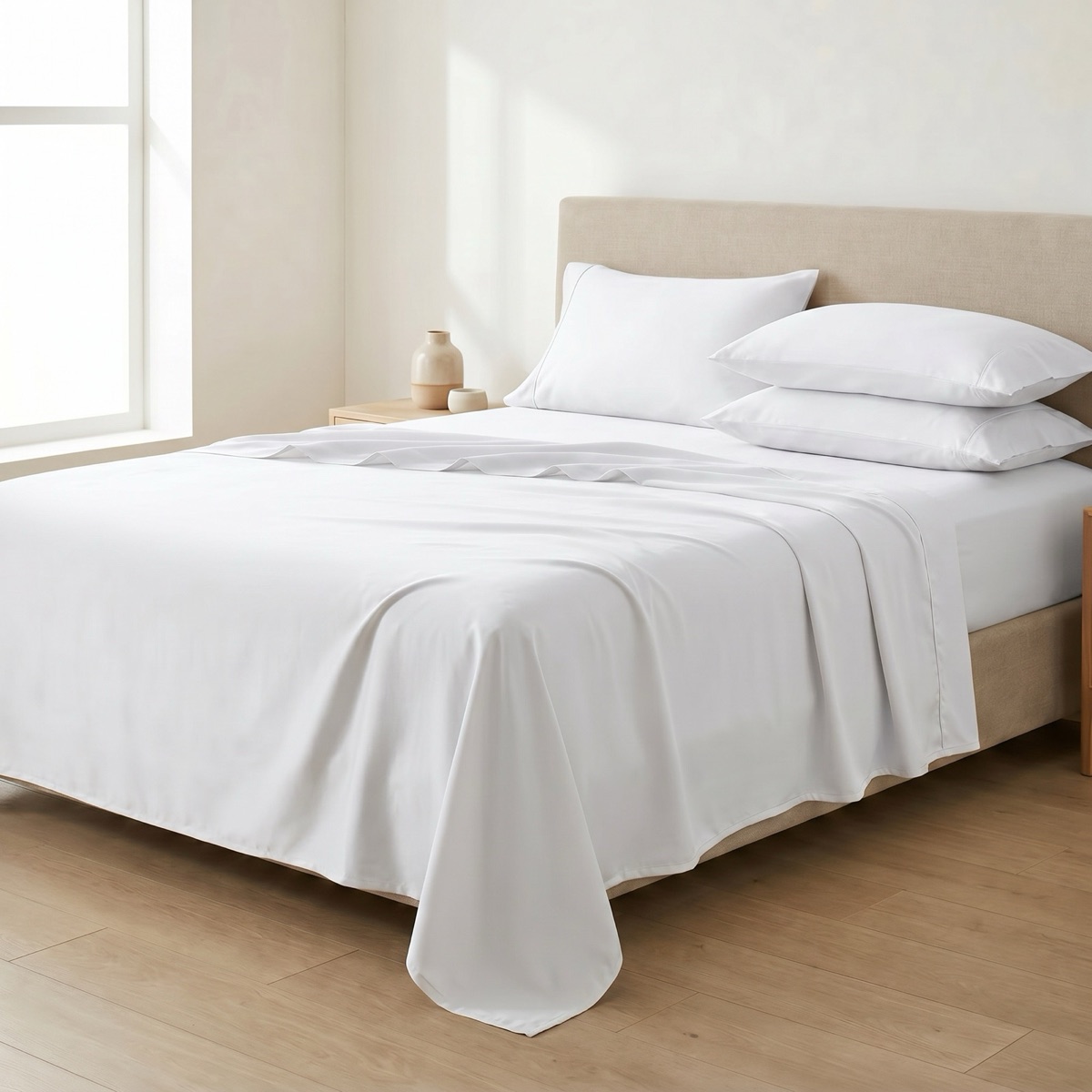
Kemet Cotton Egyptian Sateen Sheet Set
100% extra-long staple Giza cotton from Egypt's Nile Delta, woven into a smooth 600 thread count sateen. Ten colors, all standard sizes.
- 600 thread count sateen weave
- Extra-long staple Giza cotton
- Deep 16-inch pockets
- 30-day money-back guarantee
Sets from $149.95
Shop Kemet Sheets →The Scale of the Problem
The issue is straightforward: there isn’t enough Egyptian cotton grown in the world to fill even a fraction of the products claiming to contain it. Egypt’s cotton production has declined steadily over the past two decades, yet the number of “Egyptian cotton” products on Amazon alone has grown every year.
The Cotton Egypt Association puts it bluntly. Up to 90% of products labeled Egyptian cotton globally are not the genuine article. That’s not a fringe estimate. It’s the figure from the organisation responsible for certifying the real thing.
The Welspun India Scandal
If you want to understand how deep this problem runs, look at what happened in 2016. Welspun India, one of the world’s largest textile manufacturers, was caught substituting cheaper cotton blends into sheet sets sold as “100% Egyptian cotton” to Target and Walmart. These weren’t small sellers on marketplace platforms. These were major retailers with supply chain teams and quality assurance departments.
Target terminated its relationship with Welspun and recalled the affected products. Walmart followed. The industry response was swift, but the underlying problem didn’t vanish. Welspun was caught because Target commissioned independent DNA testing on the fiber. Most retailers don’t do this.
The lesson is clear: the label alone means nothing.
Five Red Flags for Fake Egyptian Cotton
1. Thread Count Above 800 at a Low Price
A queen sheet set claiming 1000-thread-count Egyptian cotton for $45 is almost certainly misleading. The problem here is twofold. First, genuine 1000 TC using single-ply yarn is extraordinarily rare and expensive. Second, most manufacturers reach that number by using two-ply or three-ply yarn and counting each ply as a separate thread.
A legitimate Egyptian cotton sheet at 400 to 600 thread count will outperform an inflated 1000 TC sheet using inferior fiber. Every time.
2. No CEA Certification
The Cotton Egypt Association (CEA) Pyramid Mark is the only internationally recognised certification that traces Egyptian cotton from the farm to the finished product. If a brand doesn’t mention this certification on its packaging or website, the Egyptian cotton claim is unverified.
Brands like Pure Parima, Hale Bedding, and Threadmill carry CEA certification. Many popular brands do not.
3. Vague or Missing Sourcing Information
Genuine Egyptian cotton brands tend to be specific about their supply chain. They’ll name the region (Nile Delta), the certification body, and sometimes the specific cotton variety (Giza 45, Giza 87, Giza 92). Brands that say “Egyptian cotton” and nothing else are giving you a marketing claim, not a provenance statement.
4. Price That Doesn’t Add Up
Egyptian cotton fiber costs roughly 30% to 50% more than standard cotton at the commodity level. After weaving, finishing, packaging, and retail margins, a genuine Egyptian cotton queen sheet set is difficult to produce and sell profitably below $80 to $100.
When you see a queen set for $30 to $40 labeled “Egyptian cotton,” the maths doesn’t work. Something in that supply chain isn’t what the label says.
5. Suspiciously Soft Out of the Box
This one surprises people. Genuine extra-long staple Egyptian cotton gets softer with washing. It shouldn’t feel like silk straight out of the packaging. That initial ultra-soft feel often comes from chemical softeners applied to lower-grade cotton to mimic premium texture. Real Egyptian cotton sheets feel smooth and fine when new, then become genuinely soft after 3 to 5 wash cycles.
Brands We’ve Flagged
We review every brand we can find that claims Egyptian cotton. Some hold up to scrutiny. Others don’t.
Sonoro Kate and Shilucheng are examples of brands selling sheets labeled as Egyptian cotton at prices that raise immediate questions. Neither carries CEA certification, and both sell queen sets well under $50. We’ve documented our findings in their individual reviews.
This doesn’t automatically mean the cotton isn’t from Egypt. But without certification, there’s no independent verification, and the pricing makes the claim difficult to accept at face value.
Your Verification Checklist
Before you buy any sheet set marketed as Egyptian cotton, run through this list:
Check for the Pyramid Mark. Look on the product packaging, the brand’s website, or the product listing for the Cotton Egypt Association logo. If it’s not there, the claim is unverified.
Verify on the CEA website. The Cotton Egypt Association maintains a list of licensed brands. If the brand isn’t listed, they haven’t been certified.
Look at the thread count. Genuine Egyptian cotton performs brilliantly at 400 to 600 TC with a sateen or percale weave. Be suspicious of anything above 800 TC, especially at lower price points.
Check the price. A queen set under $70 to $80 claiming Egyptian cotton should prompt further investigation. Some legitimate brands do run sales that bring prices into this range, but their standard pricing will be higher.
Read the fine print. “Egyptian cotton blend” is not the same as “100% Egyptian cotton,” and neither means anything without certification. Look for specific details about the cotton variety, the growing region, and any third-party testing.
Check the country of manufacture. Egyptian cotton can be woven anywhere in the world. Manufacturing in India, Pakistan, or China doesn’t make the sheets fake. But manufacturing in these countries combined with no certification and rock-bottom pricing is a pattern worth noting.
How the Industry Is Responding
The Cotton Egypt Association has expanded its licensing programme in recent years. DNA-based fiber testing (such as Oritain and Applied DNA Sciences technology) now makes it possible to verify cotton origin at the molecular level. Several major retailers have started requiring this testing from suppliers.
Progress is real, but it’s slow. The market still relies primarily on voluntary certification, and enforcement is limited. Until regulation catches up, the burden of verification falls on you.
The Bottom Line
The problem isn’t that genuine Egyptian cotton doesn’t exist. It does, and it’s genuinely superior bedding material. The problem is that the market is flooded with unverified claims, and most consumers have no way to tell the difference without knowing what to look for.
Check for the Pyramid Mark. Verify on the CEA website. Be sceptical of prices that seem too good. If a brand won’t tell you exactly where their cotton comes from and who certified it, that tells you quite a lot on its own.
See our brand reviews for detailed authenticity assessments of every sheet brand we’ve investigated.
Get our reviews first on Google
Add Cotton With Love as a preferred source and Google will show you more of our towel and sheet reviews.
Add Cotton With Love as a preferred source on GoogleAdd us as a preferred source on Google
See more of our towel and sheet reviews in your Google results.
Frequently Asked Questions
How common are fake Egyptian cotton sheets?
The Cotton Egypt Association estimates that up to 90% of products labeled as Egyptian cotton worldwide are not genuine. This figure has been cited repeatedly since 2016, and while enforcement has improved slightly, the problem remains widespread. If the sheets don't carry CEA certification, treat the claim as unverified.
What happened in the Welspun India scandal?
In 2016, Welspun India was caught substituting cheaper cotton blends for Egyptian cotton in sheets sold to Target and Walmart. Target dropped Welspun as a supplier and recalled the affected products. It was the largest documented case of Egyptian cotton fraud, but the industry consensus is that smaller-scale substitution happens constantly.
Does high thread count mean sheets are fake?
Not automatically, but thread counts above 800 are a strong red flag. Manufacturers inflate thread counts by using multi-ply yarn and counting each ply as a separate thread. A 1000-thread-count sheet often has roughly the same number of actual threads as a 500-thread-count sheet. Genuine Egyptian cotton performs beautifully at 400 to 600 thread count.
What is the Cotton Egypt Association Pyramid Mark?
The Pyramid Mark is the only internationally recognized certification for genuine Egyptian cotton. It verifies that the cotton was grown in Egypt and traces the fiber through the entire supply chain with independent third-party auditing. You can verify any product's certification on the Cotton Egypt Association website.
Are cheap Egyptian cotton sheets always fake?
Not always, but a queen sheet set priced under $60 to $70 claiming to be Egyptian cotton should raise serious questions. Genuine Egyptian cotton fiber costs significantly more than standard cotton at the farm gate. The math simply doesn't work for a $40 set to contain 100% verified Egyptian cotton after manufacturing, shipping, and retail margins.