Thread Count Explained: What It Actually Means for Sheets
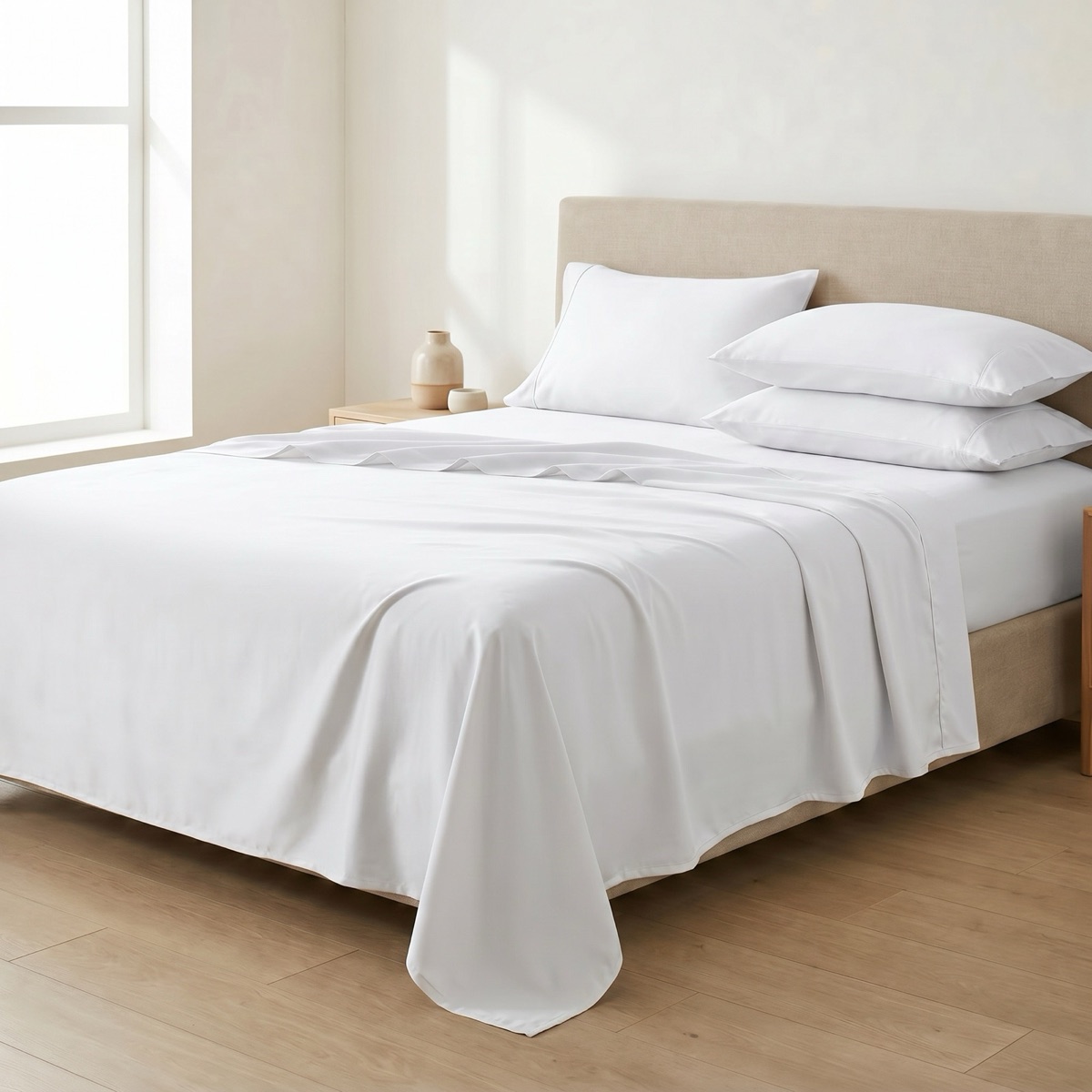
Kemet Cotton Egyptian Sateen Sheet Set
An honest 600 thread count sateen woven from extra-long staple Giza cotton — the kind of count that actually means something on the label.
- 600 thread count sateen weave
- Extra-long staple Giza cotton
- Deep 16-inch pockets
- 30-day money-back guarantee
Sets from $149.95
Shop Kemet Sheets →What Thread Count Actually Measures
Thread count is the number of threads woven into one square inch of fabric, counting both the horizontal (weft) and vertical (warp) threads. A fabric with 150 warp threads and 150 weft threads per square inch has a thread count of 300.
That is the entire definition. It is a simple density measurement. The problem is that simple measurement has been turned into the primary marketing metric for sheets, and that has created a system that actively misleads consumers.
Where the Numbers Go Wrong
The Multi-Ply Problem
This is the single biggest source of confusion in the sheets market, and it is deliberate.
Cotton yarn can be made from a single strand (single-ply) or from multiple strands twisted together (multi-ply). When a manufacturer uses two-ply yarn and counts each strand as a separate thread, they double the stated thread count.
The arithmetic is straightforward:
| Actual Yarns Per Sq Inch | Yarn Type | Stated Thread Count |
|---|---|---|
| 300 | Single-ply | 300 |
| 300 | Two-ply | 600 |
| 300 | Three-ply | 900 |
| 400 | Two-ply | 800 |
| 500 | Two-ply | 1,000 |
A 1,000-thread-count sheet using two-ply yarn has the same number of physical yarns as a 500-thread-count single-ply sheet. The fabric isn’t denser. It isn’t more refined. The number is just bigger.
This is misleading. I won’t hedge on that point. The practice exists because there is no regulation requiring brands to disclose ply count, and larger numbers sell more sheets.
Why Higher Isn’t Better Past a Point
There is a physical limit to how many yarns can be woven into a square inch of fabric. That limit depends on the thickness of the yarn, which depends on the fiber.
For Egyptian cotton (extra-long staple), which can be spun into exceptionally fine yarn, the practical ceiling for genuine single-ply thread count is roughly 600 to 700. For standard cotton, it’s lower, around 400 to 500.
Beyond those numbers, the fabric becomes so dense that it loses breathability. Air cannot pass through the weave efficiently, which defeats one of the primary advantages of cotton sheets.
Any sheet marketed above 800 thread count is almost certainly using multi-ply counting. Any sheet above 1,200 is using it aggressively.
What Thread Count Ranges Actually Feel Like
Rather than chasing a number, it’s more useful to understand what different ranges deliver in practice.
200 to 300 TC (Percale Territory)
Light, breathable, and distinctly crisp. This is the classic hotel sheet feel. Percale weaves at this count are cool to the touch and have a matte finish. They’ll feel slightly stiff when new but soften considerably after 3 to 5 washes.
The issue is that poorly made sheets at this count can feel thin and papery. Fiber quality matters enormously here. A 250TC Egyptian cotton percale will feel substantially better than a 250TC standard cotton percale.
300 to 500 TC (The Sweet Spot)
This is where most quality sheets live, and for good reason. The fabric is dense enough to feel substantial but open enough to breathe well. Both percale and sateen weaves work beautifully in this range.
Brands like Pure Parima (400TC sateen), Brooklinen (480TC sateen), and Silk & Snow (400TC percale) all operate here. These are not compromises. This is the range where cotton performs best.
500 to 700 TC (Dense and Smooth)
Heavier drape, smoother hand feel, noticeably silkier. Sateen weaves at this count can feel quite luxurious. SFERRA and Peacock Alley make excellent sheets in this range.
The trade-off is reduced breathability. If you sleep hot, this range may feel too warm, particularly in sateen.
800+ TC (Scepticism Required)
At this point, you’re almost certainly looking at multi-ply inflation. The question to ask is not “how high is the thread count” but rather “is this single-ply?”
Some brands at this count are quite honest about what they’re selling. Hale Bedding offers an 800TC sateen that performs well. But the thread count itself is not the reason.
What Matters More Than Thread Count
Thread count is one variable. These three factors have a larger impact on how your sheets actually feel and perform.
1. Fiber Quality
Egyptian cotton (extra-long staple) produces finer, stronger yarn than standard cotton. A 300TC Egyptian cotton sheet will feel smoother and last longer than a 500TC standard cotton sheet. The fiber determines the yarn quality, and the yarn quality determines the fabric quality. Thread count is downstream of this.
2. Weave Type
Percale and sateen feel completely different at the same thread count. Percale is crisp and cool. Sateen is smooth and warm. Choosing the wrong weave for your preferences will disappoint you regardless of thread count. For a detailed comparison, our percale vs sateen guide covers this thoroughly.
3. Finishing
How fabric is processed after weaving matters considerably. Mercerisation, calendering, and enzymatic treatments all affect how sheets feel out of the box. Two 400TC Egyptian cotton sateen sheets from different manufacturers can feel quite different because of finishing, not thread count.
How Brands Use Thread Count to Mislead
The pattern is consistent. Budget brands use multi-ply counting to inflate thread count, then price their sheets just below the mid-range brands that use single-ply counting honestly. The consumer sees “1000TC” at $89 and “400TC” at $170 and assumes the cheaper option is a bargain.
It isn’t. The $89 sheet has roughly the same yarn density as a 500TC single-ply sheet, made from inferior fiber, with less refined finishing.
Brands that are transparent about their construction, like Pure Parima, Silk & Snow, and Threadmill, will state their ply count clearly. If a brand doesn’t mention ply at all but advertises a thread count above 600, the omission is informative.
What to Do With This Information
When shopping for sheets, this is the practical approach:
- Prioritise fiber quality. Look for Egyptian cotton with CEA certification, or Supima cotton with verified origin. This matters more than thread count.
- Choose your weave first. Decide between percale (crisp, cool) and sateen (smooth, warm) based on your sleeping preferences.
- Look for 300 to 600 TC in single-ply. This range delivers the best performance for cotton sheets.
- Treat anything above 800 TC with scepticism. Ask whether it’s single-ply. If the brand doesn’t say, assume it’s multi-ply.
- Ignore thread count as a comparison tool between brands. A 400TC sheet from SFERRA and a 400TC sheet from an unknown Amazon brand are not equivalent, despite sharing a number.
Thread count is a useful data point. It is not a quality score. The sooner the industry stops pretending otherwise, the better off consumers will be.
Related Reading
Get our reviews first on Google
Add Cotton With Love as a preferred source and Google will show you more of our towel and sheet reviews.
Add Cotton With Love as a preferred source on GoogleAdd us as a preferred source on Google
See more of our towel and sheet reviews in your Google results.
Frequently Asked Questions
What is the best thread count for sheets?
For single-ply sheets, 300 to 600 thread count is the practical sweet spot. Within this range, you get a good balance of softness, breathability, and durability. Above 600 single-ply, returns diminish rapidly. Above 800, the number is almost certainly inflated using multi-ply counting.
Is 1000 thread count better than 400?
Usually not. A 1000-thread-count sheet made with two-ply yarn contains the same number of actual yarns as a 500-thread-count sheet. The higher number is accounting, not engineering. A genuine 400TC single-ply Egyptian cotton sheet will outperform most 1000TC sheets in softness, breathability, and longevity.
What does single-ply vs multi-ply thread count mean?
Single-ply thread count counts each yarn as one thread. Multi-ply counting counts each individual strand twisted into that yarn. A two-ply yarn counted as two threads doubles the stated thread count without adding any real threads to the fabric. This is why inflated thread counts exist.
Does thread count matter for cotton sheets?
It matters, but less than you think. Fiber quality (Egyptian cotton vs standard cotton), weave type (percale vs sateen), and finishing processes all have a bigger impact on how sheets feel and perform. Thread count is one factor among several, not the defining measure of quality.
Why do some sheets have thread counts over 1000?
Because multi-ply counting allows brands to double or triple the stated number. A sheet woven with 500 two-ply yarns per square inch can legally be marketed as 1000 thread count. There is no regulation preventing this. It is technically accurate but practically misleading.