Towel GSM Explained: What the Numbers Actually Mean (With Chart)
GSM is the one towel specification that’s hard to fake, which makes it the first number I check on any listing. It’s also routinely misread. Buyers assume the highest figure is the best towel, and brands are happy to let them. The chart below sets out what each weight actually feels like and what it’s for. After that, how to check the figure yourself, and why the fibre behind the number matters more than the number.
Towel GSM chart
| GSM range | Feel | Dry time | Best for | Example brands |
|---|---|---|---|---|
| 300 to 400 | Thin, light, slightly flat | Fast (2 to 4 hours hung) | Gym, beach, travel, hot climates | Amazon Basics Quick-Dry, most beach towels, Tesalate |
| 400 to 500 | Light but soft, a little give | Fast to moderate | Guest bathrooms, kids, humid homes, hand towels | Amazon Basics Fade-Resistant, Turkish flat-weave (pestemal) |
| 500 to 600 | Substantial, plush without bulk | Moderate (overnight in most rooms) | Everyday family bath towels, hand towels | Brooklinen Classic, Hammam Linen, Parachute Waffle |
| 600 to 700 | Thick, hotel-grade, holds heat | Moderate to slow | Primary bath towels, hotel or spa feel | Kemet Cotton Signature (600), Pure Parima (~600), Parachute Classic (~700), Frontgate Resort (~700), Matouk (~700) |
| 700 to 800 | Heavy, dense, blanket-like | Slow (needs airflow or a rail) | Luxury bathrooms with good ventilation | Kemet Cotton Reserve (700), Brooklinen Super-Plush (~820), Boll & Branch (~800) |
| 800 to 900+ | Very heavy, almost rug-like | Very slow (rail or dryer only) | Spa treatment rooms, heated-rail bathrooms | Abyss & Habidecor Super Pile (700 to 900 depending on line), hospitality suppliers |
Two notes on the table. GSM figures for named brands are the manufacturers’ own published numbers, rounded, and some lines change between production runs. And Kemet Cotton appears twice because it sells both a 600 GSM Signature line and an 700 GSM zero-twist Reserve line; I’ll come back to that brand later with the caveats it deserves.
What GSM Actually Measures
GSM stands for grams per square meter. It’s a straightforward density measurement: how much does one square meter of the towel fabric weigh? Higher GSM means more material packed into the same area, which translates to a thicker, heavier towel.
That’s all it is. Unlike thread count in sheets, which has been distorted by multi-ply counting games, GSM is quite difficult to manipulate. It’s a weight measurement. You either have the grams or you don’t.
This makes GSM one of the more reliable specifications you’ll find on towel packaging. The number tells you something genuine about the product. The issue is that it tells you only one thing.
GSM by use
The right weight depends on where the towel lives and who uses it, not on which number sounds most luxurious.
| Use | Recommended GSM | Reasoning |
|---|---|---|
| Gym or sports bag | 300 to 400 | Packs small, dries in the bag, washed constantly |
| Kids’ bathroom | 400 to 550 | Cheap to replace, dries fast, survives being left on the floor |
| Guest bathroom | 450 to 600 | Feels premium on arrival, dries even if hung badly |
| Everyday family bathroom | 500 to 650 | The balance of plushness, drying time and laundry cost |
| Hotel or spa feel at home | 600 to 800 | Only if the room has a window, fan or heated rail |
| Hand towels (any bathroom) | 450 to 600 | Used many times a day; must dry between uses |
| Washcloths | 450 to 700 | Small area, so weight matters less than fibre softness |
| Hot, humid climate | 400 to 550 | Heavier towels struggle to dry and go musty |
| Beach or pool | 300 to 450 | Thin, fast-drying, cheap to replace |
If you’re buying one set for a normal household bathroom and want a single number, make it 600 GSM. It’s the weight most quality hotels standardise on, for exactly the reasons above. Our best 600 GSM towels guide covers the specific products.
GSM Ranges and What They Feel Like
300 to 400 GSM: Lightweight
These are thin, fast-drying towels. They feel noticeably lighter in your hands and won’t give you the plush wrap-around sensation of a heavier towel.
Best for: Gym bags, beach trips, guest bathrooms where quick drying matters, and warm climates where a heavy towel feels excessive. Hand towels and washcloths also work well at this weight.
The trade-off: Less absorbent per use. You may need a second pass to dry off fully. They can also feel a bit rough if the cotton quality isn’t good, because there’s less fabric to cushion the fibers against your skin.
400 to 600 GSM: Mid-Weight
This is the everyday sweet spot for most households. Towels in this range feel substantial without being heavy. They absorb well and dry within a reasonable timeframe, even in moderately humid bathrooms.
Best for: Daily bath towels, hand towels you want to feel slightly more premium, and anyone who wants a balance between plushness and practicality.
What to expect: A 500 GSM Egyptian cotton towel will feel noticeably better than a 500 GSM towel made from standard cotton. GSM tells you the density, but the fiber type determines the texture. For more on what makes Egyptian cotton towels different, see our Egyptian cotton towels guide.
600 to 800 GSM: Luxury Weight
This is spa territory. Towels in this range feel thick and indulgent. They absorb moisture quickly and hold it. When you wrap one around yourself after a shower, you feel the weight and the warmth.
Best for: Primary bath towels in your home, particularly if you enjoy that hotel-spa feeling. Also well suited to bathrooms with good ventilation, as these towels need adequate airflow to dry properly between uses.
The trade-off: Drying time increases significantly. In a poorly ventilated bathroom, an 800 GSM towel may not dry fully between uses, which creates conditions for mildew and that musty smell nobody wants. They’re also heavier on laundry loads and take longer in the dryer.
Brands like Kemet Cotton offer towels in this range using Egyptian cotton, which combines the density with a softer hand feel than you’d get from standard cotton at the same GSM.
800+ GSM: Ultra-Heavy
These are the heaviest towels you’ll find in retail. They feel almost blanket-like in their weight and thickness.
Best for: Honestly, quite specific use cases. Spa treatment rooms, where towels are laundered commercially after every use. Bathrooms with heated towel rails that ensure full drying. People who genuinely prioritize maximum plushness above all else.
The problem here: Most home bathrooms can’t support towels this heavy. Without a heated rail or excellent ventilation, these towels become breeding grounds for bacteria and odour between washes. They’re also harder to wring out and take considerably longer to machine dry.
How to estimate GSM at home
Some brands, particularly budget options, don’t list GSM. Others list a figure I’ve found hard to believe. Either way, you can check it yourself with a kitchen scale and a tape measure in about two minutes.
The formula:
GSM = weight in grams ÷ (length in metres × width in metres)
Step by step:
- Make sure the towel is completely dry. Weigh it after a wash and full dry, not straight from the packaging, because new towels carry finishing agents and a little moisture that inflate the number.
- Weigh the towel in grams on a kitchen scale. If your scale only reads ounces, multiply by 28.35.
- Measure the length and width in centimetres, hem to hem, and divide each by 100 to get metres.
- Multiply length by width to get the area in square metres.
- Divide the weight by the area.
Worked example: A bath towel measures 70 cm by 140 cm after washing. That’s 0.70 m × 1.40 m = 0.98 square metres. On the scale it weighs 640 grams. 640 ÷ 0.98 = 653 GSM. If the listing said 700 GSM, that’s close enough to be honest rounding plus shrinkage. If the listing said 900 GSM, the listing is wrong.
A second example at the other end: a “luxury” hand towel measuring 40 cm by 70 cm (0.28 square metres) that weighs 110 grams comes out at 393 GSM. That’s a lightweight towel wearing a luxury label.
This won’t be perfectly precise because towels aren’t uniform, hems weigh more than pile, and cotton shrinks a few percent over the first washes, which pushes the calculated GSM slightly up. But a home measurement within 5 to 10 percent of the claim means the brand is being straight with you. A gap of 30 percent or more means it isn’t, and in my experience that gap rarely goes in the buyer’s favour.
GSM vs cotton quality
Here’s the part the chart can’t show you, and it’s the part that matters most. GSM measures how much fibre is in the towel. It says nothing about what that fibre is.
Cotton fibre comes in staple lengths. Short-staple upland cotton, which is most of the world’s crop, has fibres around 25 to 30 mm. Long-staple and extra-long-staple cotton (Egyptian Giza varieties, Pima, Supima, good Turkish cotton) runs from roughly 31 mm to over 36 mm. The difference sounds trivial. In a towel it isn’t, for three reasons.
Fewer fibre ends at the surface. Short fibres mean more loose ends poking out of each loop. Those ends are what feel scratchy, and they’re what break off as lint in the dryer. Long fibres produce loops that feel smooth and shed far less.
Stronger yarn at the same weight. Longer fibres overlap more inside a spun yarn, so the yarn holds together with less twist. That’s what makes zero-twist and low-twist construction possible: the fibres are long enough to stay put without being wound tight. A low-twist loop is fluffier, more absorbent and softer than a high-twist loop of the same weight. Short-staple cotton can’t be spun this way; it would fall apart.
Absorbency comes from loop structure, not mass. A towel absorbs through the surface area of its loops. Long, loosely twisted loops present more surface to the water. Short, tightly twisted loops present less, so a short-staple towel needs more grams of cotton to absorb the same amount. That’s the mechanism behind a rule I’ve seen hold up across years of checking shipments: a 600 GSM towel in long-staple Egyptian cotton will out-absorb, outlast and out-soften an 800 GSM towel in short-staple cotton. The heavier towel is carrying dead weight.
The issue is that GSM is easy to print and staple length isn’t. A budget brand can reach 800 GSM by packing in coarse fibre and a heavy high-twist loop. It’ll weigh right, feel dense in the shop, and then dry slowly, go stiff after a dozen washes, and shed. Rather than chasing the biggest number, look for the fibre claim behind it, and then check whether that fibre claim holds up. Our Turkish vs Egyptian cotton guide covers the two long-staple options most towel brands use, and our fake Egyptian cotton towels guide covers what to do when the label says Egyptian and the price says otherwise.
GSM Is Only Part of the Picture
Beyond fibre, several other factors shape how a towel performs at any given weight.
Loop construction affects texture. Towels with longer loops feel plusher and absorb more moisture. Towels with shorter loops feel smoother and more compact. Zero-twist construction produces an exceptionally soft towel with a different texture profile entirely.
Finishing processes change the hand feel. Softener treatments, enzyme washes, and combing all influence how a towel feels on first use. Some towels feel luxurious in the shop but lose softness after a few washes. Others improve over time. Silicone softeners in particular make a cheap towel feel expensive for exactly one wash.
Double-loop vs single-loop construction isn’t commonly disclosed by brands, but it affects both absorbency and drying time. Double-loop towels are denser at any given GSM.
Ground weave density (the base fabric the loops are anchored into) affects durability more than GSM does. A loose ground lets loops pull free, which is why some heavy towels go bald in patches within a year.
Matching GSM to Your Situation
Rather than chasing the highest GSM you can find, pick the weight that matches how and where you’ll use the towel.
Hot, humid climate: 400 to 500 GSM. Lighter towels dry faster and resist mildew better in moisture-heavy environments.
Temperate climate, good bathroom ventilation: 500 to 700 GSM. The broadest comfort range for daily use.
Heated towel rail or excellent ventilation: 600 to 800 GSM. If your towels dry fully between uses, heavier options are practical and pleasant.
Gym or travel: 300 to 400 GSM. Lightweight and compact. Dries quickly in a bag.
Guest bathroom: 400 to 600 GSM. A nice-feeling towel that you won’t worry about if guests don’t hang it properly to dry.
The best towel isn’t the heaviest one. It’s the one that matches your actual circumstances. A 500 GSM Egyptian cotton towel in a well-ventilated bathroom will outperform an 800 GSM standard cotton towel in a damp, windowless room, both in how it feels and how long it lasts. If musty towels are already a problem in your house, our guide on why towels smell musty deals with the causes.
Where Kemet Cotton fits on the chart
Since Kemet Cotton sits in both the 600 and 800 rows of the chart, it’s the obvious brand to use as a worked example of GSM and fibre together.
Kemet launched in 2025 and sells Giza Egyptian cotton towels sourced from the Nile Delta in two weights: the Signature line at 600 GSM and the Reserve line at 700 GSM, both zero-twist. That construction detail is the relevant one. Zero-twist only works with long-staple fibre, so a zero-twist towel that performs as claimed is itself a modest piece of evidence that the cotton is what the brand says it is. Sets of two run $93.95 (Signature) to $149.95 (Reserve), the towels carry the Cotton Egypt Association’s Gold Seal (licence 1624) and OEKO-TEX Standard 100 certification, and there’s a 30-day money-back guarantee.
The caveats, because this site exists to state them. Kemet does not hold the Cotton Egypt Association Pyramid Mark, which is the only third-party certification of Egyptian origin, so the Giza claim rests on the brand’s own disclosure rather than independent verification. And a brand a year old has no long-term track record. What I can say is that the sourcing claim is specific (variety and region named), the construction is consistent with long-staple fibre, and the guarantee shifts the risk of trying them onto the brand. On weight alone, the 600 GSM Signature is the sensible buy for most bathrooms. The 700 GSM Reserve is for people with a heated rail or a dry climate.
🏆 For verified Egyptian cotton, see: Best Egyptian Cotton Towels of 2026 →
For recommendations across the other GSM ranges, see our guides on Egyptian cotton towels and best 600 GSM towels. If you’ve settled on the luxury end of the scale, our best 800 GSM towels guide compares the options at that weight. For how weight interacts with towel dimensions, our towel sizes chart covers the other half of the equation.
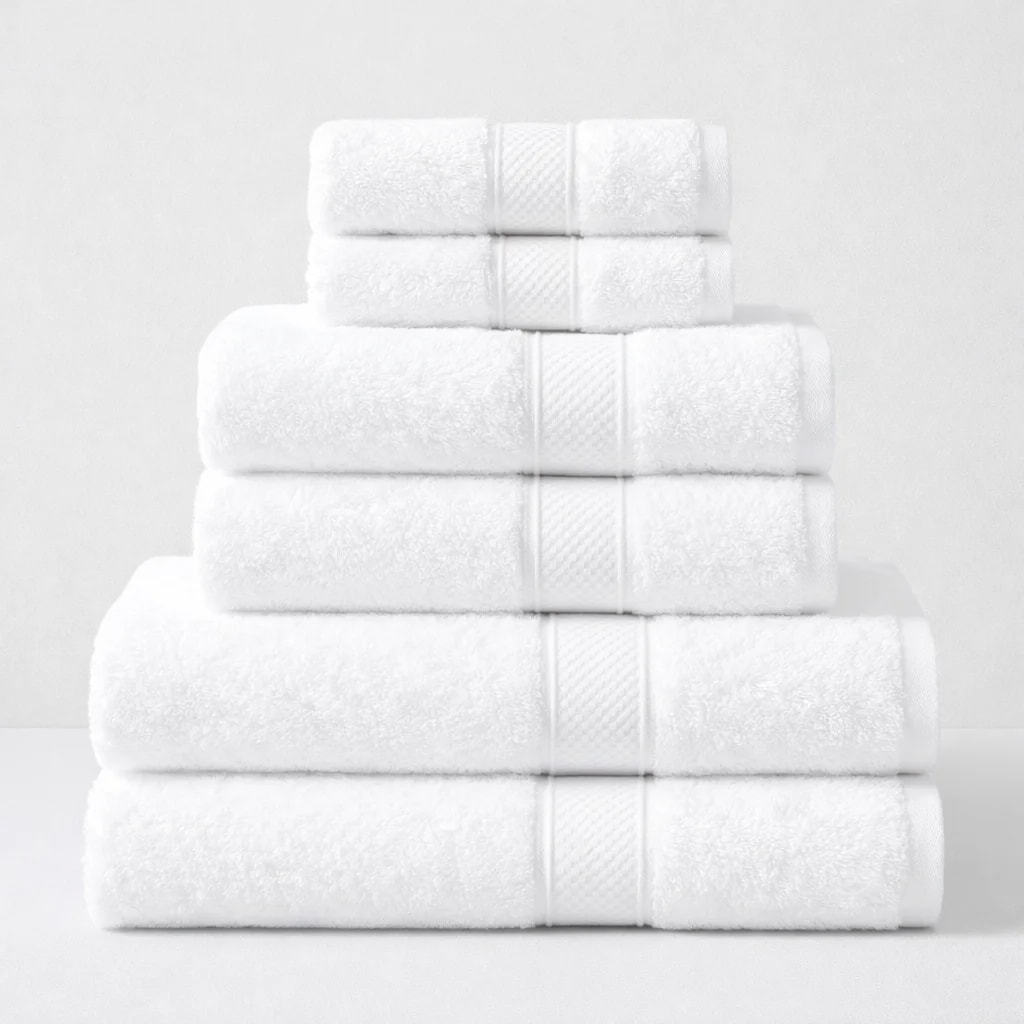
Kemet Cotton Egyptian Cotton Towels
100% Giza cotton from the Nile Delta, available at both 600 and 700 GSM with zero-twist weaving.
- 600 & 800 GSM weights
- OEKO-TEX certified
- Free worldwide shipping
- 30-day money-back guarantee
Sets of two from $93.95
Shop the Kemet Sale →Get our reviews first on Google
Add Cotton With Love as a preferred source and Google will show you more of our towel and sheet reviews.
Add Cotton With Love as a preferred source on GoogleAdd us as a preferred source on Google
See more of our towel and sheet reviews in your Google results.
Frequently Asked Questions
What GSM is best for bath towels?
For everyday bath towels, 500 to 700 GSM is the practical sweet spot. This range gives you good absorbency and a plush feel without being so heavy that the towel takes hours to dry. If you prefer a lighter towel or live in a humid climate, 400 to 500 GSM works well.
What does GSM mean for towels?
GSM stands for grams per square meter. It measures the weight of the fabric per unit area, which directly correlates with density and thickness. A higher GSM means a heavier, denser, more plush towel. A lower GSM means a lighter, thinner, quicker-drying towel.
Is 600 GSM good for a bath towel?
Yes. 600 GSM is the weight most quality hotels use and the point where a towel feels substantial without becoming slow to dry. It's the best all-round choice for a household bathroom with average ventilation. In long-staple cotton, a 600 GSM towel will typically outperform a heavier towel made from short-staple fibre on both softness and absorbency.
Is 800 GSM too heavy for a towel?
Not too heavy to use, but heavy enough to need the right bathroom. An 800 GSM towel holds a great deal of water and can take a full day to air-dry in a room with poor airflow, which leads to musty smells. If you have a heated rail, a window, or a dry climate, 800 GSM is genuinely luxurious. If not, stay at 600 to 700.
Is higher GSM always better?
No. Higher GSM means denser and heavier, but that isn't always desirable. An 800 GSM towel is luxuriously thick but takes significantly longer to dry, which can lead to musty smells in humid bathrooms. The best GSM depends on your use case, climate, and personal preference.
What GSM are hotel towels?
Most quality hotel towels fall in the 500 to 700 GSM range. Luxury hotels and spas often use 600 to 800 GSM towels. Hotels balance plushness against practical concerns like laundry costs and drying times, so even five-star properties rarely go above 800 GSM for regular bath towels.
How can I check the GSM of a towel?
If GSM isn't listed, you can calculate it. Weigh the towel in grams on a kitchen scale, then measure its area in square meters (length times width). Divide the weight by the area. For example, a towel weighing 600 grams that measures 70cm by 140cm (0.98 square meters) has a GSM of roughly 612.
What GSM is a good hand towel?
Hand towels do their best work at 450 to 600 GSM. They're used many times a day and need to dry between uses, so the heaviest luxury weights are a poor fit. A 500 GSM hand towel in decent cotton feels premium at the sink and will be dry again within a couple of hours.
Does GSM differ between cotton and bamboo towels?
GSM measures density regardless of fiber type, so the scale applies equally to cotton, bamboo, and blended towels. However, the same GSM can feel different across fiber types. Bamboo towels at 500 GSM may feel softer and silkier than cotton towels at the same GSM, while cotton tends to feel more structured and substantial.