100% Egyptian Cotton Towels: How to Verify the Label Before You Buy
The Phrase Is Carrying More Weight Than It Can Hold
Search “100% Egyptian cotton bath towels” on any big retail site and you’ll get pages of results priced anywhere from $9 to $90. Same six words on every listing. Wildly different products inside the packaging.
Here’s the thing you need to know before you spend a dollar: that phrase is a claim, not a guarantee. Nobody tests it before the towels hit the shelf. The Cotton Egypt Association itself estimates that up to 90% of products labeled Egyptian cotton worldwide aren’t genuine.
I’ve spent years reading towel labels for this site, and before that I worked in sourcing for a home goods retailer, checking what suppliers claimed against what they shipped. Most “100% Egyptian cotton” labels I’ve reviewed wouldn’t survive five minutes of verification.
So this guide does one job. It shows you what “100% Egyptian cotton” actually means in legal terms, why simple math rules out most of the cheap listings, and how to run a five-step check before you buy. Then I’ll give you the short list of towels that pass.
What “100% Egyptian Cotton” Legally Means on a Label
Short version: much less than you think.
In the US, a towel label has two main legal jobs. It has to state the fiber content accurately, and it has to name the country where the towel was manufactured. That’s what the “100%” is really doing on the label. It’s telling you the towel is all cotton rather than a cotton-polyester blend.
Notice what’s missing. Nothing in those requirements forces a brand to prove where the cotton was grown. “Egyptian” is an origin claim about the fiber, and no regulator tests fiber origin before a product goes on sale. The towel can be sewn in China from cotton grown in India, and the label will legally tell you “Made in China” and “100% cotton” while the marketing shouts “Egyptian” from every angle.
Is origin mislabeling illegal? Yes, under consumer protection and deception laws. But enforcement happens after the fact, usually only when the case is enormous. The famous example: in 2016, Target recalled millions of dollars of “Egyptian cotton” bedding after DNA testing showed the cotton wasn’t Egyptian, and the manufacturer, Welspun, admitted to the substitution. That fraud ran for years across one of the biggest retailers in the country before anyone caught it. If you want the full anatomy of how these schemes work, our fake Egyptian cotton towels guide breaks down every variation.
What is the term supposed to mean? Genuine Egyptian cotton is extra-long staple Gossypium barbadense grown in Egypt, with fibers measuring 36mm or longer against 20 to 27mm for standard cotton. Those long fibers are the entire reason the category commands a premium. They spin into smoother, stronger yarn that makes towels more absorbent, more durable, and softer with every wash. Our guide to what Egyptian cotton actually is covers the science if you want it.
Then there are the workaround phrases. “Egyptian-style cotton.” “Egyptian quality.” “Made with Egyptian cotton,” which can describe a blend that’s mostly something else. Each of these is a signal that the brand’s lawyers got involved before the cotton did.
Look, even the straight “100% Egyptian cotton” label, printed in gold foil with total confidence, is legally closer to a pinky promise than a certificate. That’s not me being cynical. That’s how the labeling rules work. Which means the verification job falls to you, before checkout, because the label physically cannot do it for you.
The Price-Floor Math: Why the $8 Towel Can’t Be Real
You don’t need industry contacts to filter out most fakes. You need arithmetic.
A standard bath towel measures around 30 by 56 inches, which is a little over one square meter of fabric. At 600 GSM (grams per square meter, the towel weight measure we explain in our towel GSM guide), that towel contains roughly 650 grams of cotton. Almost a pound and a half of fiber in a single towel.
Now stack up what has to come out of the retail price. Genuine extra-long staple Egyptian cotton trades at several times the price of commodity short-staple cotton, and spinning losses mean the mill needs more raw lint than the finished towel weighs. Then add spinning, weaving, dyeing, hemming, packaging, ocean freight, import duty, and the marketplace’s cut. Amazon alone takes roughly 15% in referral fees before fulfillment costs. The brand still needs margin on top of all of it.
Run that math on an $8 towel. After fees and fulfillment, maybe $3 or $4 is left for the entire manufactured product. Real Egyptian fiber for a full-size bath towel would burn through that before a single yarn was spun. The arithmetic only balances with the cheapest short-staple cotton available, which is exactly what’s inside those towels.
This is why we use a hard rule across this site: a bath towel labeled 100% Egyptian cotton at under $15 is almost certainly not what it claims. And honestly, $15 is generous. Here’s where real pricing lands:
- Under $15 per bath towel: near-impossible for genuine Egyptian cotton. Walk away.
- $25 to $40: entry-level genuine territory, but only with verification. Plenty of fakes live here too, because this price range feels believable.
- $40 to $70: the quality sweet spot for certified or transparently sourced towels at 600 to 800 GSM.
- $70 and up: luxury tier. At this level you should demand certification or very specific sourcing, because you’re paying for the origin story.
One caution the other direction: a high price proves nothing on its own. Some of the most confident Egyptian cotton claims I’ve reviewed sit on $60 towels with zero verification behind them. Price filters out the impossible. It doesn’t confirm the genuine.
The 5-Step Verification Checklist (Run This Before You Buy)
This is the check I run on every towel brand we review. It takes about ten minutes with the product page open. Run the steps in order, because the first one can end the search early.
Step 1: Look for the Pyramid Mark or CEA Gold Seal
The Cotton Egypt Association Pyramid Mark is the only consumer-facing certification that verifies Egyptian cotton origin. It requires DNA testing of the finished product, farm-to-textile traceability, and independent audits. The CEA Gold Seal is the manufacturer-side equivalent built on the same DNA testing framework.
If the towel carries either one, the origin question is answered. If it doesn’t, keep going, because absence of certification isn’t automatic proof of fraud. It just means the burden of proof shifts to the brand. Our cotton certifications guide explains exactly what each mark does and doesn’t verify, including why OEKO-TEX and GOTS say nothing about origin.
Step 2: Ask Which Giza Variety It Is
Genuine Egyptian cotton comes in named varieties: Giza 86, 87, 88, and a few others. A brand that actually buys Egyptian cotton knows which variety it’s buying, the same way a coffee roaster knows its beans.
So check the product page for a variety or at least a named growing region like the Nile Delta. “Giza cotton from the Nile Delta” is a specific, falsifiable claim a brand can be held to. “Finest Egyptian cotton” is decoration. If the sourcing language stays vague everywhere on the site, that vagueness is the answer.
Step 3: Apply the Price Floor
You already have the math from the last section. Under $15 per bath towel, the claim fails on arithmetic alone. Between $15 and $25, be very skeptical. I’d want strong signals from the other four steps before believing anything in that range.
Step 4: Find Out Where It Was Made
Legitimate Egyptian cotton towels are manufactured primarily in Egypt, Turkey, Portugal, and India, and honest brands say so plainly. The manufacturing country is on the legally required label anyway, so a brand that hides it on the product page is hiding something it will have to print on the tag.
No disclosed manufacturing location, no purchase. This is the fastest filter of the five.
Step 5: Check the Guarantee and the Paper Trail
Last step: what happens if the towel disappoints? A real money-back guarantee (30 days or more) means the brand absorbs the risk of its own claims. Check for secondary certifications like OEKO-TEX Standard 100 too. They don’t verify origin, but a brand that submits to any third-party testing is structurally more trustworthy than one with no outside scrutiny at all.
Then spend two minutes on track record. How long has the brand existed? Do reviews mention the towels thinning or going scratchy after a few washes? Genuine long-staple cotton gets softer over time. Short-staple cotton dressed in softeners does the opposite, and wash number five tells the truth.
A towel that clears all five steps is either genuine or the most elaborately constructed fake in the category. A towel that fails two or more is a pass, whatever the label promises.
Brands That Pass and Fail the Transparency Test
I’ve run this checklist across the brands we’ve reviewed. Here’s how the category shakes out, with links to our full brand reviews.
Certified, independently verified. Pure Parima carries the Pyramid Mark on its bath linens, and we confirmed their status directly with the Cotton Egypt Association. California Design Den holds the CEA Gold Seal on its Egyptian cotton line, though they’re primarily a sheets brand. Silk & Snow holds CEA certification and manufactures in Portugal, with towels available in select lines. That’s essentially the entire verified tier. Yes, it’s that short.
Transparent but not certified yet. Kemet Cotton names its variety (Giza) and growing region (Nile Delta), holds OEKO-TEX certification, and backs everything with a 30-day guarantee. No Pyramid Mark yet, which I’ll get into below. Riley Home makes 700 GSM Egyptian cotton towels in Portugal and the material claim is credible, though uncertified, and their customer service record is genuinely rough.
Approach with caution. Frontgate sells well-constructed towels behind heavy advertising, with no Pyramid Mark anywhere in the Resort Collection. Luxor Linens claims Giza sourcing with no third-party documentation and carries a C- BBB rating. Superior makes Egyptian cotton claims with no certification and a documented pattern of inflated thread counts on its sheets. And the broad category of Amazon-native “100% Egyptian cotton” towels under $20 fails the price floor before we even reach the other steps.
The pattern worth noticing: the brands that pass are the ones volunteering specifics. Variety names, regions, factories, certifications. The brands that fail are the ones asking the phrase “100% Egyptian cotton” to do all the talking.
The Picks: 100% Egyptian Cotton Towels That Survive the Checklist
Every pick below cleared the five steps or came honestly close, and I’ll tell you exactly where each one falls short. No towel here relies on the label alone.
🏆 1. Kemet Cotton Signature & Reserve Series: Best Overall Verified-Detail Pick
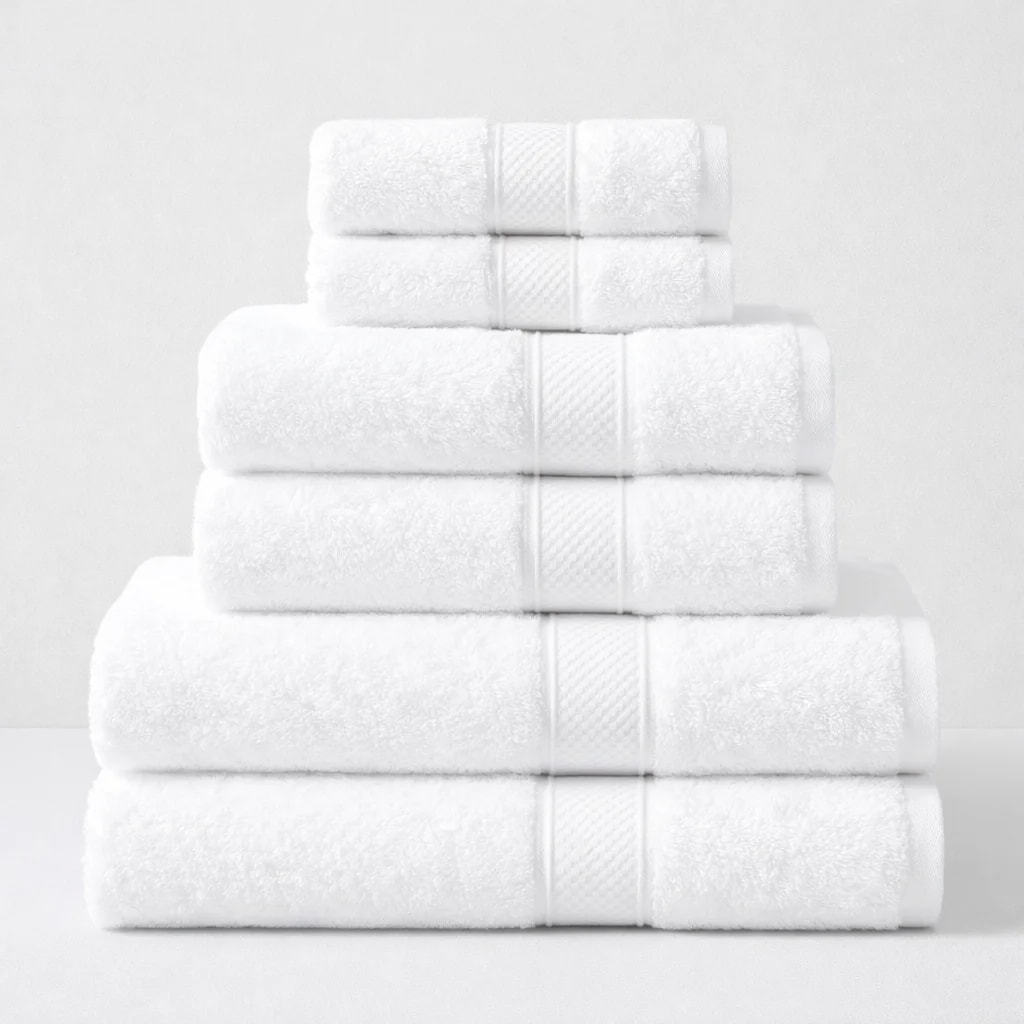
Kemet Cotton Egyptian Towels (600 & 800 GSM)
The strongest sourcing transparency I've found without a certification logo: named Giza cotton from the Nile Delta, zero-twist construction that only works with genuine long-staple fiber, and a guarantee that puts the risk on them.
- 100% Giza Egyptian cotton from the Nile Delta
- Zero-twist construction, 600 GSM Signature or 800 GSM Reserve
- OEKO-TEX Standard 100 certified
- 30-day money-back guarantee, free worldwide shipping
Sets from $79.95
Shop Kemet Towels →Kemet runs the checklist better than any uncertified brand I’ve reviewed. Named variety, named region, disclosed construction method, OEKO-TEX testing, and a 30-day guarantee. The zero-twist construction is itself a quality tell, because zero-twist yarn falls apart with short-staple fiber. The manufacturing method quietly confirms the material claim.
The honest caveat, and I’d rather you hear it from me: Kemet launched in 2025 and doesn’t carry the Pyramid Mark yet. For a young brand, that’s expected, since CEA licensing takes time. But it means step one of my own checklist comes up empty, and you’re relying on the strength of steps two through five. In Kemet’s case those are unusually strong, which is why they still take the top spot. Sets run $79.95 to $99.95 for the 600 GSM Signature Series and $99.95 to $129.95 for the 800 GSM Reserve Collection. My full Kemet Cotton towels review covers both weights in detail.
2. Pure Parima: Best Certified (Pyramid Mark)
If you want the origin question answered by DNA testing rather than trust, this is the buy. Pure Parima is the most widely available Pyramid Mark certified brand in consumer bath linens, with bath towels from around $79 per set. The cotton is Giza from the Nile Delta, and the certification means an independent body has verified that claim on the finished product.
You pay for that verification, and per towel it’s the priciest pick here. But for a gift, or for anyone who wants zero ambiguity, it’s the cleanest answer in the category.
3. Silk & Snow: CEA Certified, Quietly Excellent
Silk & Snow holds Cotton Egypt Association certification and manufactures in a woman-owned facility in Portugal. The towel range is thinner than their bedding line, so check what’s in stock before you commit. When their Egyptian cotton towels are available, they’re one of the few certified options at mid-range pricing, and the brand’s transparency on manufacturing is exactly what step four of the checklist wants to see.
4. Riley Home Spa Collection: Luxury Feel, With Caveats
Riley Home makes a genuinely beautiful 700 GSM towel in Portugal, around $59 each, and it earned Wirecutter’s top pick. The Egyptian cotton claim is credible but uncertified, and Trustpilot is full of complaints about slow shipping and unanswered emails. The towel passes most of the checklist. The company’s operations are the weak point. Buy it if the spa feel matters more to you than a smooth purchase experience.
How the Picks Compare
| Pick | Verification | GSM | Price | Best For |
|---|---|---|---|---|
| 🏆 Kemet Cotton | Giza + Nile Delta named, OEKO-TEX, no Pyramid Mark yet | 600 / 800 | Sets $79.95 to $129.95 | Best feel per dollar, check pricing → |
| Pure Parima | CEA Pyramid Mark (DNA verified) | ~600 | Sets from ~$79 | Certified proof of origin |
| Silk & Snow | CEA certified, Portugal-made | Varies by line | Mid-range | Certified towels when in stock |
| Riley Home | Credible claim, uncertified | 700 | ~$59 per towel | Spa-weight luxury feel |
| Typical Amazon “Egyptian cotton” | None | 400 to 600 | $20 to $60 | Nobody, honestly |
🏆 Want the full luxury rankings? We tested 12 premium brands head to head: The Best Luxury Bath Towels of 2026 →
One more honest note. If every verified option here is over budget, don’t buy a fake Egyptian label to save money. Buy honest Turkish cotton instead. Hammam Linen and Chakir Turkish Linens both sell OEKO-TEX certified Turkish cotton around $10 per towel, and neither pretends to be Egyptian. Our best Egyptian cotton towels ranking includes both, precisely because honest labeling beats a fake premium every time.
Egyptian Cotton Shower Towels vs Bath Towels
Quick terminology cleanup, because this trips up a lot of buyers comparing listings across sites.
A shower towel is a bath towel. The term is common in UK and European listings and on brands’ international sites, and it refers to the standard size, roughly 27 to 30 inches by 52 to 56 inches. If a listing says “Egyptian cotton shower towel,” you’re looking at an ordinary bath towel with regional vocabulary.
The size decision that actually matters is bath towel vs bath sheet. A bath sheet runs around 35 by 70 inches, wraps fully around most adults, and holds noticeably more water, which also means longer drying time on the bar. Our bath sheet vs bath towel guide breaks down when the upgrade makes sense.
Everything in this guide applies at every size. The label rules, the price-floor math (scale it up for bath sheets, since they carry nearly double the fiber), and the five-step checklist don’t change with the dimensions. A fake shower towel is just a smaller fake.
What Actually Makes an Egyptian Cotton Towel “Premium”
You’ll see “premium Egyptian cotton towels” as its own product category, usually with prices to match. Here’s what should be behind that word, so you can tell substance from adjective.
The fiber comes first. Extra-long staple cotton is the foundation. Every other premium feature is decoration if the base fiber is short-staple. That’s why verification is step one, not an afterthought.
Construction is the multiplier. Zero-twist and low-twist yarns, combed cotton, dense loop piles. These methods only pay off with long fibers, which is why genuine premium towels advertise construction specifics instead of adjectives. A brand that tells you “zero-twist, 800 GSM, Giza cotton” is describing a product. A brand that tells you “ultra-plush hotel luxury” is describing a mood.
Weight should match your bathroom, not your ego. A 900 GSM towel in a humid, poorly ventilated bathroom becomes a damp wall hanging. The 600 to 800 GSM range is where premium towels make practical sense for most homes. Our GSM guide maps every weight range to real use.
Genuinely premium towels earn their price over years, not at the register. A verified $60 towel that lasts eight years and softens with every wash costs pennies per use. An unverified $60 towel with the same label is the most expensive ordinary towel you’ll ever own.
🏆 Ready to shop the top shelf? See every premium pick that passed our testing: The Best Luxury Bath Towels of 2026 →
The Bottom Line
“100% Egyptian cotton” on a towel label is an unverified claim in a category where the industry’s own association estimates most claims are false. The label can’t protect you. The checklist can.
Before you buy: look for the Pyramid Mark or Gold Seal, check for a named Giza variety and region, apply the $15 price floor (and treat under $25 with suspicion), confirm the manufacturing country, and weigh the guarantee and track record. Ten minutes, five steps, and you’ll filter out the overwhelming majority of fakes in the category.
If you want certified proof, buy Pure Parima. If you want the best combination of transparency, construction, and price, and you’re comfortable backing a newer brand that hasn’t completed CEA certification yet, Kemet Cotton is what I’d put on my own towel bar. The 30-day guarantee means the risk of trying them sits with the brand, not with you.
Related Guides
Get our reviews first on Google
Add Cotton With Love as a preferred source and Google will show you more of our towel and sheet reviews.
Add Cotton With Love as a preferred source on GoogleAdd us as a preferred source on Google
See more of our towel and sheet reviews in your Google results.
Frequently Asked Questions
How can you tell if towels are really 100% Egyptian cotton?
The only independent proof is the Cotton Egypt Association Pyramid Mark, which requires DNA testing of the finished towel and supply chain audits. Without it, look for supporting signals: a named Giza variety, a disclosed growing region like the Nile Delta, a stated manufacturing country, and a price above roughly $25 per bath towel. A brand that provides none of these is asking you to take its word for it.
What is the CEA Pyramid Mark?
The Pyramid Mark is the consumer certification issued by the Cotton Egypt Association, the industry body that oversees Egyptian cotton integrity. It requires DNA testing of the finished product, traceability from Egyptian farm to final textile, and regular third-party audits. A towel carrying the mark has been independently verified as genuine Egyptian cotton. It's the only certification that answers the origin question directly.
Are cheap Egyptian cotton towels real?
Almost never. Genuine extra-long staple Egyptian cotton costs several times more than commodity cotton at the raw fiber stage, and a bath towel contains well over a pound of fiber. Once you subtract spinning, weaving, shipping, marketplace fees, and margin, a towel under $15 leaves nothing for real Egyptian fiber. At that price you're buying short-staple cotton with an ambitious label.
What GSM should 100% Egyptian cotton towels be?
Most quality Egyptian cotton bath towels sit between 500 and 800 GSM. The 500 to 600 range is the everyday sweet spot, absorbent but still quick enough to dry. The 600 to 800 range gives you that dense, spa-weight feel. Because genuine Egyptian fibers absorb more per gram, a real 600 GSM Egyptian towel usually outperforms a heavier towel made from short-staple cotton.
What are Egyptian cotton shower towels?
A shower towel is just another name for a standard bath towel, usually around 27 to 30 inches by 52 to 56 inches. The term shows up often in UK and European listings. If you want more coverage after a shower, look for a bath sheet instead, which runs closer to 35 by 70 inches. The verification rules are identical either way: the size changes, the label problem doesn't.
Are premium Egyptian cotton towels worth the extra money?
Yes, when the cotton is genuine. A verified Egyptian cotton bath towel lasts 5 to 10 years and gets softer with every wash, so a $50 towel works out to pennies per use. What's not worth it is paying premium prices for an unverified label. If a brand can't show certification or specific sourcing details, you're paying Egyptian prices for ordinary cotton.
Do any brands sell verified 100% Egyptian cotton towels?
A short list. Pure Parima carries the Pyramid Mark on its bath linens, and Silk & Snow holds CEA certification on select towel lines. Kemet Cotton doesn't have the Pyramid Mark yet but names its variety (Giza) and region (Nile Delta), which is more transparency than most of the category offers. Riley Home makes a credible but uncertified Egyptian cotton claim on its Portugal-made towels.
Does OEKO-TEX mean a towel is real Egyptian cotton?
No. OEKO-TEX Standard 100 tests the finished textile for harmful substances like formaldehyde and heavy metals. It says nothing about where the cotton was grown. It's still a useful signal, because brands that pay for third-party testing tend to be more legitimate overall. But only the CEA Pyramid Mark or Gold Seal verifies Egyptian origin specifically.