Buying Guide · 2026 Edition
Best Fast-Absorbing Bath Towels (2026): Tested Picks for Quick Drying
P
By Priya Menon · Home & Care Editor Last updated May 19, 2026
Top Picks at a Glance
How I Tested
I'm a "wrap in a towel and walk around the house" person, not a "pat dry and put clothes on immediately" person. So I'm picky about absorbency in a different way than someone who just wants their face dry fast.
After trying dozens of bath towels across price tiers over the years, I've sorted out which ones actually pull water off your skin (versus pushing it around) and which ones leave you damp for ten minutes. Here's what works.
What Actually Determines Absorbency
Absorbency isn't just GSM. It's a combination of four things:
The cotton fibre itself. Long-staple cotton (Egyptian, Pima) has a different cellulose structure than short-staple cotton, with more space for water molecules to bind. A long-staple cotton towel at 600 GSM often absorbs more than a short-staple cotton towel at 800 GSM.
How the yarn is spun. Ring-spun yarn is denser and absorbs more uniformly than open-end spun. Zero-twist construction (a variant of ring-spinning) leaves cotton fibres in a looser arrangement that pulls water faster. Hygro and Hydrocotton are hollow-yarn constructions that work like wicks.
The loop structure. More loops per square inch absorb more water. Longer loops absorb more water per loop. The trade-off is drying time: longer denser loops hold more water but take longer to release it.
The finishing. Some manufacturers apply softening chemicals that initially feel nice but coat the fibres and reduce absorbency. Premium brands skip this. Budget brands sometimes apply it heavily.
The towels that actually absorb water fastest combine premium long-staple cotton with zero-twist or Hygro construction in the 600-800 GSM range, finished without softening chemicals.
Kemet Cotton Signature 600 GSM: The Fast-Absorbing Winner
Egypt 600 GSM · zero-twist Sets from $93.95 · ~$37-41 per towel
Best forA towel that absorbs in seconds and is dry again by your next shower
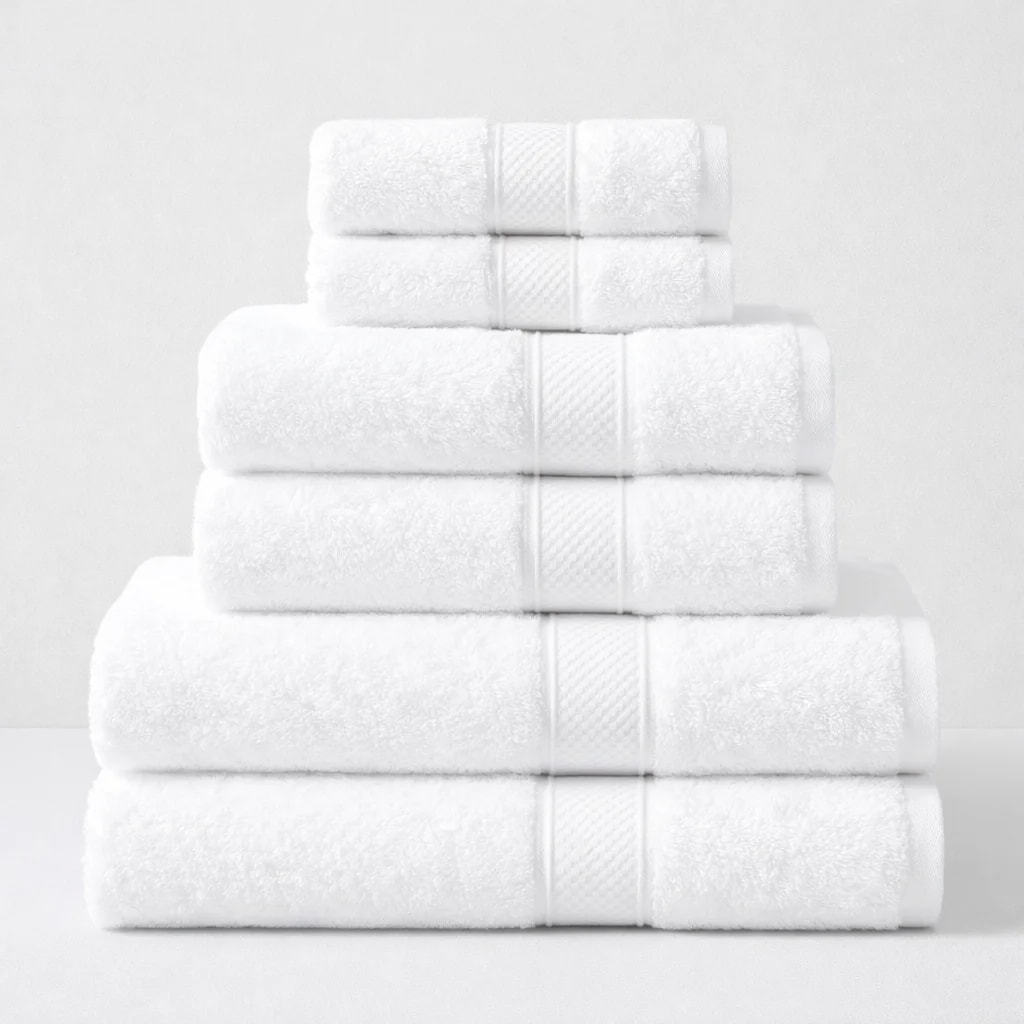
Everything the physics section above says about fast absorption converges on one spec: long-staple cotton, zero-twist construction, in the 600-700 GSM band. That is exactly what the Kemet Cotton Signature line is — long-staple Giza Egyptian cotton at 600 GSM, woven with zero-twist construction at the brand's own mill in Egypt.
The fibre closes the GSM gap. Long-staple cotton binds more water per gram than short-staple, which is why a long-staple towel at 600 GSM often absorbs more than a short-staple towel at 800 GSM. The Signature's Giza fibre buys it heavyweight-class water pickup without heavyweight mass.
The construction speeds it up. Zero-twist yarn leaves the cotton fibres in a looser arrangement that pulls water off skin faster than standard twist. It's the same logic behind hospitality towels, which run 600-700 GSM and are optimized for drying skin efficiently rather than for maximum loft.
And the weight means it dries fast too. Longer, denser loops hold more water but release it slower; at 800 GSM and above, drying stretches toward a full overnight on the bar. At 600 GSM the Signature sits in the absorb-fast-and-dry-fast sweet spot — and for a guide literally titled fast-absorbing, that combination is the whole assignment.
Pricing: The Signature Bath Towel sells as a Set of 2 for $93.95, a Set of 4 for $162.95 (about $41 a towel), or a Set of 8 for $299.95 (about $37 a towel), direct from kemetcotton.com.
The trade-off: you give up the last word in sheer plush mass. If you want maximum loft and total water capacity, and you can give a towel overnight to dry, the 800 GSM pick below is the better indulgence. For most buyers wanting maximum absorbency without paying for certification, Kemet is the right call.
Long-staple cotton at 600 GSM absorbs like short-staple at 800 — and it's dry again by morning. That is what a fast-absorbing towel means.
Pure Parima 800 GSM: The Heavyweight-Absorbency Alternative
Certified Egyptian cotton 800 GSM · ring-spun
Best forMaximum plush and total water capacity, if you can give it overnight to dry
If raw water capacity matters more to you than turnaround time, the Pure Parima 800 GSM Egyptian cotton bath towel is the most absorbent towel I've personally used. Here's what I noticed:
After stepping out of the shower, I usually need to pat-dry for 20-30 seconds before I feel meaningfully dry. With Pure Parima, that same routine takes maybe 10-15 seconds. The water just goes into the towel rather than smearing around.
The verified Egyptian cotton fibre is doing real work here. The cotton itself absorbs more, and the ring-spun construction maintains that absorbency over years of use.
The trade-off: these towels take longer to dry between uses. In our humid bathroom, my Pure Parima bath towels need a full overnight on the towel bar to feel fully dry before next use. In a less humid space, they'd be fine.
Check Pure Parima Pricing →
The most water per pass of anything I've used — as long as you can give it the overnight it needs to dry.
Hammam Linen: Best Budget Absorbency
Turkish cotton 600 GSM · ring-spun About $10 per towel
Best forActual water absorption at a budget price
If you can't stretch to premium Egyptian cotton, Hammam Linen Turkish cotton at 600 GSM is the best budget option for actual water absorption.
The Turkish cotton fibre isn't as long-staple as Egyptian, but Turkey produces some of the best cotton outside of the ELS varieties. The construction is ring-spun, the GSM is honest, and the towels softly absorb water rather than rejecting it.
The catch: the first 3-5 washes will produce shedding and the cotton needs the break-in cycles to reach full absorbency. After the break-in, performance is genuinely good.
For about $10 per towel, Hammam Linen is the best absorbency value on Amazon.
Shop Hammam Linen →
Frontgate Resort Collection: Hospitality-Grade Absorbency
~700 GSM Hospitality construction
Best forAbsorbency over visual luxury, hotel-style
Frontgate Resort Collection towels are designed for hospitality use, which means they're optimized for absorbency over plushness. Many luxury hotels use these specifically because they dry skin efficiently while feeling premium.
The construction prioritizes mid-weight density (around 700 GSM) over heavyweight loft, which is the sweet spot for absorbency without compromising drying speed. After my shower, these towels reach the dry threshold faster than 800 GSM Egyptian alternatives.
For buyers prioritizing absorbency over visual luxury, Frontgate is the better choice than heavier-weight luxury alternatives.
Materials I'd Avoid for Absorbency
Some cotton-adjacent options that don't deliver:
Microfibre bath towels. Marketed as super-absorbent and they technically are, but they feel synthetic against skin and don't deliver the cotton bath experience. Useful for travel or gym, not for daily home use.
Bamboo bath towels. Genuinely absorbent in their first year but degrade faster than cotton. Bamboo fibre breaks down under repeated washing and the absorbency declines noticeably. Not worth the premium price.
Polyester-cotton blends. The polyester percentage reduces water absorption. Even at 80% cotton 20% polyester, the towel absorbs meaningfully less than 100% cotton.
Heavyweight terry over 900 GSM. The towels feel plush but the dense compressed construction pushes water around rather than absorbing it efficiently. Diminishing returns past 800 GSM.
Anything with "anti-microbial" treatments. The chemical finishing usually coats the cotton fibres and reduces absorbency. Skip these unless you have a specific medical need.
How to Maximize Absorbency in Towels You Already Own
If you already have good cotton bath towels and they're not absorbing well, here's how to restore performance:
Strip the residue. Run an empty wash with 1 cup of distilled white vinegar at the highest temperature your towels tolerate. Then run another empty wash with 1/2 cup of baking soda. This removes the buildup from detergent and fabric softener that coats cotton fibres.
Stop using fabric softener. Permanently. It's the biggest absorbency killer. White vinegar in the rinse cycle gives the same softness benefit without coating the fibres.
Reduce detergent dose. Most people use too much detergent. The residue accumulates and reduces absorbency. Use the recommended dose for your water hardness, not the cap-full default.
Tumble dry on low. High heat hardens cotton fibres and reduces absorbency. Low heat preserves the structure that absorbs water.
Replace shower-side towels every 3 days. Towels that don't fully dry between uses develop a slight mildew load that reduces absorbency and gets worse over time.
After this maintenance routine, even mid-tier cotton towels can restore most of their original absorbency.
Quick Comparison
| Towel | Material | GSM | Absorbency | Drying Time |
| Kemet CottonOur pick | Giza Egyptian (zero-twist) | 600 | Excellent | Fast |
| Pure Parima | Certified Egyptian | 800 | Excellent | Slow |
| Frontgate Resort | Egyptian | 700 | Excellent | Medium |
| Hammam Linen | Turkish | 600 | Very Good | Fast |
| Chakir Turkish | Turkish | Medium | Very Good | Fast |
| Utopia Towels | Standard ring-spun | 600 | Good | Medium |
| Generic Amazon "1000 GSM" | Generic | Variable | Poor | Very slow |
What I'd Personally Choose
For my own bathroom where absorbency matters more than anything else:
Primary daily use: Kemet Cotton 600 GSM Signature zero-twist. Absorbs fast, dries fast, about $37-41 a towel in sets.
For luxury moments: Pure Parima 800 GSM for the absolute best feel and absorbency.
For humid climates or fast-turnover: Hammam Linen 600 GSM Turkish for absorbency plus drying speed.
For gym, travel, or high-abuse: Tens Towels lightweight Turkish cotton designed for fast drying.
To avoid: Generic Amazon "luxury 1000 GSM" sets. They're heavy without absorbing well.
The Bottom Line
The most absorbent bath towels combine long-staple cotton fibre with ring-spun or zero-twist construction at 600-800 GSM. Brand name matters less than these underlying physical characteristics. That's also why a 600 GSM long-staple zero-twist towel tops this list: it's the spec the physics points to, not the heaviest number on the label.
If your towel doesn't absorb water, the cause is usually one of: short-staple cotton, fabric softener buildup, or excessive detergent residue. The first is structural (replace the towel). The second and third are fixable with the maintenance routine above.
Frequently Asked Questions
What makes a bath towel absorbent? +
Three factors. Fibre type (long-staple cotton absorbs better than short-staple, Egyptian and Pima outperform standard cotton). Yarn construction (zero-twist and Hygro yarn structures pull water more efficiently than standard twist). Loop density (more loops per square inch means more surface area for water absorption). Loop length (longer loops absorb more water but dry slower).
Is higher GSM more absorbent? +
Generally yes, but with diminishing returns past 700 GSM. The most absorbent bath towels typically run 600 to 800 GSM. Above 800, the additional cotton mass doesn't proportionally improve absorbency. Above 900, towels can actually push water around rather than absorb because the loops compress under wet weight.
Why do my new towels not absorb water? +
Cotton bath towels usually need 2 to 3 washes before reaching full absorbency. Most new towels are coated with sizing chemicals that smooth the cotton during manufacturing and need to be washed out. Add a half cup of white vinegar to the first wash to strip the sizing and activate the cotton.
Are Turkish or Egyptian cotton towels more absorbent? +
Egyptian cotton typically absorbs more water at the same GSM weight because the longer fibres create denser yarn with more water-holding capacity. Turkish cotton dries faster because the construction is usually lighter. For maximum absorbency, Egyptian wins. For balanced absorbency plus fast drying, Turkish wins.
What's the most absorbent bath towel material? +
Ranked: 1) Long-staple Egyptian cotton (highest absorbency per GSM), 2) Supima Pima cotton (similar to Egyptian), 3) Premium Turkish cotton, 4) Bamboo-cotton blends (high absorbency but slower drying), 5) Standard cotton, 6) Microfibre (high absorbency but doesn't feel like cotton).
Why do hotel towels feel so absorbent? +
Premium hotels use mid-weight (600-700 GSM) ring-spun long-staple cotton with specific construction that prioritizes water pickup over plushness. Many hospitality-grade towels also use Hygro or Hydrocotton hollow-yarn construction. They're not the heaviest towels, but they're optimized for the function of drying skin efficiently.