Best White Bath Towels: What to Buy and How to Keep Them White
Why White Towels Are Worth the Trouble
There’s a reason hotels use white towels even though they’re harder to keep clean. White just looks better. It signals fresh, signals luxury, photographs well, matches everything, and most importantly, you can actually tell when they’re clean.
A grey or beige towel can be hiding a lot. A white towel, you can see exactly what’s going on with it. That’s not a downside. That’s the point.
I switched my main bathroom to all white towels about three years ago and haven’t gone back. I have a kid and a golden retriever, both of which create plenty of laundry problems, but the white towels have held up better than any of the colored ones I had before. The trick is the right cotton and a few simple care habits.
Here’s what to buy and how to keep them looking like they should.
What Makes a White Towel Worth Buying
Three things matter more than anything else for white towels specifically.
Fiber length. Long-staple cotton (Egyptian, Turkish, or Supima) keeps its whiteness longer than standard cotton because the longer fibers don’t break down as fast. Broken short fibers create a fuzzy surface that accepts dirt, oils, and minerals more readily. Premium fiber actually pays off more visibly with white towels than with colored ones.
GSM weight. For the hotel-quality feel most people want from white towels, you’re looking at 600 to 700 GSM. That’s where you get the substantial plushness without crossing into spa-weight territory where the towels stay damp for hours. If you’re in a humid bathroom or you don’t have great airflow, lean toward 600 GSM.
Hem and edge construction. White towels show wear at the edges first. Look for double-stitched hems, reinforced corners, and tight binding. These details are what separates a towel that looks crisp after 50 washes from one that looks tired.
What doesn’t matter as much as marketing would have you believe: brand prestige, thread count claims (irrelevant for towels), and color of packaging. None of those affect how the towel actually performs.
Top Picks for White Bath Towels
| Pick | Best For | Price | Where to Buy |
|---|---|---|---|
| 🏆 Kemet Cotton Reserve, Pure White | Best overall, certified Egyptian cotton, 700 GSM | $149.95 for 2 | Check Price → |
| Kemet Cotton Signature, Pure White | Same cotton at 600 GSM, faster drying | $93.95 for 2 | Check Price → |
| Pure Parima White | Silkier certified Egyptian cotton | About $50 per towel | Shop on Amazon → |
| Chakir Turkish Linens White | Budget volume | About $10 per towel | Shop on Amazon → |
| Frontgate Resort Collection White | Resort-pool oversized feel | $40 to $80 per towel | frontgate.com |
| Hudson Park Egyptian Cotton White | Department store, wait for sales | $40 to $65 | bloomingdales.com |
🏆 For the full ranking across every colour, see: Best Egyptian Cotton Towels of 2026 →
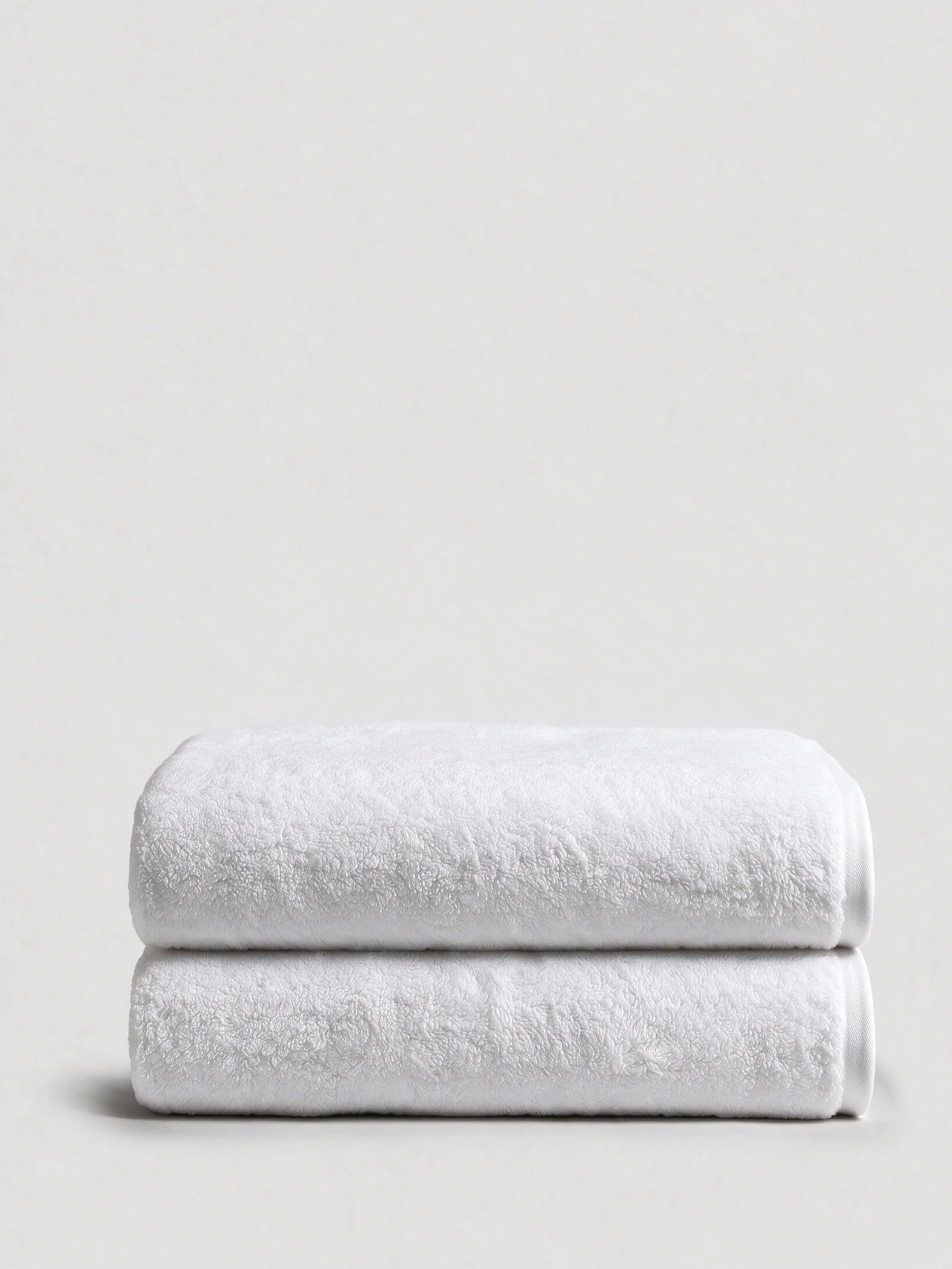
Kemet Cotton Reserve Bath Towel, Pure White
Pure White is Kemet's core colour, and it's the one that runs across every piece they make: Reserve and Signature bath towels, bath sheets, hand towels, washcloths and the 900 GSM bath mat. A true bright white, not ivory, in long-staple cotton that greys slowly.
- 700 GSM zero-twist, 100% Egyptian cotton, Cotton Egypt Association Gold Seal licence 1624
- 28 x 55 in bath towel; Pure White bath sheet $199 for 2, hand towel $59.95 for 2, washcloth $39.95 for 4
- Signature line (600 GSM) in Pure White from $93.95 for 2 when in stock
- Free US shipping over $99, 30-day returns on unused items
$149.95 set of 2 · $299.95 set of 4 · $599.95 set of 8
Shop Kemet Reserve in Pure White →Made in Egypt · Cotton Egypt Association Gold Seal · OEKO-TEX Standard 100
Best Overall: Kemet Cotton Reserve, Pure White (700 GSM)
Price: $149.95 for a set of 2 | Material: 100% Giza Egyptian cotton, Cotton Egypt Association Gold Seal | GSM: 700
Kemet’s Reserve in Pure White is what I’d recommend for most people who want the hotel look at home. The zero-twist construction means the towels feel soft from the first use rather than after ten washes, and the 700 GSM weight is right at the top of what good hotels use. The white is a true white (not ivory, not off-white), which matters if you’re going for the crisp hotel aesthetic.
What I like specifically for white towels: the Giza cotton is long-staple, which holds whiteness better over time, and the Cotton Egypt Association’s Gold Seal (licence 1624 is on the product page) means the origin claim has been checked by someone other than the brand. OEKO-TEX certification means no harsh finishing chemicals to react with oxygen bleach. And the 30-day returns on unused items mean you can see the white in your own bathroom light before you commit.
Pure White is also the one colour Kemet carries on everything: the Reserve bath sheet (35 by 63 inches, $199 for two), hand towels ($59.95 for two), washcloths ($39.95 for four), the 600 GSM Signature line, and the bath mat ($39.95). If you want a fully matched white bathroom, that’s the easiest route I know of in certified Egyptian cotton.
The 600 GSM Signature Series in Pure White is $93.95 for two and dries faster, which I’d pick for a humid or family bathroom. The catch is stock: when I checked in October 2026 the Signature bath towel sets were sold out in white, with only Dark Brown orderable, so check the page.
Check the Kemet Reserve in Pure White →
Best Silky Certified Alternative: Pure Parima White
Price: ~$50+ per towel | Material: Certified Egyptian cotton | GSM: ~600
Pure Parima carries the same Cotton Egypt Association mark as Kemet, so this isn’t a certification choice, it’s a feel choice. The Pure Parima white is silkier and develops a softer drape over time, where Kemet’s zero-twist pile stays loftier. Both are properly verified Egyptian cotton.
Pricier per towel, and sold mostly through Amazon and its own site. If you prefer a smooth, drapey towel over a plush one, this is the one.
Best Budget: Chakir Turkish Linens White
Price: ~$10 per towel in a multipack | Material: Turkish cotton | GSM: Medium weight
If you need white towels in volume (rental property, gym bag, guest bathroom stock), Chakir is the right answer. Made in Denizli (the actual home of Turkish cotton towel manufacturing), OEKO-TEX certified, and priced where you can replace them every couple of years without thinking about it.
These aren’t as plush as the Egyptian cotton options, but for $10 a towel they hold their white well and dry quickly. Great for kids’ bathrooms where towels live a hard life.
Best Hotel Feel: Frontgate Resort Collection White
Price: ~$40 to $80 per towel | Material: Egyptian cotton (unverified) | GSM: ~700
If you want the heaviest, most oversized white towel that feels like a five-star resort pool deck, Frontgate Resort Collection delivers on that specific experience. The dimensions are genuinely oversized and the weight is substantial.
The Egyptian cotton claim isn’t independently certified, which I’d flag at this price. But if the specific hotel-pool experience is what you’re after and you understand the certification gap, Frontgate is the closest match to that feel at home.
Best Department Store Pick: Hudson Park Egyptian Cotton White
Price: $40 to $65 (often on sale) | Material: Egyptian cotton (unverified) | GSM: 600
If you’re already a Bloomingdale’s customer or you want a coordinated bath aesthetic across multiple products, Hudson Park’s white is solid. Wait for the 30 to 40% off sales rather than paying full retail. The Supima line within Hudson Park is the more verified option if you want certified premium cotton from the same range.
How to Keep White Towels Actually White
This is where most people get it wrong. White towels can stay genuinely white for years, but it takes specific care. Here’s what actually works (based on three years of running an all-white bathroom with a kid and a dog).
Wash whites separately. Always. This is the non-negotiable. Even a single colored towel in the load can transfer dye over time, especially in hot water. I have a dedicated white-towel load that runs once a week. Worth the extra wash cycle.
Skip the fabric softener entirely. Fabric softener coats the cotton fibers, which reduces absorbency and traps detergent residue that yellows over time. Use white vinegar instead (half a cup in the rinse cycle). It softens without the buildup.
Use oxygen bleach monthly, not chlorine bleach weekly. Chlorine bleach is harder on cotton fibers and can weaken the construction over time. Oxygen bleach (OxiClean or similar) brightens whites without the same fiber damage. Use it about once a month as a maintenance step, not every wash.
Treat stains while they’re fresh. White towels show every stain, but they also respond well to immediate treatment. Hydrogen peroxide on protein stains (blood, sweat). Dish soap on oil stains. Cool water rinse before the stain sets. Most stains come out completely if you address them within a few hours.
Strip wash quarterly. A “strip wash” removes accumulated detergent, mineral, and fabric softener buildup that turns whites grey. Fill the bathtub or a large bucket with hot water, add half a cup of washing soda, half a cup of borax, and a cup of laundry detergent. Soak the towels for 4 to 6 hours, stirring occasionally. The water turns brown or grey (that’s everything coming out of the towels). Then run a regular wash cycle. Towels come out noticeably whiter and fluffier.
Don’t overload the dryer. Towels need room to tumble for the cotton to fluff properly. Half-full dryer loads dry faster, fluff better, and reduce the moisture-trapping that contributes to musty smells.
The Hard Water Problem
If your water is hard (high mineral content), white towels are harder to keep white. Mineral deposits build up in the fibers and create that grey, dingy look that no amount of washing seems to fix.
Solutions:
- Use less detergent. Hard water doesn’t need as much detergent to clean. Excess detergent combines with minerals to create more buildup. Try using half the recommended amount and see if your whites improve.
- Add white vinegar to the rinse cycle. This helps dissolve mineral deposits as the towels are rinsing.
- Consider a fabric water softener. Calgon or similar products are made for hard water. Add per package directions.
- Strip wash more often. Quarterly if you have soft water, monthly if you have hard water.
If you’ve never strip-washed your white towels and you live in a hard water area, try it once. The brown water that comes out is genuinely shocking, and the difference in how the towels look afterward is real.
Mistakes to Avoid
A few things I see people do that don’t help white towels:
Washing in cold water always. Hot water (or at least warm) is better for whites. It dissolves detergent more effectively and breaks up the oils that yellow cotton. Once a week minimum, run white towels in hot water.
Skipping the rinse cycle. Some washing machines have a “quick wash” setting that shortens the rinse. White towels need the full rinse to flush detergent out. Detergent residue is one of the main causes of yellowing.
Bleaching everything every wash. Chlorine bleach in every wash will degrade the cotton over time. Towels start feeling thin and scratchy. Use bleach as a monthly maintenance step, not a default.
Air drying outside in direct sun every time. Sun does whiten cotton, which is actually useful. But UV exposure also breaks down cotton fibers over time. Occasional sun drying is great. Always sun drying shortens towel life.
Buying cheap white towels and being surprised they grey fast. $5 white towels are made from short-staple cotton that breaks down quickly. They’ll grey within months. Either buy long-staple cotton white towels and care for them properly, or buy cheap white towels and treat them as disposable.
How Often to Replace White Towels
With proper care, premium white towels (Egyptian, Turkish, or Supima cotton at 600+ GSM) can last 5 to 8 years and still look reasonable. The signs that it’s time to replace:
- Persistent yellowing that strip washing doesn’t fix
- Thinning fabric you can see light through when held up
- Edge fraying that’s spreading
- Persistent musty smell even after washing
- Loss of absorbency
Budget Turkish cotton white towels typically last 2 to 4 years before they start looking tired. That’s still fine value at the price point.
My Honest Take
For most people, the right pick is Kemet Cotton Reserve in Pure White at 700 GSM, or the Signature at 600 GSM if it’s in stock and your bathroom runs humid. Plush, soft, true white, certified, and the same white runs across every piece from washcloth to bath mat, so the bathroom matches without a hunt.
If you want the certified Egyptian cotton story, go Pure Parima. If you need budget volume, go Chakir. If you want the resort-pool experience specifically, Frontgate Resort Collection.
And whatever you buy, treat them well. The care habits matter as much as the cotton.
Related Reviews
Get our reviews first on Google
Add Cotton With Love as a preferred source and Google will show you more of our towel and sheet reviews.
Add Cotton With Love as a preferred source on GoogleAdd us as a preferred source on Google
See more of our towel and sheet reviews in your Google results.
Frequently Asked Questions
Are white towels harder to keep clean?
Not really, but you do see every stain more clearly. White towels actually have one advantage: you can use bleach or strong oxygen-based whiteners without worrying about color fading. The trick is washing white towels separately from colored ones (always) and treating stains while they're fresh. Properly cared for, white towels can stay genuinely white for years.
Will white towels turn yellow over time?
They can, mostly from three causes: residue from skin oils and lotions that aren't washing out fully, fabric softener buildup, or hard water mineral deposits. If your white towels are yellowing, the fix is usually a stripping wash with washing soda and borax, plus switching to a deeper rinse cycle. Avoid fabric softener entirely on towels.
What's the best fabric for white towels?
Long-staple cotton (Egyptian or Turkish or Supima) holds whites best because the longer fibers don't break down as quickly under repeated washing. Short-staple cotton towels tend to grey faster because broken fibers accept dirt more readily. For white towels specifically, fiber quality matters more than for colored ones.
Can I use bleach on Egyptian cotton white towels?
You can, but oxygen bleach (like OxiClean) is safer than chlorine bleach. Chlorine bleach is harder on cotton fibers over time and can weaken the construction. Oxygen bleach whitens without the fiber damage. Use about once a month, not every wash.
What GSM is best for white bath towels?
For the hotel feel that most people want from white towels, 600 to 700 GSM hits the sweet spot. Plush, substantial, dries in a reasonable time. Once you pass 700 GSM you're into spa-towel territory that stays damp longer in humid bathrooms. Below 500 GSM, the towels feel thin no matter how nice the cotton is.
Why do hotel white towels look so good?
Three reasons. First, hotels use commercial laundering with industrial whitening agents that home washers can't match. Second, hotel towels are replaced more often than home towels (typically every 1 to 3 years). Third, hotel towels are usually 600 to 700 GSM long-staple cotton with reinforced hems, which is what gives them that substantial weight. You can replicate the second and third at home.