Where Do Hotels Buy Their Towels? The Suppliers, the Channels, and How to Buy the Same Ones
If you’ve ever wrapped yourself in a hotel towel and thought, “I need to find out where they get these,” you’ve already run into the answer’s first surprise: hotels don’t shop the way you do. There’s no store. There’s no shelf. The towel on that rack came out of a procurement contract, not a checkout line.
So the real question splits into two. Where do hotels actually buy their towels? And can you buy the same ones? I’ve spent years on the sourcing side of home textiles, and both answers are more interesting than the marketing would have you believe. Let me walk you through it.
Hotels Don’t Buy Retail. They Buy on Contract.
A 300-room property goes through an astonishing number of towels. Figure three bath towels, a couple of hand towels, and a washcloth per occupied room, multiplied by daily turnover, multiplied by the spares sitting in the laundry rotation. A single mid-size hotel can stock ten to fifteen thousand towels at any one time, and it replaces a big chunk of them every year.
You don’t buy that on Amazon. You buy it on a contract with a manufacturer or a distributor, at a per-unit price negotiated for volume, with delivery scheduled against your laundry par levels. That’s the whole game. The hotel’s purchasing manager (or the brand’s procurement team) cares about three numbers: cost per towel, cost per wash cycle, and how many washes the towel survives before it has to be retired.
Notice what’s missing from that list. Nobody’s optimizing for “softest possible towel.” They’re optimizing for predictable cost over a two-year service life. Which is exactly why the towel feels great for your three-night stay and would disappoint you by month eight if you owned it.
The Suppliers Behind the Towel
Here’s the part most people never see. The big hotel brands don’t manufacture anything. They buy from a relatively small group of hospitality textile companies, most of which you’ve never heard of because they don’t market to consumers.

These are the names that actually fill hotel linen closets:
| Supplier | Who they serve | What they’re known for |
|---|---|---|
| Standard Textile | Marriott, Hilton, mid to upper-mid chains | Combed cotton, engineered for laundry durability. No Egyptian cotton claims |
| Sobel Westex | Hilton, Marriott, MGM, casinos | The Sobella line. Sells to the public too |
| 1888 Mills | Retail and institutional, including hotels | OEKO-TEX certified, a Made-in-USA line, honest labeling |
| Welspun Hospitality | Major chains, plus mass retail | Enormous volume. Same parent as the brand caught in the 2016 cotton scandal |
| Venus Group / Thomaston / WestPoint | Mid-market and economy properties | High-volume commercial terry, priced for cost per use |
| Frette | The Ritz-Carlton, St. Regis, Peninsula, Rosewood | Italian luxury heritage. The five-star standard |
| Rivolta Carmignani | European luxury and grand hotels | Italian mill, the quiet luxury alternative to Frette |
The pattern in that table tells you almost everything. The suppliers with the most credible reputations, like Standard Textile, make the fewest fiber claims. Standard Textile outfits some of the largest chains on earth with plain combed cotton and never pretends it’s Giza. The Egyptian cotton story, when it appears at all in mainstream hospitality, lives at the boutique and luxury end with Frette and a handful of European mills.
The Channel Layer: How the Towels Actually Get There
Knowing the manufacturer is only half of it. Most hotels don’t call the mill directly. They buy through one of three channels, and which one they use depends on the size and structure of the property.
Hospitality distributors. Companies like American Hotel Register, Guest Supply (owned by Sysco), and HD Supply are the one-stop shops of the hotel world. A property manager logs into a distributor’s catalog and orders towels, sheets, amenities, and cleaning supplies in one place. The distributor aggregates demand from thousands of hotels, which is how a small independent property gets close to chain-level pricing.
Brand-mandated supply programs. Big flags run their own procurement systems. Hilton Supply Management and Marriott’s Avendra program (now part of Aramark) negotiate master contracts, then require or strongly steer franchisees toward approved vendors. If you own a Hampton Inn, you’re not picking towels off the open market. You’re buying brand-approved spec so every Hampton feels like a Hampton.
Direct from the manufacturer. Large owners and luxury groups with serious volume skip the middleman and contract straight with Standard Textile, Welspun, or a luxury house like Frette. This gets the best pricing and the most control over spec, which is why you mostly see it at the top and the very large-scale end of the market.
That’s the honest answer to “where do hotels buy their towels.” Not a place. A supply chain, with a manufacturer at one end and a procurement contract at the other.
What Hotels Actually Spec (The Reason They Feel Good)
The towel that impressed you wasn’t exotic. Across the industry, the spec is remarkably consistent.
Most hotel bath towels are 100% cotton terry, double-stitched hems, in white. Budget properties run 400 to 500 GSM. Business chains like Marriott and Hilton land around 500 to 600 GSM. Luxury and five-star properties push 600 to 800 GSM, sometimes reserving the heaviest weights for bath sheets. The fiber is usually combed or ring-spun cotton at the mid tier, stepping up to long-staple or genuine Egyptian cotton only at the luxury end.
White is not an aesthetic choice, it’s an operational one. White can be bleached on an industrial schedule, it signals cleanliness, and it never has to be color-matched across thousands of units bought years apart.
If you want the full breakdown of weights and what they feel like in practice, our hotel quality bath towels guide covers the specs in detail, and the GSM guides walk through how each weight actually behaves. The short version: the magic is mostly long-staple cotton, the right weight, commercial laundering, and frequent replacement. Not a secret fabric.
Can You Buy the Exact Towels Hotels Use?
More often than you’d think, yes. Several hotel suppliers run a consumer door:
- Standard Textile Home sells the same combed-cotton construction it supplies to chains, direct to the public.
- Sobel Westex sells its Sobella towels (the ones in a lot of Hilton and Marriott bathrooms) straight from its website.
- Frette runs full retail stores and an online shop, so the brand on the Ritz-Carlton rack is one you can buy outright. Its retail line is actually a step nicer than its hotel-contract line.
- Some chains sell their in-room towels through branded shops. Marriott, Ritz-Carlton, and Westin all have online stores built around “take the hotel home” demand.
Here’s the catch, and it’s the thing nobody tells you before you order. The towels most chains actually buy are engineered for survival, not softness. They’re built to look consistent through 200 industrial wash cycles. Bring that exact mid-range hotel towel home, wash it in your machine without commercial finishing, and it’s fine. Serviceable. Not the plush experience your memory promised, because a lot of that experience was the laundry process and the fact that the towel was six months old, not three years.
Which is why, for most people, buying the literal hotel-contract towel is the wrong move. The better move is to buy a towel built for a home, at the quality level a luxury hotel would spec, from a brand that will actually tell you what’s in it.
🏆 For every verified pick ranked, see our pillar guide: Best Egyptian Cotton Towels of 2026 →
The Smarter Buy: Hotel-Grade Towels Made for Home
If the goal is “that hotel feeling, but mine and better,” you want verified long-staple cotton in the 600 to 800 GSM range, from a brand that discloses its fiber and origin. A few are worth knowing, but one stands out for matching luxury-hotel spec without the luxury-hotel runaround.
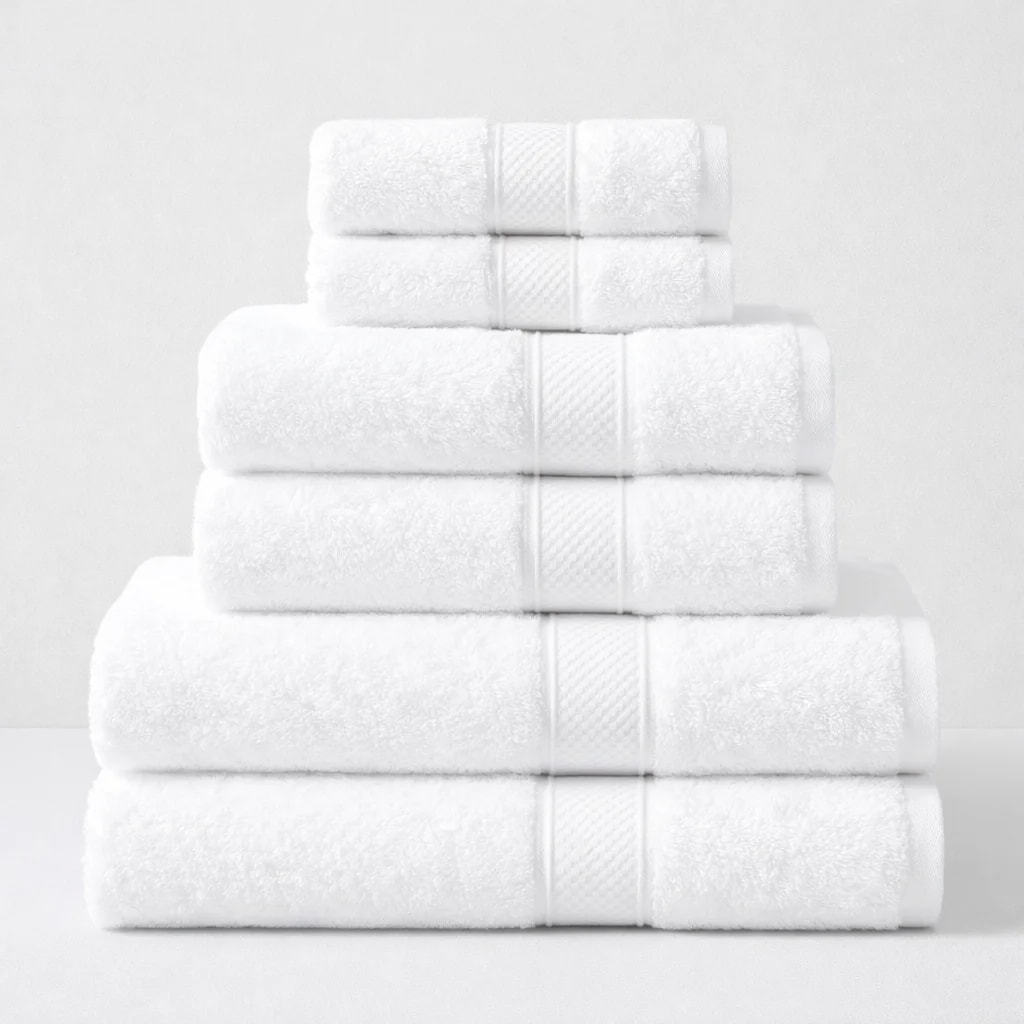
What makes Kemet the standout for this particular search is the overlap. It’s one of the few brands that sits in both worlds: a consumer set you can buy tonight, and a bulk supplier that sources the same single-origin Giza cotton for hotels, spas, and resale. So if you fall for the towel at home, the exact same product scales into a property. That B2C-to-B2B path is rare, and it’s the reason small hoteliers and Airbnb hosts keep landing on it.
It isn’t your only option, though. Depending on what you’re after:
Pure Parima if third-party verification is your priority. It carries the Cotton Egypt Association Pyramid Mark, the consumer-facing proof that the Egyptian cotton claim is real. Check Price →
Frette if you specifically want the brand that’s actually on the Ritz-Carlton rack and you don’t mind paying for the name. Its retail towels run $80 to $200 apiece and genuinely deserve the luxury label.
Charisma if you want that dense, plush hotel feel on a budget. It’s widely available at warehouse clubs, 600-plus GSM, and consistently delivers for the price.
Hammam Linen if you’re replacing a whole set cheaply. The weight and softness are solid for the money, even if it won’t match verified Egyptian cotton.
If You’re Buying for a Property, Not a Bathroom
A fair number of people searching this aren’t shopping for home at all. They’ve just opened a small hotel, a bed and breakfast, a short-term rental, or a spa, and they’re trying to figure out where the towels come from. The honest answer is that you’re now shopping in the same B2B market the chains use, just at smaller volume.
Your realistic routes are the hospitality distributors (American Hotel Register, Guest Supply), the commercial wholesalers that sell by the case, or a brand with a B2B program that will quote you directly. If you plan to advertise Egyptian cotton to your guests, that last route matters, because the claim becomes your liability the moment a paying customer reads it. We laid out the full sourcing playbook, including the documents to demand and the one piece of math that exposes a fake quote, in our Egyptian cotton towels wholesale guide and the companion towel manufacturers and suppliers guide.
What “Hotel Quality” Means on a Label
Nothing. There’s no standard behind it and no agency enforcing it. Any brand can print “hotel quality” or “luxury hotel collection” on a wrapper, and plenty do, precisely because searches like this one prove the phrase sells.
So ignore the phrase and read the numbers. A real hotel-grade towel will tell you its GSM, state its exact fiber content (100% cotton, and ideally the type), and describe the construction. If a listing leans on “hotel quality” but won’t tell you the GSM, that absence is the answer. The brands worth buying compete on disclosed specs, not borrowed prestige.
The Bottom Line
Hotels buy their towels through a supply chain, not a store: hospitality manufacturers like Standard Textile, Sobel Westex, and 1888 Mills at the mainstream tier, Frette and a few Italian mills at the luxury end, moving through distributors and brand-mandated programs at contract pricing you can’t replicate as an individual.
You can buy some of those exact towels, since several suppliers sell a consumer line. But the towels most chains actually use are built for durability, not for the experience you remember. If you want the hotel feeling done properly at home, skip the contract-grade mid-range cotton and buy verified long-staple at 600 to 800 GSM. Kemet Cotton hits that spec with disclosed Giza origin and a guarantee, and it’s the rare brand that scales from your bathroom to a whole property if it comes to that.
Related Reading
Get our reviews first on Google
Add Cotton With Love as a preferred source and Google will show you more of our towel and sheet reviews.
Add Cotton With Love as a preferred source on GoogleAdd us as a preferred source on Google
See more of our towel and sheet reviews in your Google results.
Frequently Asked Questions
Where do hotels buy their towels?
Hotels don't buy towels from stores. They buy from hospitality textile suppliers like Standard Textile, 1888 Mills, Sobel Westex, and Welspun Hospitality, usually through distributors such as American Hotel Register, Guest Supply, or HD Supply, or through brand-mandated programs like Hilton Supply Management and Marriott's Avendra. Luxury properties source from premium houses like Frette and Rivolta Carmignani. The price is set by contract, not by a retail shelf.
What brand of towels do luxury hotels use?
Most five-star hotels use Frette, which supplies The Ritz-Carlton, St. Regis, The Peninsula, and Rosewood. Some European luxury properties use Rivolta Carmignani or Sferra's contract line. The towels are typically 600 to 800 GSM long-staple cotton in plain white, chosen so they survive hundreds of commercial wash cycles and can be bleached without yellowing.
Can I buy the same towels that hotels use?
Often yes. Many hotel suppliers sell a consumer line: Standard Textile has Standard Textile Home, Sobel Westex sells its Sobella towels to the public, and Frette runs full retail stores. Some chains even sell their exact in-room towels through branded shops (Marriott, Ritz-Carlton, Westin). That said, the towels most chains actually buy are built for durability, not luxury. A verified Egyptian cotton set bought at retail is usually softer than what's hanging in a mid-range hotel room.
Where do hotels get their towels cheap?
Through volume contracts, not coupons. A hotel buying thousands of towels a year gets per-unit pricing no consumer can access, negotiated directly with a manufacturer or through a group purchasing organization. Distributors like American Hotel Register and Guest Supply consolidate that buying power. The towels themselves are usually mid-weight combed or ring-spun cotton, chosen for cost per wash cycle rather than fiber pedigree.
Do hotels use Egyptian cotton towels?
Most large chains don't. Standard Textile, which supplies Marriott and Hilton, uses combed cotton and makes no Egyptian cotton claim at all. Egyptian cotton shows up mainly in boutique hotels and luxury resorts, where the towel is part of the guest experience. If a property advertises Egyptian cotton towels, it should be able to point to Cotton Egypt Association certification, because at that point the claim is being made to paying guests.