Are Loofahs Bad for You? The Bacteria Evidence, How to Clean One, and When to Replace It
The straight answer
A loofah is not bad for you. A loofah that’s been sitting wet in the shower for three weeks is.
That distinction gets lost in most of the coverage on this subject, which tends to run under headlines like “Dermatologists want you to ditch your loofah.” Read past the headline and every one of those articles says the same thing: the sponge stays damp, damp sponges grow bacteria, and scrubbing your skin with a bacterial reservoir is unwise. Nobody has shown that a clean, dry loofah does any harm. Plenty of evidence shows that a perpetually wet one can.
So the useful question isn’t whether to own a loofah. It’s whether you’re prepared to rinse it, dry it and replace it on a schedule. If you are, carry on. If you’re not, a cotton washcloth is the better tool, and I’ll explain why below.
What the evidence actually says
The study that everybody cites, usually without reading it, is a 1994 paper by Bottone and Perez in the Journal of Clinical Microbiology, “Loofah sponges as reservoirs and vehicles in the transmission of potentially pathogenic bacterial species to human skin.” The authors traced a case of Pseudomonas aeruginosa folliculitis to a contaminated loofah, then cultured loofahs and found they supported Pseudomonas, Xanthomonas, Klebsiella, Enterococcus and group B Streptococcus. Their key finding was that the sponge didn’t just carry the bacteria; it actively grew them, and the population increased with each day the loofah stayed moist.
There have been case reports since. Impetigo caused by Streptococcus pyogenes has been linked to loofah use. So has recurrent folliculitis on the back and thighs, which are the areas people scrub hardest. The Cleveland Clinic’s summary puts it plainly: a loofah’s nooks trap dead skin cells, the shower keeps it wet, and it becomes a breeding ground for bacteria and fungi.
Two things stand out when you read the primary sources rather than the write-ups.
First, every contaminated loofah in the literature was one kept in the shower and used daily without drying. Bottone and Perez recommended, as their solution, that loofahs be dried thoroughly between uses and disinfected regularly. They did not recommend giving them up.
Second, the bacteria involved are mostly opportunists. Pseudomonas and Staphylococcus live on healthy skin without incident. The trouble starts when a scrub abrades the surface, opens a follicle and delivers a concentrated dose from the sponge into it. That’s why the problem shows up as folliculitis rather than as some generalised infection, and why people with broken skin or a fresh shave are at more risk than anyone else.
The real problem is drying, not the loofah
Here’s the mechanism in plain terms. Bacteria need three things: water, food and time. A loofah hanging on the shower head has all three. It’s rewetted every morning, it’s packed with soap residue and skin cells, and it never gets the 24 hours of airflow needed to dry a porous object right through.
A plastic pouf is worse than a natural loofah on this measure, not better. The synthetic mesh is folded and bunched into a ball, so the centre stays wet long after the outside feels dry. The loops don’t absorb water, which sounds like an advantage until you realise it means water sits on the surface of every strand rather than wicking out to evaporate. And because the material never degrades, people keep poufs for months.
A natural loofah is an open lattice. Hang it flat and it dries in a few hours. The problem is that most people don’t hang it flat; they drop it on the edge of the bath or on a wet shelf.
Three things fix this:
- A hanging loop or rope, so the loofah can hang in free air rather than lie on tile. Buy one with a loop. Most whole loofahs come with a cord; the better pads have a cotton loop sewn in.
- A hook outside the spray zone. The back of the bathroom door, a towel bar, a peg by the window. Anywhere the loofah won’t be rewetted by the next person’s shower.
- Two loofahs in rotation, so each one gets a full day to dry. This alone does more for hygiene than any disinfecting soak.
How to clean a loofah
The weekly routine takes ten minutes and it’s set out step by step above. The principles behind it:
Rinsing is the main event. Soap film and skin cells are the food supply. A loofah that’s rinsed until the water runs clear, every single time, starts each dry cycle with very little for bacteria to eat.
Vinegar for natural loofah, diluted bleach for plain synthetics. A five to ten minute soak in warm water with a generous splash of white vinegar lowers the pH enough to knock back most of what’s growing. For a plastic pouf or a natural loofah with no cotton parts, a one-to-ten bleach solution is more effective, followed by a very thorough rinse. Don’t bleach a pad with cotton terry or a rope; it weakens the cotton and leaves a smell.
No microwave for anything with cotton. The advice to microwave a damp loofah circulates online. It’s marginal for a plain synthetic pouf and dangerous for a natural loofah with stitching, a terry back or a cord, all of which can scorch. Skip it.
Sunlight helps. A couple of hours on a windowsill after the weekly soak does more than most people expect. Ultraviolet light kills surface bacteria and moving air finishes the drying.
Never share a loofah. Each person, one loofah. Sharing defeats the entire exercise.
How often to replace it
The Cleveland Clinic’s guidance is three to four weeks for a natural loofah and four to eight weeks for a plastic pouf. If you scrub with a loofah every day, make it two weeks.
I used to be comfortable stretching a well-dried natural loofah to two or three months. I’ve tightened that to a month, because the fibre holds water and skin cells however well it dries between uses, and a month is also roughly how long the lattice keeps its texture before it flattens, so the hygiene limit and the useful life still coincide.
Ignore the calendar and replace it immediately if it smells musty when wet, feels slimy, has developed dark or pink patches, or has lost its spring and stays compressed after a squeeze. Any of those means the lattice is colonised and no soak will reverse it.
A natural loofah with cotton parts can go in the compost. A plastic pouf goes in the bin, which is one reason we favour the natural version on principle.
Loofah vs washcloth
This is the comparison that matters if hygiene is your main concern, because a washcloth solves the drying problem by simply going through the laundry.
| Natural loofah | Plastic pouf | Cotton washcloth | |
|---|---|---|---|
| Can it be laundered? | No (vinegar soak only) | No (bleach soak only) | Yes, at 60C with the towels |
| Dries between uses? | Yes, if hung properly | Slowly; centre stays wet | Yes, or swap for a clean one |
| Exfoliation | Medium to firm | Very mild | Mild (firmer with a textured weave) |
| Lifespan | 3 to 4 weeks | 1 to 2 months | 1 to 2 years |
| Cost per year | $30 to $120 | $15 to $40 | $10 to $40 for a set of six |
| Compostable | Yes | No | Yes (100% cotton) |
| Best for | Exfoliating 2 to 3 times a week | Lathering only | Daily cleansing, sensitive skin, face |
The honest summary is that a washcloth is cleaner and a loofah exfoliates better. The two aren’t competing for the same job. In my own bathroom there’s a stack of Egyptian cotton washcloths for daily washing, changed every day or two and laundered hot, and a loofah pad that comes out two or three times a week for elbows, knees, heels and back.
When a washcloth is the better tool
Use a washcloth rather than a loofah if:
- You wash your face with it. Never put a body loofah anywhere near your face.
- Your skin is sensitive, dry or prone to eczema. A soft cotton terry cloth cleans without abrading.
- You can’t or won’t hang a loofah to dry properly. Be honest with yourself about this one.
- You share a bathroom with several people and can’t keep track of whose loofah is whose.
- You’re washing a child. A fresh washcloth every bath is far simpler than managing a loofah.
A good washcloth is cheap, launders with the towels and lasts a year or two. Our washcloth guide covers the ones worth buying.
Who shouldn’t use a loofah at all
Some people should give the loofah a miss regardless of how well they clean it.
Anyone with broken skin, an open cut, active body acne, eczema, psoriasis or a recent sunburn. Anyone who has just shaved or waxed, since the follicles are open and that’s precisely the route the bacteria take. Anyone with a weakened immune system, and people with diabetes, who should be cautious about any small skin abrasion on the lower legs and feet.
If you have keratosis pilaris, a loofah can help, but only used gently and not daily. We’ve covered that separately in our guide to loofahs for keratosis pilaris.
If you’re keeping a loofah, buy one built to dry
Given everything above, the features that matter in a loofah are the ones that help it dry: a real hanging loop, an open natural fibre rather than bunched plastic mesh, and a cotton rather than polyester backing so the pad doesn’t hold water against itself.
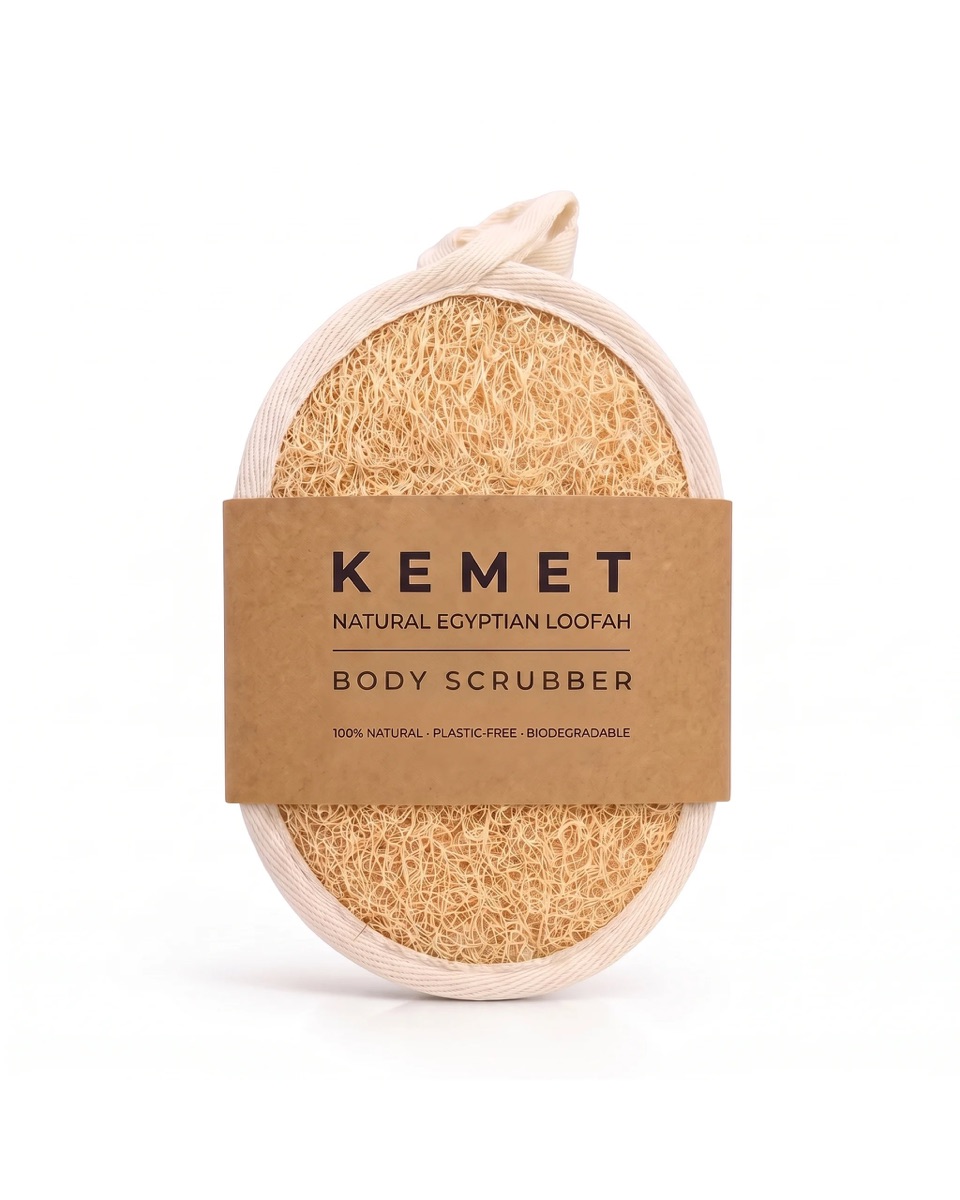
Kemet Cotton Egyptian Loofah Body Scrubber
A natural loofah pad designed around the drying problem: cotton twill hanging loop, open Egyptian loofah face and a cotton terry back that wicks rather than traps water. Fully compostable when it's done.
- Natural Luffa aegyptiaca, grown and sun dried in Egypt
- Cotton terry back for lathering; loofah face for exfoliating
- Sewn-in cotton loop for hanging outside the spray
- No plastic, foam or polyester; compost the whole pad
From $29.95, set of 4 for $59.95 (two in rotation, two spare)
Shop the Kemet Loofah →The usual caveats apply. Kemet Cotton launched this in September 2026, so there’s no track record yet, and the single pad is expensive next to a $5 drugstore loofah. The set of four brings it to about $15 each and gives you the two-in-rotation setup that does most of the hygiene work. If the price doesn’t suit, any natural loofah with a loop, hung properly, will do the job. What you’re buying here is the stated Egyptian origin and the all-cotton construction, which we cover in our Egyptian loofah guide.
🏆 Prefer a cloth you can launder? See Best Egyptian Cotton Washcloths →
The bottom line
Loofahs aren’t bad. Wet loofahs are. The research that gets cited against them was conducted on sponges left damp in the shower, and the authors’ own recommendation was to dry and disinfect them, not to bin them.
Rinse it every time, hang it to dry outside the spray, soak it in vinegar once a week, and replace it every three to four weeks, or every two if you scrub daily. Keep it away from your face and away from broken skin. If that routine sounds like more than you’ll actually do, use a cotton washcloth and launder it with the towels. Either way, the problem was never the loofah. It was the shower head it was hanging on.
Related Reading
Get our reviews first on Google
Add Cotton With Love as a preferred source and Google will show you more of our towel and sheet reviews.
Add Cotton With Love as a preferred source on GoogleAdd us as a preferred source on Google
See more of our towel and sheet reviews in your Google results.
Frequently Asked Questions
Are loofahs really full of bacteria?
A loofah that stays wet is. Research going back to 1994 found loofah sponges act as reservoirs for Pseudomonas aeruginosa and other bacteria, and case reports have linked contaminated loofahs to folliculitis and impetigo. The common factor in every study is a loofah kept damp in the shower. One that's rinsed and dried fully between uses carries a far smaller load.
How often should you replace a loofah?
The Cleveland Clinic advises replacing a natural loofah every three to four weeks and a plastic pouf every four to eight weeks. If you scrub with the loofah daily, make it every two weeks. Drying it completely between showers keeps it fresher inside that window, but the fibre still holds water and skin cells, so don't stretch it to months. Replace it sooner if it smells musty, feels slimy or shows dark patches.
How do you clean a loofah?
Rinse it thoroughly after every use, squeeze it out and hang it to dry outside the shower spray. Once a week, soak it for five to ten minutes in warm water with white vinegar, or in a one-to-ten bleach solution for a natural loofah with no cotton parts, then rinse well and dry it, in sunlight if possible.
Can you put a loofah in the microwave?
Only a plain synthetic pouf, damp, for 20 seconds, and even then the benefit is marginal. Never microwave a natural loofah, particularly one with cotton terry, stitching or a rope, which can scorch or catch fire. A vinegar or diluted bleach soak is safer and works better.
Is a washcloth better than a loofah?
For hygiene, yes. A cotton washcloth goes through the washing machine at 60C and comes out clean, which no loofah can match. A loofah exfoliates more effectively. Many people use both: a washcloth for daily cleansing and a loofah two or three times a week for exfoliation.
Who shouldn't use a loofah?
Anyone with broken skin, eczema, psoriasis, active acne on the body, a fresh shave or a recent wax should avoid loofahs entirely. People with weakened immune systems or diabetes should be cautious too, since the bacteria involved are opportunistic and a small abrasion is enough of an entry point.