Egyptian Loofah Explained: What Luffa Really Is, Why Egypt's Is Prized, and How to Spot a Fake
The short answer
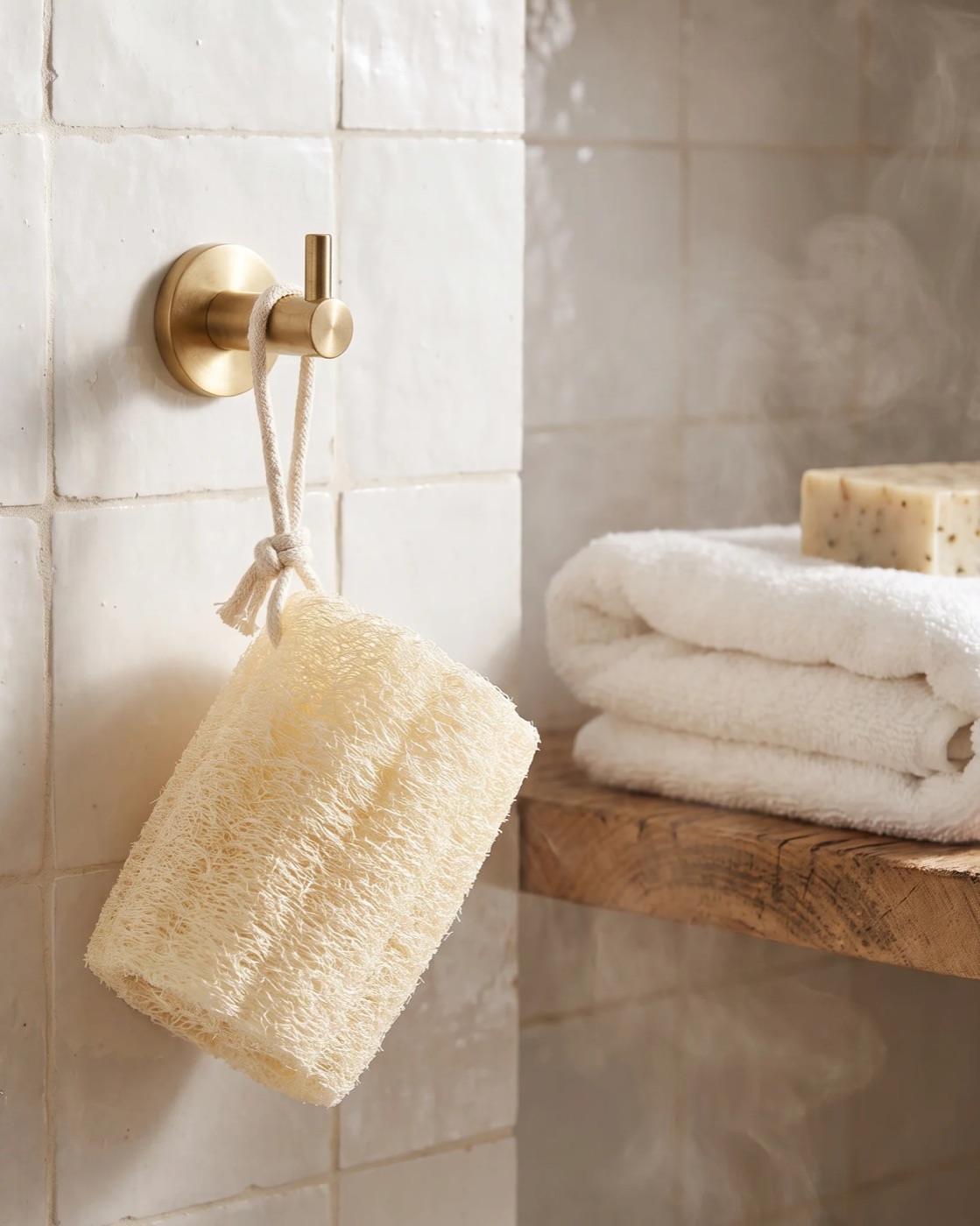
A loofah is a vegetable. Specifically, it’s the dried fibrous skeleton of a gourd called Luffa aegyptiaca, a climbing vine in the same family as cucumbers and squash. It is not a sea sponge, and it has nothing in common with the plastic mesh pouf that most people picture when they hear the word.
“Egyptian loofah” ought to mean luffa grown in Egypt, where the plant has been cultivated for bath use for centuries and where hot, dry summers produce a denser fibre than most other growing regions. The issue is that the plant’s Latin name contains the word aegyptiaca. That gives any seller, anywhere, a technically defensible reason to print “Egyptian” on the packet whether the gourd was grown in the Nile Delta, Guangdong or Guatemala.
So the label is worth having, and it’s also quite easy to abuse. This guide covers what the plant actually is, how it becomes a sponge, where the Egyptian name is honest and where it isn’t, and a checklist you can run on any listing before you pay for it.
If you came here to buy rather than to study, this is the one loofah I found whose origin claim is specific enough to hold the brand to. The rest of the guide explains how to judge every other listing yourself.
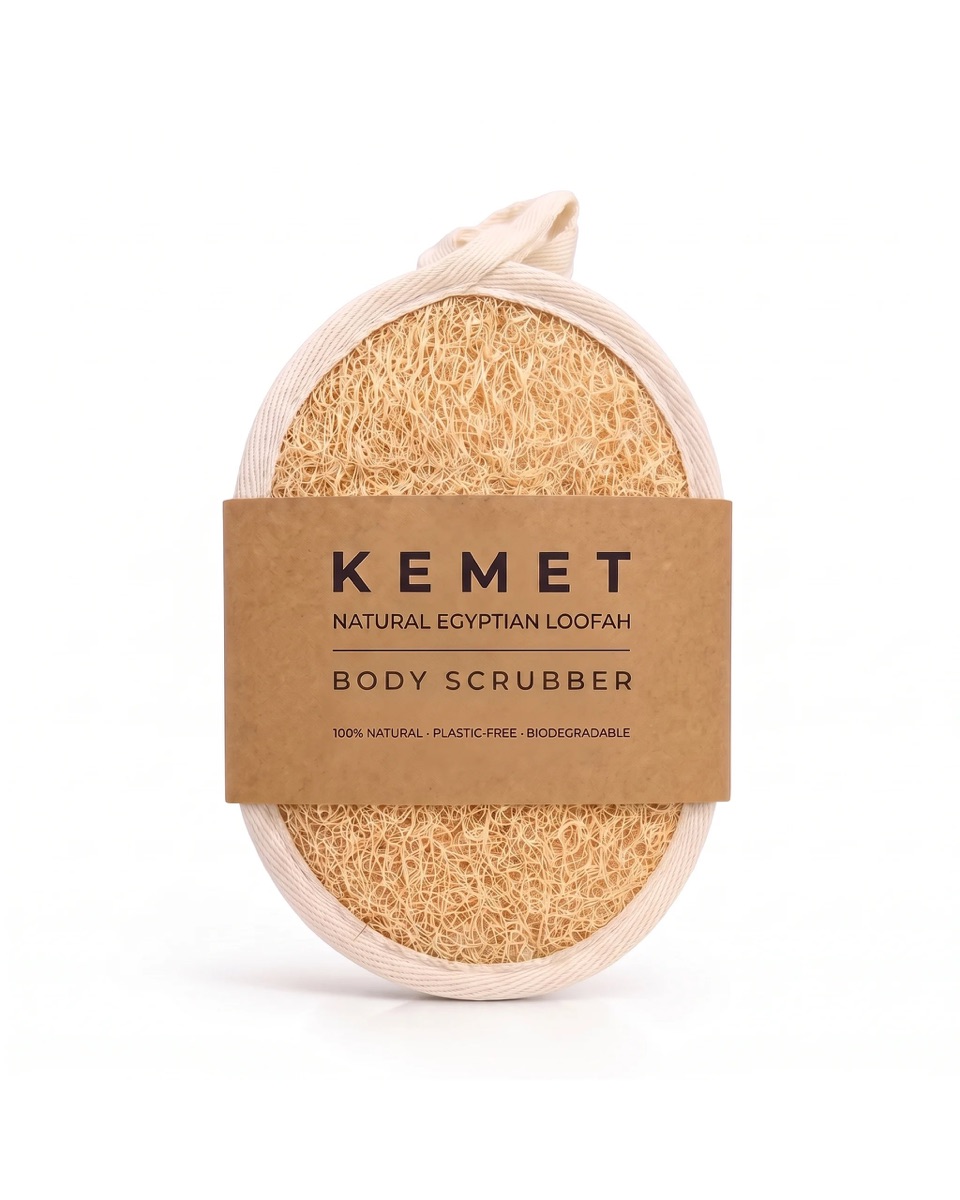
Kemet Cotton Egyptian Loofah Body Scrubber
The one loofah pad we found that states a specific growing origin (Nile Delta farms, sun dried and sewn in Egypt) rather than borrowing the species name. Natural loofah on one face, cotton terry on the other, with a cotton loop for hanging.
- Whole-cut Luffa aegyptiaca, grown and processed in Egypt
- Dual sided: loofah face for exfoliating, cotton terry back for lathering
- No plastic mesh, foam or polyester; fully compostable
- About 6 x 4.5 in; also sold as a whole cone with cotton rope
$29.95 single · $59.95 set of 4 ($14.99 each) · $119.95 set of 12 ($9.99 each, ships free)
Shop the Kemet Loofah →30-day returns · duties included · grown, sun dried and sewn in Egypt
What a loofah plant actually is
Luffa is an annual vine that needs a long, hot growing season. Left on the vine, the fruit grows to somewhere between 30 and 60 centimetres, looks a bit like a ribbed courgette, and is edible when young. Growers who want sponges rather than vegetables leave the fruit to mature and dry on the vine until the skin turns brown and brittle and the fruit rattles when shaken.
Inside, what remains is a network of vascular fibre, essentially the plant’s plumbing, hardened into a three-dimensional lattice. That lattice is the sponge. It’s coarse, open and full of channels where the seeds sat, and it’s the reason a loofah exfoliates rather than simply lathers.
Two species are sold commercially. Luffa aegyptiaca (sold under the older synonym Luffa cylindrica as well) is the smooth-skinned type that makes most bath sponges. Luffa acutangula, the ridged or angled luffa, is grown mainly as a vegetable across South and Southeast Asia and produces a thinner, less useful fibre. When you’re buying a bath sponge, the smooth species is what you want, and it’s what Egyptian growers plant.
How a gourd becomes a bath sponge
The processing is simple, which is part of why the product is so difficult to verify. There’s no factory step that leaves a signature.
- Harvest and dry. The mature fruit is picked when the skin has gone brown, or left on the vine until it dries naturally. Sun drying over several weeks is traditional in Egypt and produces a firmer fibre than kiln drying.
- Peel. The brittle outer skin is cracked and stripped off by hand. Dry fruit peels cleanly; fruit picked green has to be soaked first, which softens and sometimes weakens the fibre.
- Deseed. The sponge is shaken and tapped to release the black seeds. Any left inside will rattle in the finished product, which is a reasonable sign of minimal processing rather than a fault.
- Wash and optionally lighten. Sap and residue are rinsed out. Some processors then use a dilute hydrogen peroxide bath to lift brown staining. Others use chlorine bleach, which gives a whiter result and a shorter-lived sponge.
- Press and cut. Whole loofahs are sold as cylinders or cut into slices, pads and mitts. Pads are often flattened under pressure and sewn to a cotton terry backing with a hanging loop.
That’s it. No chemicals are strictly required at any point, and an untreated loofah is a pale straw colour with darker patches where sap remained. A brilliant white loofah has been bleached.
Why Egypt’s loofah has a reputation
Egypt has grown and used luffa for bathing far longer than the West has known the word. The Nile Delta gives the vine what it needs: a long frost-free season, intense sun and irrigation from the river. Growers there dry the fruit in the field rather than in a shed, and the result is a fibre that’s noticeably denser and springier than loofah from cooler or wetter regions.
Growers and importers describe the difference the same way: sun-dried Egyptian material is heavier for its size, holds its shape better after soaking and takes longer to flatten with use. Loofah grown in cooler or wetter regions, which supplies much of the low-cost Amazon market, tends to be lighter and more open, and buyer reviews of the cheap pads consistently describe them collapsing into a soft mat within a few weeks.
None of that is a criticism of other countries’ farmers. It’s a growing-conditions difference, much like the reason Giza cotton is prized over upland cotton. But it does mean the word “Egyptian” carries a real quality signal, which is exactly why it’s worth counterfeiting.
Where “Egyptian” is honest and where it’s marketing
Here’s the problem in one sentence: the species is called Luffa aegyptiaca, so “Egyptian loofah” can describe the plant rather than the place, and most sellers are relying on you not knowing the difference.
I read through the top twenty Amazon results for “Egyptian loofah” in September 2026. Every listing used the word Egyptian in the title. Not one showed a certificate of origin, named a growing region, or explained where the fruit was harvested. Several were shipped from the same fulfilment centres as generic “natural loofah” products at the same price, which makes a separate Egyptian supply chain rather unlikely. A few had the phrase “Egyptian luffa plant” in the bullets, which is the species name doing the work of an origin claim.
The pattern is the same one we see with fake Egyptian cotton towels: a name that carries prestige, no verification mechanism, and a price point that’s too low for the claim to be true. There is no Pyramid Mark equivalent for loofah. No trade body certifies the origin, so the burden falls entirely on the seller’s honesty and your scepticism.
What a credible origin claim looks like:
- A named region, not just a country. “Grown in the Nile Delta” or “from farms near Fayoum” is specific enough to be checked. “Egyptian” on its own isn’t.
- A description of the process that matches Egyptian practice, particularly sun drying in the field.
- A price that reflects a real supply chain. Egyptian loofah costs more to grow, dry and ship than bulk Chinese loofah. A two-pack for $9 with free shipping is almost certainly not what it says.
- Consistency across the brand. A company that sources its cotton, packaging and other products from Egypt has a plausible reason to source loofah there too. A brand that sells nothing else Egyptian and uses the word only on this one product is a red flag.
How to verify the loofah you’re holding
If you already own one, or you’re standing in a shop, these checks take a minute.
Natural or plastic? Dry natural loofah is stiff, coarse and slightly scratchy. It softens within half a minute in warm water. The fibre network is irregular, with visible channels running lengthwise where the seed cavities were. A synthetic pouf is soft when dry, made of perfectly uniform loops, and doesn’t change in water. If you have a loose thread from each, hold a lit match nearby: plant fibre chars and smells like burnt paper, nylon melts into a bead.
Bleached or not? Natural colour ranges from pale cream to tan, often with darker patches. A uniform bright white means bleaching. Peroxide-treated loofah is fine; chlorine-treated loofah often has a faint pool smell when wet and breaks down faster. If you can’t tell which, assume the cheaper product used chlorine.
Dyed? Coloured loofah (pink, green, blue) has been dyed. The dye is usually harmless but it’s a sign of a processed product, and colour will bleed into a white towel for the first few uses.
“Organic”? The word is legal on a loofah listing whether or not anyone certified it. Genuine organic certification (USDA or EU) comes with a certificate number and a certifying body. If the listing doesn’t name one, the seller means “untreated” at best.
Whole or reconstituted? Some pads are made from loofah offcuts glued or heat-pressed together. They’re recognisable by a flat, uniform face with no seed channels and a tendency to shed fragments. A pad cut from a whole gourd shows the lattice structure clearly and holds together.
Backing and loop. If the pad has a terry side, check whether the terry is cotton or polyester. Cotton feels dry and matte; polyester feels slick and shiny. This matters for drying, which is the single biggest factor in whether a loofah stays hygienic.
Where to buy a real Egyptian loofah
I’ll be straightforward about the state of the market. Almost every Egyptian loofah sold online is unverified, and most of it is fine as a $5 scrubber. If you want one where the origin claim is specific enough to mean something, the field is small.
Kemet Cotton’s Body Scrubber, featured near the top of this page, is the one that clears that bar: Nile Delta farms named, sun dried and sewn in Egypt, cotton terry back, $29.95 single or $59.95 for four. Shop the Kemet Loofah →
A few honest caveats. Kemet Cotton launched these in September 2026, so there are no long-term owner reviews yet. The single pad is $29.95, which is three to five times the Amazon going rate, and the value only becomes reasonable at the set-of-four price (about $15 each) or the set of 12 (under $10 each, and the only pack that ships free). It’s sold direct only, in one natural colour. What you’re paying for is a stated origin from a company that already sources its cotton from the same region, plus a cotton rather than polyester back. Whether that’s worth the premium depends on how much the origin matters to you.
The rest of the market:
Almooni is the best-selling “Egyptian” loofah on Amazon, a rectangular dual-sided pad with a terry back and a hand strap, usually sold in two-packs for around $10 to $15. It’s a decent product and I’d buy it as a generic loofah pad. The listing says Egyptian and offers nothing to support it. See Almooni on Amazon →
Crafts of Egypt sells 6 x 6 inch loofah scrubbers on Amazon and through its own site. The company name at least implies a sourcing relationship with Egypt, and the product feels denser than the cheapest options. Still no origin documentation. See Crafts of Egypt on Amazon →
Earth Therapeutics and EcoTools are drugstore brands selling loofah pads and netted loofah sponges for $4 to $9. Neither claims Egyptian origin, which I’d rather see than an unsupported claim. Perfectly good for the price.
Egyptian loofah vs the alternatives
| Egyptian loofah | Generic loofah | Plastic pouf | Sea sponge | |
|---|---|---|---|---|
| What it is | Sun-dried Luffa aegyptiaca fibre | Luffa, usually Chinese, often kiln dried | Nylon or polyethylene mesh | Marine animal skeleton |
| Exfoliation | Medium to firm | Medium, softens quickly | Very mild | Almost none |
| Dry-out speed | Fast if hung; fibre is open | Fast | Slow; loops trap water | Slow; holds water like a cloth |
| Lifespan | 3 to 4 weeks (2 with daily scrubbing) | 3 to 4 weeks, often flattens sooner | 4 to 8 weeks | Years |
| Typical price | $10 to $30 | $3 to $8 | $2 to $5 | $20 to $30 |
| Compostable | Yes | Yes | No | Yes |
| Verifiable origin | Rarely, but possible | No | Not relevant | Sometimes (Gulf of Mexico, Greece) |
For a broader comparison that includes konjac and sea wool sponges, see our natural bath sponge guide.
Care and lifespan
A natural loofah is a plant fibre that has been dried. Get it wet and leave it wet, and it will do what plant matter does. The care routine is short.
Rinse it thoroughly after every use to clear soap and skin cells from the lattice. Squeeze it out, then hang it somewhere it can dry completely before the next shower, ideally outside the spray zone rather than on the shower head. Even a loofah that dries fully every day should go in the compost after three to four weeks, which is the Cleveland Clinic’s guidance, and after two weeks if you scrub with it daily. The fibre holds water and skin cells however well you rinse it.
Once a week or so, soak it for five to ten minutes in warm water with a good splash of white vinegar, then rinse and dry. Don’t microwave a loofah that has cotton or any stitching, and don’t put a whole loofah through the dishwasher, which is advice that circulates online and which softens the fibre permanently.
When the fibre goes flat and stops springing back after a squeeze, it’s finished. The whole thing, cotton loop included if it’s a genuine cotton product, can go in the compost.
The bottom line
Loofah is a gourd, not a sponge from the sea and not a pouf from a factory. Egypt grows a genuinely better version of it, and “Egyptian loofah” is a label worth paying for when it’s true.
The issue is that the species name makes the label almost impossible to police, and the Amazon market has taken full advantage. Treat “Egyptian” as a species descriptor unless the seller names a region, describes sun drying, prices the product like a real import and has some other reason to be sourcing from Egypt. By that standard, Kemet’s loofah is the only one I’ve found that clears the bar, at a price that only makes sense in the multi-pack. For everything else, buy the cheapest untreated natural loofah you can find, expect it to last a month, and don’t pay extra for a word.
Related Reading
Get our reviews first on Google
Add Cotton With Love as a preferred source and Google will show you more of our towel and sheet reviews.
Add Cotton With Love as a preferred source on GoogleAdd us as a preferred source on Google
See more of our towel and sheet reviews in your Google results.
Frequently Asked Questions
Is a loofah a plant or a sea sponge?
A loofah is a plant. It's the dried, fibrous interior of a gourd from the cucumber family, Luffa aegyptiaca (also sold as Luffa cylindrica). Sea sponges are marine animals harvested from the seabed. The two get confused because both are sold as natural bath sponges, but they're unrelated in origin, texture and price.
What does Egyptian loofah mean?
Strictly, it should mean luffa grown and dried in Egypt, usually in the Nile Delta. The problem is that the species name is Luffa aegyptiaca, so a seller can call any luffa Egyptian and technically be describing the plant rather than the origin. Unless the listing names a farm region or country of growing, treat the word as a species label, not a place of origin.
How can I tell a natural loofah from a plastic one?
A natural loofah is stiff and scratchy when dry, softens within 30 seconds in warm water, has an irregular fibre network with visible seed channels, and smells faintly of straw. A plastic pouf is soft when dry, made of identical mesh loops, never changes texture in water and will melt rather than char if you hold a lit match near a loose thread.
Is bleached loofah bad?
Not necessarily. Some processors rinse loofah in a dilute hydrogen peroxide solution to lift stains, which leaves nothing harmful behind. Chlorine bleaching is harsher and can weaken the fibre so the sponge collapses faster. A very bright, uniform white loofah has almost certainly been bleached; a pale straw or tan colour is the natural state.
Can a loofah be certified organic?
The plant can be grown organically and a farm can hold USDA or EU organic certification, but very few loofah brands publish a certificate number. Most Amazon listings that say organic loofah mean untreated rather than certified. Ask for the certificate if the word matters to you.
How long does an Egyptian loofah last?
Retire it every three to four weeks, which is the Cleveland Clinic's guidance for natural loofahs, and every two weeks if you scrub with it daily. The fibre holds water and skin cells even when it's rinsed and hung to dry after every shower, so drying keeps it fresher inside that window rather than stretching it to months. A good sun-dried loofah keeps its texture for about that long anyway.