Natural Bath Sponge Guide: Sea Sponge vs Loofah vs Konjac (Which One to Buy)
The Short Answer
If you want a bath sponge that is actually natural, you have three real choices. A sea sponge (the softest and the longest lasting), a loofah (the one that exfoliates), or a konjac sponge (the gentle little one for your face). Everything else in the bath aisle, however earthy the packaging looks, is usually plastic.
Here’s how I’d split it: babies, eczema, and anyone who flinches at the word “scrub” should get a sea wool sponge. Anyone who likes feeling properly buffed after a shower should get a loofah, and my current favourite is the whole Egyptian loofah from Kemet Cotton (more on that below). If you want something for your face and nothing else, a konjac sponge is the right buy.
I’ve had all three in rotation in my bathroom this year, alongside two kids, one golden retriever who thinks the tub is a water bowl, and a bathroom with no window. So “does it dry out?” was not a hypothetical question for me.
Natural Bath Sponges Compared
| Sponge | What it is | Softness | Exfoliation | Lifespan | Price | Vegan? | Best for |
|---|---|---|---|---|---|---|---|
| Sea wool sponge | Marine animal, hand harvested | Softest | Very light | 1 to 3+ years | $20 to $30 | No | Sensitive skin, babies, lather lovers |
| Natural loofah | Dried fruit of a gourd vine | Firm dry, supple wet | Medium to strong | 3 to 4 weeks | $5 to $30 | Yes | Daily exfoliation, rough patches |
| Konjac sponge | Konjac root fibre | Very soft | Barely any | 4 to 12 weeks | $6 to $12 | Yes | Face, cleansing only |
| Plastic mesh pouf | Polyethylene netting | Squishy | Light | Weeks, then it harbours bacteria | $2 to $5 | Yes | Nothing, honestly |
🏆 A good sponge deserves a good towel to dry off with afterwards. See our pillar guide: Best Egyptian Cotton Towels of 2026 →
Sea Sponges: The Softest Option
A natural sea sponge is a real animal. It has no brain, no nerves, and no organs, just a skeleton of spongin fibres that soaks up an enormous amount of water. That’s what you’re buying, the skeleton, cleaned and dried.
You’ll see three grades on sale. Sea wool is the premium bath grade: dense, springy, and very soft. Silk (or “fina”) sponges are finer and smaller, usually sold for faces and babies. Honeycomb sponges are bigger and coarser, more of a Mediterranean bath sponge with a slightly rougher hand, though still nothing like a loofah.
Most bath sponges sold in the US come from the Gulf of Mexico (Tarpon Springs in Florida is the historic hub) or the Mediterranean, mainly Greece. Divers cut the sponge above its base so it regrows, and fragments that break off reattach and grow into new sponges. That’s about as sustainable as a harvested animal product gets, which is why sea sponges keep turning up on zero-waste lists despite not being vegan.
How it feels: genuinely lovely. Soaked and squeezed, a wool sponge holds a ridiculous amount of lather from a tiny bit of body wash, and it feels like washing with a soft cloud. My younger one calls it “the marshmallow.” What it doesn’t do is exfoliate. If you have keratosis pilaris or rough heels, a sea sponge won’t touch them.
What to buy: Baudelaire sells a 5.5 inch wool sponge for around $29.50 and it’s the one I see in nice bathrooms most often. Farmaesthetics and The Sponge Factory sell similar wool grades in the $20 to $30 range. Anything under $10 for a “sea wool sponge” is usually a smaller or lower grade piece, or occasionally a dyed synthetic, so check that the listing says the species and where it was harvested.
Care: rinse well, squeeze (don’t wring, which tears the fibres), and hang it to dry. Once a month, soak it for 15 minutes in warm water with a tablespoon of baking soda to freshen and re-soften it. Never boil it, bleach it, or put it in the microwave. Treated well, a wool sponge lasts years, which makes the $30 much less scary.
Loofah: The One That Exfoliates
A loofah is a plant. Specifically, it’s the dried inside of Luffa aegyptiaca, a gourd in the cucumber family that grows on a vine and looks like a giant, oversized zucchini before it’s dried and peeled. The species name gives away where it was grown best for centuries: Egypt. (If you want the full story, including why “Egyptian loofah” on an Amazon listing doesn’t always mean grown in Egypt, read our Egyptian loofah guide.)
Dry, a loofah feels stiff and scratchy, and plenty of people give up right there. Soak it in warm water for 20 to 30 seconds and it relaxes into a supple, open mesh that scrubs without scratching. That’s the texture people who love loofahs are talking about. It’s a proper scrub, and my skin feels smoother and lotion soaks in better afterwards.
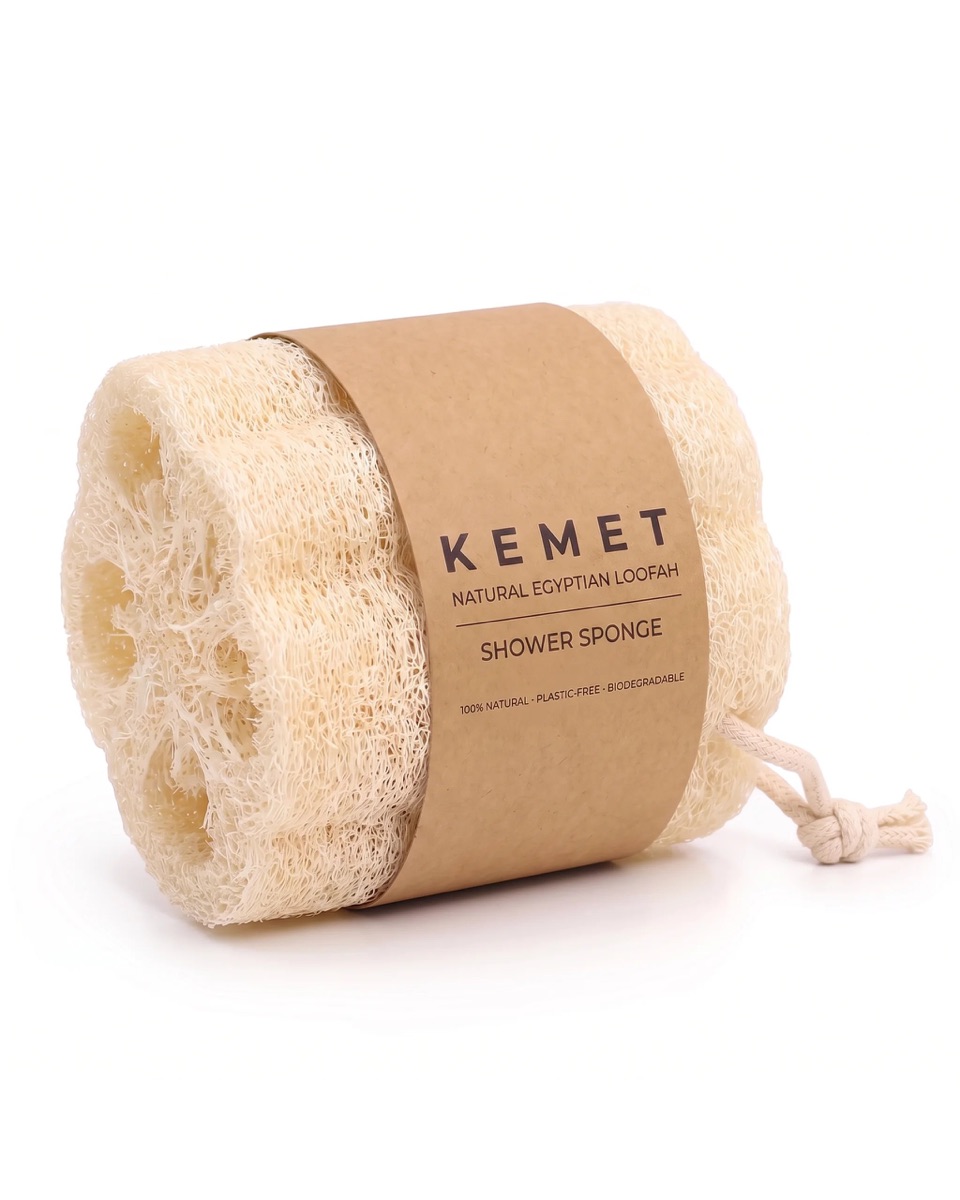
Kemet Cotton Egyptian Loofah Shower Sponge
One whole, uncut loofah cone grown on Nile Delta farms and sun dried in Egypt, finished with a braided cotton rope so it hangs and dries properly. No backing, no filler, no plastic anywhere.
- Whole Luffa aegyptiaca cone, about 5.5 x 4 inches
- Grown, dried, and finished in Egypt, plastic-free packaging
- Braided cotton hanging rope for faster drying
- Fully compostable at the end of its life
From $29.95, set of 4 for $59.95
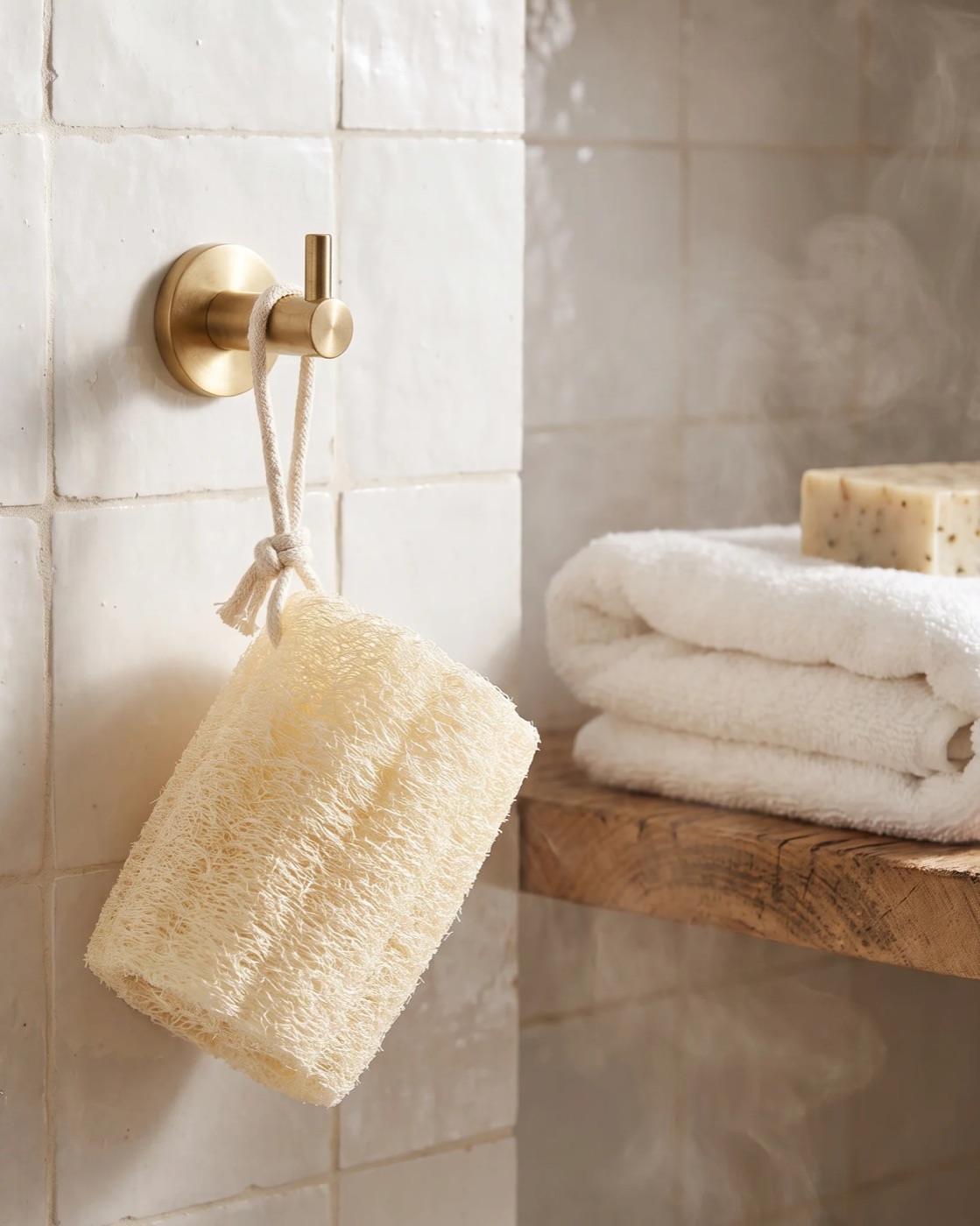
Shop the Kemet Loofah Sponge →The Kemet sponge is the one I reach for on days I want a real scrub. It’s a whole loofah rather than a slice, so it’s chunky in the hand, and the fibre network is more open and uniform than the flattened pads I’ve bought on Amazon. The cotton rope matters more than it sounds: it hangs on a hook outside the shower and it’s dry by morning, which is the whole battle with a loofah in a windowless bathroom.
Kemet also makes a dual-sided loofah pad with a cotton terry back, which is my pick if you want one tool for both scrubbing and lathering. Same price, from $29.95, or a set of 4 for $59.95 (about $15 each).
Now the honest part. Both Kemet loofahs are new as of September 2026, so there are no long-term reviews yet, they come in one natural colour, and you can only buy them direct. And $29.95 for a single loofah is a lot when Almooni sells two “Egyptian” loofah pads on Amazon for roughly $10 to $15. The Almooni pads are perfectly fine for the price. The Kemet ones are thicker, better finished, and come from a brand that already proves its Egyptian origin on its towels. If you’re loofah-curious, start with Almooni. If you already know you’re a loofah person, the Kemet set of 4 works out to about $15 each and, replaced every three to four weeks, is a month for two people or two months for one. The set of 12 is a quarter for two.
Care: rinse after every use, hang it to dry (outside the shower if you can), and give it a five minute soak in warm water with a splash of white vinegar once a month. Replace it every three to four weeks (every two if you scrub daily), or sooner if it stays damp between showers. Our are loofahs bad? guide goes through the bacteria research and how to stay on the right side of it.
Konjac: The Face Sponge
A konjac sponge is made from the root of the konjac plant (the same one behind shirataki noodles), pressed into a small dome of very soft fibre. It’s been used in Japan and Korea for cleansing for a long time, and it’s had a moment in Western skincare over the last decade.
Dry, it’s hard as a rock. Wet, it turns into something between a jelly and a very soft sponge, and that’s the point: it cleanses without any real friction. On your face, that’s exactly what you want. On your legs, it does basically nothing.
What to buy: The Konjac Sponge Co is the original UK brand and sells plain, charcoal, and green clay versions for around $8 to $12. Beauty By Earth makes a larger body-sized konjac if you really want the softness for your whole body (my daughter uses one, and for a six year old it’s perfect).
Care and lifespan: squeeze (never wring) and hang to dry. Expect four to twelve weeks. It starts to fall apart when it’s done, which is your signal.
What to Skip
Plastic mesh poufs. The colourful netting balls. They’re polyethylene, they never fully dry, they trap dead skin in every fold, and they shed microplastic every time you scrub. Replace one with any of the three natural options above and you’ll never go back.
“Natural” cellulose sponges that aren’t. Some kitchen-style bath sponges are labelled cellulose but are actually cellulose bonded with polyester or polyurethane. If the listing doesn’t say 100% cellulose or 100% plant fibre, assume it’s a blend.
Dyed loofah. Loofah is naturally a pale straw colour. Bright pink or teal loofah has been dyed, sometimes with dyes that aren’t disclosed. It isn’t dangerous exactly, but it defeats the point of buying natural.
Bleached-white sea sponges. A snowy white sea sponge has been bleached, which weakens the fibres. Natural sea sponges are tan to honey coloured.
Anything infused with body wash. Spongelle and its imitators are fun as gifts but they’re synthetic buffers designed to be thrown away after 14 or so uses.
Pairing a Sponge With the Right Towel and Washcloth
Here’s something I didn’t appreciate until I started paying attention: the sponge is only half of the routine. What you dry off with matters just as much, especially if you’ve just exfoliated.
After a loofah scrub, your skin is freshly buffed and a little more sensitive, so a scratchy old towel undoes the good work. A soft, dense Egyptian cotton towel pats you dry without dragging. (If your towels have gone rough, our guide on why towels get rough explains the fabric softener trap.)
And for your face, I honestly prefer a good Egyptian cotton washcloth over any sponge, konjac included. A washcloth goes in the washing machine at 60°C, which no sponge can do, so it’s the most hygienic option for the skin you care most about.
Care and Drying, All Three
The rule that matters more than any other: get it dry between uses. Every natural sponge is a plant or animal fibre that holds water, and a damp sponge in a warm shower is where bacteria and mildew set up house.
Hang it outside the shower if you possibly can. A hook on the back of the door, a towel bar across the room, even the windowsill. In my windowless bathroom, moving the loofah from the shower caddy to a hook by the door was the single change that stopped it going musty.
Monthly refresh: baking soda soak for sea sponges, white vinegar soak for loofah, nothing but a squeeze and hang for konjac. And replace on schedule. A sponge past its prime doesn’t announce itself; it just starts smelling faintly of damp.
The Bottom Line
For babies, eczema, or very sensitive skin: a sea wool sponge. Softest, gentlest, lasts for years. Baudelaire or Farmaesthetics, around $25 to $30.
For daily exfoliation and smoother skin: a natural loofah. The Kemet Egyptian loofah shower sponge if you want the best fibre and a rope that actually dries it, Almooni on Amazon if you want to try one for under $15.
For your face: a konjac sponge, or better yet, a proper Egyptian cotton washcloth you can machine wash.
For nobody: the plastic pouf.
This is personal preference to a point, and I know people who’d never give up their sea sponge for anything. But if you’re only buying one, buy the loofah. It’s the one that does something.
Related Reading
Get our reviews first on Google
Add Cotton With Love as a preferred source and Google will show you more of our towel and sheet reviews.
Add Cotton With Love as a preferred source on GoogleAdd us as a preferred source on Google
See more of our towel and sheet reviews in your Google results.
Frequently Asked Questions
What is the most natural bath sponge?
Three options are genuinely natural: sea sponges (a marine animal, hand harvested), loofah (the dried fruit of a gourd vine), and konjac (pressed konjac root fibre). All three are plastic-free and biodegradable. Most 'bath sponges' sold in drugstores are polyurethane foam or polyester mesh, even when the packaging says natural.
Is a sea sponge or a loofah better for the shower?
It depends on what you want from it. A sea sponge is the softest of the natural options, holds a lot of lather, and lasts for years, but it barely exfoliates. A loofah gives real exfoliation and costs less, but the fibre holds water and skin cells, so it needs replacing every three to four weeks, and every two if you scrub daily. Most people who like a scrub choose loofah; people with very sensitive skin or babies in the house tend to prefer a sea sponge.
Are sea sponges vegan?
No. Sea sponges are simple animals (phylum Porifera), so they are not vegan, even though they have no brain or nervous system and are harvested in a way that lets the sponge regrow. Loofah and konjac are both plants and are vegan.
How long does a natural bath sponge last?
A good sea wool sponge lasts one to three years or more with rinsing and occasional baking soda soaks. A natural loofah should be retired every three to four weeks, which is the Cleveland Clinic's guidance, and every two weeks with daily scrubbing; that is also about when the fibres start to flatten. A konjac sponge is the shortest lived at four to twelve weeks, because it is so soft.
Can I use a konjac sponge on my body?
You can, but it is really a face sponge. Konjac is extremely soft and small, so it cleanses well but gives almost no exfoliation on thicker body skin. For arms, legs, and back, a loofah or a larger sea sponge is a better use of your money.
How do I keep a natural sponge from getting smelly?
Rinse it thoroughly after every use, squeeze it out, and hang it somewhere it can dry fully, ideally outside the shower. Once a month, soak a sea sponge in warm water with a tablespoon of baking soda, or soak a loofah in warm water with a splash of white vinegar. Never microwave or boil a sea sponge, and replace a loofah as soon as it stays damp between showers.