Best Natural Loofah Sponges (2026): Egyptian, Plastic-Free Picks That Actually Last
The Short Version
Most of the “loofahs” sold in the US aren’t loofahs. They’re polyethylene mesh poufs. A real natural loofah is a dried gourd, it’s compostable, and it exfoliates in a way that plastic mesh can’t.
I went through the top-selling natural loofah listings on Amazon, two Egyptian specialists, and the drugstore brands. Here’s what I’d buy, and what I’d skip.
| Pick | Best For | Price | Where to Buy |
|---|---|---|---|
| Kemet Cotton Egyptian Loofah Body Scrubber | Best overall | From $29.95 | Check Price → |
| Kemet Cotton Egyptian Loofah Shower Sponge | Best whole loofah | From $29.95 | Check Price → |
| Almooni Egyptian Loofah Pads | Best budget pad | About $10 to $15 for 2 | Shop on Amazon → |
| Crafts of Egypt Loofah Scrubber | Best large scrubber | Around $10 to $15 | Shop on Amazon → |
| Earth Therapeutics Super Loofah | Best drugstore option | $7.99 | Shop on Amazon → |
| EcoTools Loofah Bath Sponge | Cheapest natural loofah | From about $4.32 | Shop on Amazon → |
| Loofah on a stick | Backs and shoulders | $8 to $15 | Shop on Amazon → |
🏆 A loofah handles the scrub. For what you dry off with afterwards, see: Best Egyptian Cotton Towels of 2026 →
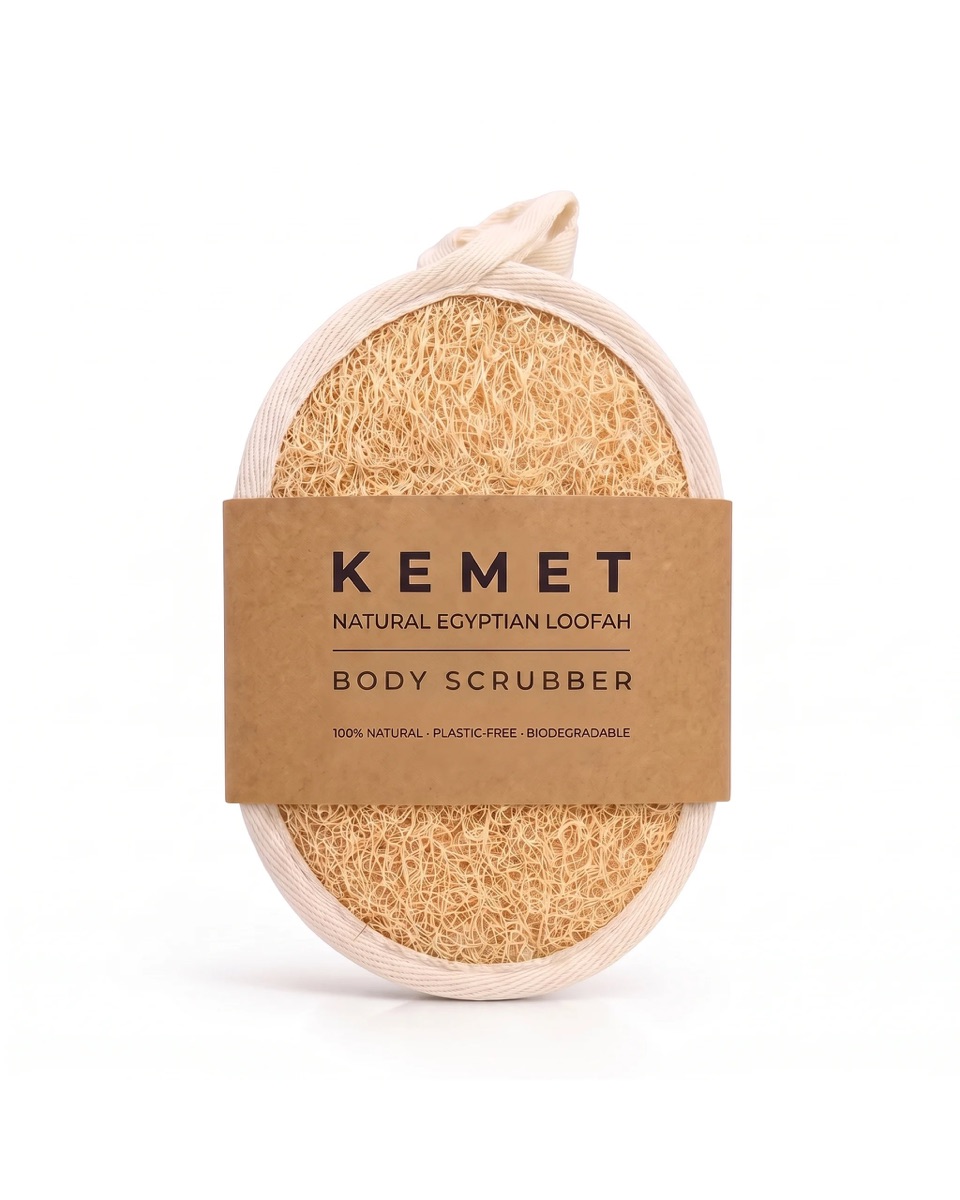
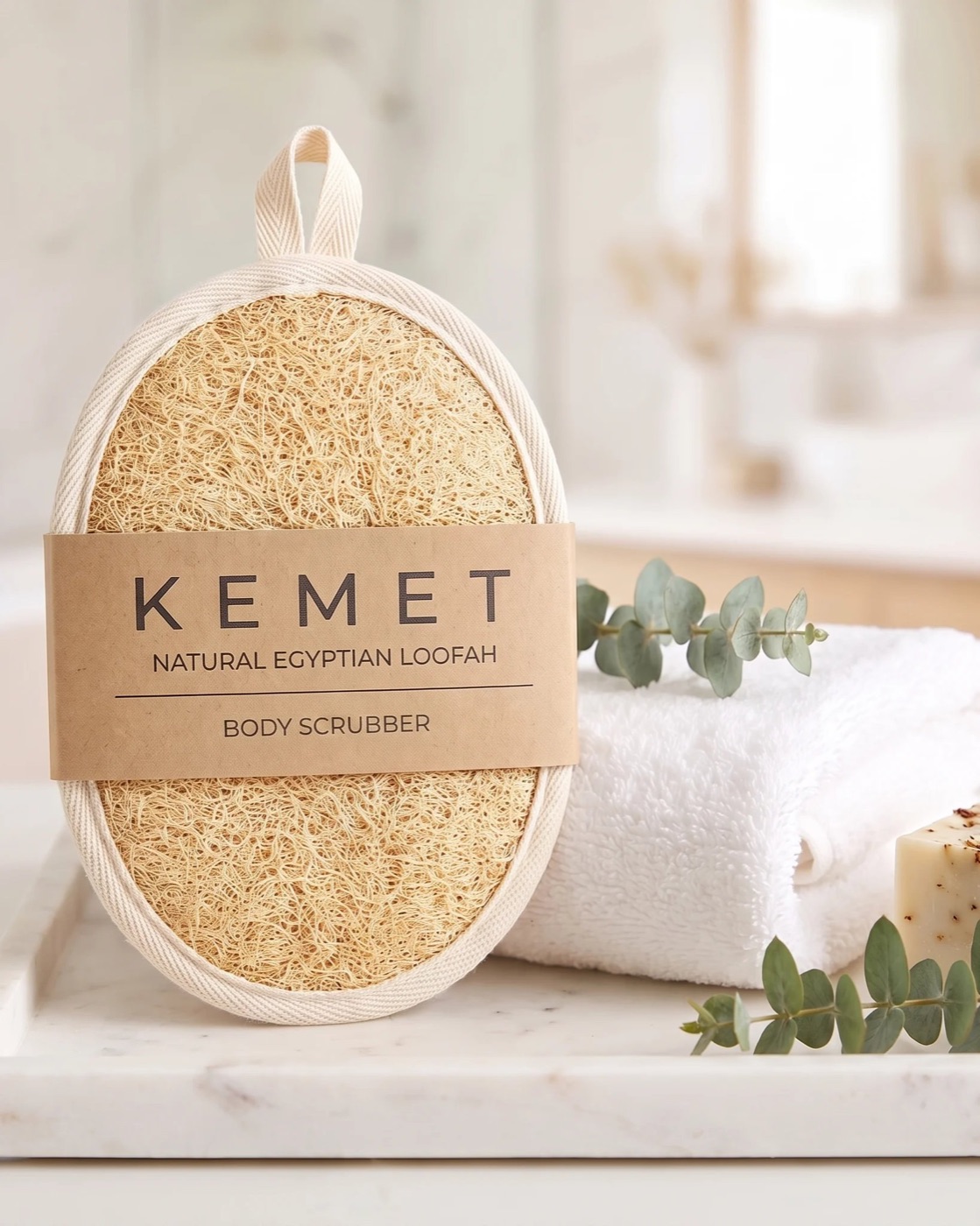
Kemet Cotton Egyptian Loofah Body Scrubber
The only natural loofah pad I found that states where the plant was grown and finished. Nile Delta loofah on one side, cotton terry on the other, and a twill loop so it actually dries between showers.
- Luffa aegyptiaca grown on Nile Delta farms, sun dried, sewn in Egypt
- Large 6 x 4.5 inch oval, loofah fibre face with cotton terry back
- No plastic mesh, no foam, compostable at end of life
- Plastic-free packaging, sets of 4 and 12 bring the per-pad price down
$29.95 single · $59.95 set of 4 ($14.99 each) · $119.95 set of 12 ($9.99 each, ships free)
Shop the Kemet Loofah →30-day returns · duties included · grown, sun dried and sewn in Egypt
Best Overall: Kemet Cotton Egyptian Loofah Body Scrubber
Kemet Cotton is an Egyptian cotton towel brand that added two loofah products in September 2026. The Body Scrubber is a big oval pad, about 6 by 4.5 inches, with sun-dried Nile Delta loofah on the front and soft cotton terry on the back.
Here’s why it’s on top. Every other “Egyptian” loofah pad I checked either doesn’t say where the plant was grown or names a country that isn’t Egypt. Kemet says it outright: grown, dried, cut and sewn in Egypt, same supply chain as their towels. That’s the kind of claim you can hold a brand to.
The terry back is the practical win. You lather on the cotton side, scrub with the loofah side, and the whole thing hangs from a twill loop. Everything is plant fibre, so the retired pad goes in the compost.
The cons are real. It’s $29.95 for one pad, which is three times what an Almooni 2-pack costs. It only comes in natural, it launched in September 2026 so long-term owner reports are still thin, and you can only buy it direct. The set of 4 for $59.95 (about $15 a pad) is the price I’d actually pay, and the set of 12 for $119.95 works out under $10 each and ships free if you’re stocking multiple bathrooms.
Best Whole Loofah: Kemet Cotton Egyptian Loofah Shower Sponge
Some people want the loofah, not a pad. Kemet’s Shower Sponge is one whole cone of loofah, roughly 5.5 by 4 inches, with a braided cotton rope through the top.
Whole loofah exfoliates harder than a pad because you’re working with the full ridged structure, not a flat slice. It’s the closer match to what you’d get in an actual Egyptian hammam.
Same pricing as the pad: $29.95 single, $59.95 for 4, $119.95 for 12. Same caveats too. If you’re used to $5 loofahs, this is a premium jump. If you want an uncut loofah with stated Egyptian origin and a rope that lets it dry properly, it’s the one I’d pick.
Check the Kemet Shower Sponge →
Best Budget Pad: Almooni Egyptian Loofah Pads
Almooni is the Amazon bestseller in this category, and for good reason. The rectangular pads are dual-sided (loofah plus terry), have an elastic hand strap, and a finished edge that doubles as a hanging loop. A 2-pack runs about $10 to $15, and there are 6-count facial pads and a 3-pack of round sponges too.
The loofah itself is thinner than Kemet’s, and it flattens out faster. Expect four to six weeks before it stops exfoliating properly. Almooni says “Egyptian loofah” but doesn’t state a farm origin anywhere I could find, and nothing on the listing backs up the origin. It may well be Luffa aegyptiaca. Whether it was grown in Egypt is anyone’s guess.
For a first natural loofah at a price that doesn’t hurt if you hate it, Almooni is the right call.
Best Large Scrubber: Crafts of Egypt Loofah
Crafts of Egypt sells a 6 by 6 inch flat loofah scrubber, sold direct and on Amazon for roughly $10 to $15. The size is the point. A 6-inch square covers a lot of skin per pass, which matters if you scrub your whole body twice a week and don’t want to spend ten minutes doing it.
It’s a single-sided slice, so there’s no terry for lathering, and the edges aren’t bound. Bound edges last longer. The brand does state the loofah is from Egyptian luffa plants, which is more than most say.
Shop Crafts of Egypt on Amazon →
Best Drugstore Option: Earth Therapeutics Super Loofah
If you want to buy a natural loofah at CVS or Walgreens, Earth Therapeutics is the brand you’ll find. The Super Loofah Exfoliating Body Sponge is $7.99, the Loofah Bath Pad is $5.99, and there’s a Super Loofah Mitt for $8.99.
The loofah content is real, but it’s stitched onto foam or terry backing with polyester thread, so it’s not fully compostable. The mitt is genuinely useful if you have trouble gripping a pad in a soapy shower. Nothing here will last more than a month or so, which is fine at this price.
Shop Earth Therapeutics on Amazon →
Cheapest Natural Loofah: EcoTools Loofah Bath Sponge
EcoTools sells a small piece of natural loofah wrapped in mesh netting for around $4.32 at Walmart. It’s the cheapest way to get real plant fibre in your shower.
The problem is the mesh. It’s synthetic, it traps soap, and it makes the loofah harder to rinse clean. You get about three weeks of decent use out of one. Fine as a stopgap, not something I’d build a routine around.
For Your Back: Loofah on a Stick
A loofah on a stick is exactly what it sounds like, a whole loofah cone or slice fixed to a wooden handle around 15 inches long. If you can’t reach your shoulder blades, this is the tool.
There’s no standout brand. Most are made by the same handful of factories and sold under different names for $8 to $15. Look for a solid wood handle (bamboo is fine), a loofah that’s stitched on rather than glued, and a hanging cord. Skip the ones with a plastic handle, which defeats the point of going natural.
Shop loofah back scrubbers on Amazon →
What “Natural” Actually Means (and Doesn’t)
This is the part that trips people up, so let me be blunt.
Plastic mesh poufs are not loofahs. The colourful ball on a string that most Americans call a loofah is polyethylene netting. It sheds microplastic, it can’t be composted, and it barely exfoliates. If the listing shows a puffy ball, it’s not a natural loofah no matter what the title says.
Real loofah is a gourd. Luffa aegyptiaca grows on a vine, looks like a giant cucumber when green, and dries into the fibrous skeleton you scrub with. It’s tan or cream when unbleached.
Bright white loofah has been bleached. Some sellers bleach the fibre so it photographs cleaner. It weakens the structure and it’s not something I’d want against my skin. Dyed loofah (green, pink, blue) is the same story with colour added. Go for the natural tan.
“Egyptian” on the label doesn’t mean grown in Egypt. Because the species name is Luffa aegyptiaca, “Egyptian loofah” gets used as a botanical description. Much of the low-cost loofah on Amazon is grown in China or Central America, and that’s fine as a product, but don’t pay extra for Egyptian branding unless the brand says where it farms. I go deeper on this in the Egyptian loofah guide.
“Organic loofah” is rarely certified. Loofah is a low-input crop and most of it is grown without much spraying, but I found zero listings with a USDA Organic seal. Treat “organic” as marketing unless there’s a certificate.
How to Choose: Pad vs Whole Cone vs Slice vs Stick
Dual-sided pad. Loofah on one side, terry on the other. Easiest for daily use, lathers well, dries fastest because it’s thin. Best for most people. Kemet and Almooni are the two to compare.
Whole cone. The full loofah, usually with a rope. Hardest scrub, most traditional, takes longest to dry. Best for people who want strong exfoliation on legs, arms and back.
Flat slice. A cross-section or split loofah with no backing. Cheap, covers a lot of skin, but the unbound edges fray. Crafts of Egypt’s 6-inch scrubber is the good version of this.
Loofah on a stick. For backs only. Nobody scrubs their shins with a 15-inch handle.
One more thing: size matters. A 6-inch pad covers twice the skin of a 4-inch one, and it’s easier to hold when it’s wet and soapy. Go big.
Care and Replacement
A natural loofah sponge is a plant. Treat it like one.
Rinse it properly. Get all the soap out, every time. Soap residue is what the bacteria feed on.
Squeeze and hang. Hang it by the loop or rope somewhere air moves, ideally outside the shower. This is why I care so much about hanging loops. A loofah sitting on the tub ledge stays wet for days and turns into a petri dish.
Vinegar soak weekly. Five minutes in warm water with a splash of white vinegar, then rinse and hang. Cleveland Clinic recommends this as the deep clean.
Replace on schedule. Cleveland Clinic says every three to four weeks for a natural loofah, and every two weeks if you scrub daily. Kemet quotes the same window for its pad, which is why the packs come in fours and twelves: a set of 4 is a month for two people or two months for one, and a set of 12 is a quarter for two. My rule: if it goes flat, slimy, or smells after a rinse, it’s done.
Once it’s done, compost it. That’s the whole point of buying natural.
If you want the full breakdown of the bacteria research and how it compares with a washcloth, read Are Loofahs Bad for You?.
Who Should Skip Loofahs
Loofahs are not for everyone, and I’d rather you know that before spending $30.
Eczema or psoriasis. Physical exfoliation on inflamed skin makes it worse. Use a soft washcloth and see a dermatologist about the rest.
Broken skin, sunburn, fresh shaves. Wait until it heals. Scrubbing over open skin is how people end up with folliculitis.
Very sensitive skin. Even softened loofah can be too much. A good Egyptian cotton washcloth gives mild exfoliation without the scratch, and you can throw it in the wash every day.
Anyone who won’t hang it up. Honestly. If the loofah is going to live on the shower floor, buy a washcloth instead.
The Bottom Line
If you want the best natural loofah and you can stomach $15 to $30 a pad, buy Kemet’s Body Scrubber in the set of 4. It’s the only one that tells you where the plant came from, and the terry back and loop solve the two problems (lather and drying) that make cheap loofahs annoying.
If you want to try a natural loofah for $10, buy Almooni and don’t overthink it.
If you want a whole cone for a proper scrub, get Kemet’s Shower Sponge.
Whatever you buy, hang it up, soak it in vinegar once a week, and replace it the moment it smells. A $5 loofah used right beats a $30 loofah left in a puddle.
Related Reading
Get our reviews first on Google
Add Cotton With Love as a preferred source and Google will show you more of our towel and sheet reviews.
Add Cotton With Love as a preferred source on GoogleAdd us as a preferred source on Google
See more of our towel and sheet reviews in your Google results.
Frequently Asked Questions
What is a natural loofah actually made of?
A natural loofah is the dried, fibrous interior of a gourd from the cucumber family, Luffa aegyptiaca (also sold as Luffa cylindrica). It grows on a vine, gets harvested when mature, then peeled, deseeded and sun dried. It has nothing to do with sea sponges or with the plastic mesh poufs most people picture when they hear the word loofah.
Is a natural loofah better than a plastic mesh pouf?
For exfoliation, yes. The plant fibre has real texture that lifts dead skin, while a mesh pouf mostly just holds lather. A natural loofah is also compostable, so you aren't throwing plastic in the bin every month. The trade-off is that plant fibre needs to dry fully between showers, so hang it up and replace it on schedule.
How long does a natural loofah sponge last?
Cleveland Clinic recommends replacing a natural loofah every three to four weeks, and every two weeks if you scrub with it daily. The fibre holds water and skin cells, so a terry-backed pad with a hanging loop dries faster and stays fresher inside that window, but it doesn't earn extra months. In practice, replace it as soon as the fibre goes flat, feels slimy, or smells musty after rinsing.
Are Egyptian loofahs really from Egypt?
Sometimes. The plant's Latin name includes 'aegyptiaca', so some sellers use 'Egyptian loofah' to describe the species rather than where it was grown. If origin matters to you, look for a brand that states where its loofah is farmed and finished. Most Amazon listings don't, and the ones that do name an origin rarely name Egypt.
Can I use a natural loofah on my face?
Use the soft terry side of a dual-sided pad if you want to, and keep the loofah fibre for your body. Facial skin is thinner, and even softened loofah can cause tiny scratches that lead to redness. A konjac sponge or a good Egyptian cotton washcloth is a safer face tool.
How do I keep a loofah from getting mouldy?
Rinse all the soap out after each shower, squeeze it, and hang it somewhere with airflow, ideally outside the shower. Once a week, soak it for five minutes in warm water with a splash of white vinegar, rinse and hang. If it smells after that, bin it and start fresh. A loofah that never dries out will grow bacteria no matter how good it is.