What Towels Do 5-Star Hotels Use? The Actual Brands, and How to Buy Them
For eight years, my job was checking what textile factories actually shipped against what the purchase order said. Some of those purchase orders were destined for hotel groups, and I can tell you the gap between what guests imagine hangs in a five-star bathroom and what the procurement paperwork says is one of my favorite gaps in this whole industry.
So let’s answer the question properly. Not “where do hotels shop” (we covered the procurement channels and distributors in our where do hotels buy their towels guide), and not “what does hotel quality mean on a label” (that spec breakdown lives in our hotel quality bath towels guide). This is the consumer version of the question: which specific brands are hanging in the bathrooms at The Ritz-Carlton, St. Regis, Four Seasons, The Peninsula, and Mandarin Oriental, and what is the smartest way to get the same thing on your own towel bar.
The short version: the names are Frette, 1888 Mills, Sobel Westex, Rivolta Carmignani, and Standard Textile. The long version is more interesting, because five-star hotels quietly run two different towel programs at once, and the one you remember is not always the one you can buy.
The Short Answer, Chain by Chain
If you only take one thing from this guide, take this table. These are the supplier relationships that are actually documented, either by the supplier’s own hospitality client list or by the hotel’s retail program.
| Hotel | Towel and linen source | What that means in the bathroom |
|---|---|---|
| The Ritz-Carlton | Frette (luxury linen partner); 1888 Mills via Marriott’s US procurement | Italian-house linens at the top, American-made floor towels underneath |
| St. Regis | Frette, including the co-branded Frette 1860 for St. Regis line | The retail line is openly Frette, sold through the St. Regis Boutique |
| The Peninsula | Frette (listed hospitality partner) | Classic Italian mill construction, mostly white, mid-600s GSM |
| Rosewood | Frette (listed hospitality partner) | Same house as above, customized per property |
| Four Seasons | Sobel Westex runs the Four Seasons at Home retail program under license | The buyable version of the Four Seasons towel is a Sobel Westex product |
| Marriott, Westin (upper tier) | 1888 Mills, Standard Textile | US-made and contract-grade towels engineered for laundry survival |
| Mandarin Oriental, Aman tier | Not publicly disclosed; European luxury mills dominate this tier | Heaviest weights in hospitality, 700 to 800 GSM, often custom |
| Boutique five-stars | Matouk, Rivolta Carmignani, Frette | Small-batch luxury mills with hospitality programs |
Every one of those names deserves context, because the same brand can mean two very different towels depending on which door of the hotel it came through.
Five-Star Hotels Run a Two-Towel System
Here is the thing nobody tells you at check-in. A luxury property does not buy one towel. It buys tiers.
At the top sits the front-of-house linen program: the spa towels, the suite linens, the robes, the pieces that carry the luxury partner’s name. This is where Frette lives. The Italian house has been supplying grand hotels since it outfitted the Royal Hotel Danieli in Venice in 1899, and its hospitality division today lists The Ritz-Carlton, St. Regis, The Peninsula, Rosewood, and Soho House among its partners, with linens in thousands of properties worldwide. These pieces are often customized per hotel: specific hems, specific monograms, sometimes a specific weight the brand asked for.
Underneath that sits the floor stock: the everyday bath towels, hand towels, and washcloths that get turned over daily across hundreds of rooms. These come through the procurement machine, and the machine optimizes for cost per wash cycle, not poetry. Marriott made this visible in a way most chains never do: since 2012 it has stocked American-made towels from 1888 Mills, woven in Griffin, Georgia, across its nearly 3,000 US properties. The company’s own framing was “from Courtyard to Ritz-Carlton.” Read that again. The everyday towel program at a US Ritz-Carlton runs through the same procurement system as a Courtyard, just at a higher spec tier.
Neither tier is a scandal. It is just how the economics work when a single property turns over thousands of towels a week. But it explains something that confuses a lot of shoppers: how the towel in the spa felt like a cloud while the towel by the shower felt merely very good. They were probably different products from different purchase orders.
The Spec the Label Never Mentions: 86/14
This is the insider detail that separates people who know hotel textiles from people who read hotel marketing.
A large share of chain hotel towels, including plenty hanging in upper-tier properties, are not 100% cotton. They are 86% cotton, 14% polyester. Before you feel cheated, look at where the polyester goes. It is spun into the ground weave, the base structure of the towel, while the pile (the loops that actually touch your skin) stays cotton. The poly acts like a skeleton. 1888 Mills is so unembarrassed about this that its commercial line built on the construction is literally named Durability.
Why do hotels pay for this? Three numbers from the laundry room:
- Wash survival. A cotton-poly ground towel is engineered to hold shape and size through 200 or more industrial wash cycles, including regular bleaching. Pure cotton grounds shrink and distort sooner under that abuse.
- Drying speed. Polyester holds far less water, so blended towels dry roughly 30 to 40% faster in commercial dryers. Multiply that saving across ten thousand towels a month and it pays someone’s salary.
- Wet weight. Lighter wet towels cost less to move and machine-dry. Procurement people genuinely think about this.
Now the consumer punchline: the retail versions sold through hotel-at-home programs are usually 100% cotton. The hotel buys the 86/14 workhorse for the floors; you get offered the all-cotton version, because your laundry room is gentler and your priorities are softness, not bleach survival. This is one of the few situations in textiles where the consumer version is arguably the better product. But it also means “I bought the actual hotel towel” is rarely a literal statement. Check the fiber content line on any hotel-branded towel before you assume it matches the room.
The exception is the true luxury tier. Frette, Rivolta Carmignani, and the mills serving Mandarin Oriental-level properties spec 100% long-staple cotton and accept that the towels retire sooner. At that tier the towel is part of what the nightly rate is buying, so the replacement cost is a rounding error.
What the Weights Actually Are
Five-star towels are heavy, but not as heavy as marketing would have you believe. The documented pattern across hospitality suppliers looks like this: mainstream chains run 400 to 600 GSM, luxury properties spec 600 to 700 GSM for bath towels, and the ultra tier (Mandarin Oriental, Aman, the grand European houses) pushes 700 to 800 GSM, usually reserving the top of that range for bath sheets and spa towels.
There is a ceiling for a reason. Every gram of a towel has to be washed, dried, and carted around a property daily, so hotels stop where the plushness gain stops justifying the laundry cost. Around 650 GSM is the sweet spot most luxury programs land on. If GSM numbers are new to you, our towel GSM explained guide covers what each weight band feels like in the hand, and the hotel quality bath towels guide maps weights to hotel tiers in more detail.
For home use, you can go heavier than a hotel would, because you are not running an industrial laundry. This is exactly why 800 GSM towels exist almost entirely in the retail market: they are the “five-star, but nobody has to launder four hundred of them” weight. Our best 800 GSM towels guide ranks the options at that weight.
The Hotel-at-Home Programs, Reviewed Honestly
Every major luxury flag now sells “the hotel towel” to consumers. Having spent years comparing shipped goods to spec sheets, I love these programs as evidence and like them slightly less as purchases. Here is the honest rundown.
Frette retail. The most direct route to what is genuinely in five-star bathrooms. Frette sells its retail line through its own stores and site, and the retail product is actually a step nicer than its hotel-contract line. The catch is pricing: expect $80 to $200 per towel. You are paying for the name on the Ritz-Carlton rack, and to Frette’s credit, the product deserves the luxury label. See our Frette brand review for the full breakdown.
Frette 1860 for St. Regis. The co-branded line sold through the St. Regis Boutique. It is real Frette, openly labeled, which makes St. Regis the most transparent luxury flag about who makes its linens. Pricing is comparable to Frette retail.
Marriott at Home / Shop Marriott. The most affordable legitimate program, and the towels connect to the real supply chain: Marriott’s US towel program is 1888 Mills, made in Georgia. Expect roughly $20 to $40 per towel. These are honest, durable, mid-weight towels. They are also a reminder that most of what hangs in a Marriott-family property, Ritz-Carlton included, is engineered for laundry survival rather than plushness. Our Marriott at Home review covers the line item by item.
Four Seasons at Home. Run by Sobel Westex under license from Four Seasons. Sobel Westex is a genuine hospitality supplier (Hilton, MGM, and the Las Vegas casino corridor are its home turf), so the program has real supply-chain credibility. The towels are good hotel-grade product at premium branded pricing. Our Four Seasons at Home review rates the range.
Standard Textile Home. Not a luxury program, but worth naming because it is the least gimmicky option on this list. Standard Textile has supplied Marriott and Hilton properties since before most DTC brands existed, and its consumer line is the same combed-cotton specification it sells to chains. When this company says hotel quality, it is a client list, not a slogan.
Frontgate Resort Collection. Here is where my verification instinct kicks in. Frontgate’s 700 GSM Resort Collection towels are physically excellent: oversized, dense, genuinely plush. But despite the name and the pool-deck photography, Frontgate is a catalog retailer, not a hotel supplier. Actual resort procurement runs through the B2B channels above. “Resort Collection” is positioning, not provenance, and at $40 to $80 per towel you should know the difference. Our full Frontgate Resort Collection review weighs the construction against the claims.
Supplier vs Program: The Comparison Table
| Source | Hotel connection | Typical spec | Price per bath towel | Where to buy |
|---|---|---|---|---|
| Frette | Ritz-Carlton, St. Regis, Peninsula, Rosewood partner | 100% long-staple cotton, ~600 to 700 GSM | $80 to $200 | Frette stores and site |
| Frette 1860 for St. Regis | Co-branded St. Regis line | 100% cotton, luxury construction | $100+ | St. Regis Boutique |
| 1888 Mills | Marriott US program, Courtyard to Ritz-Carlton | Combed cotton; commercial 86/14 line | $20 to $40 retail | Shop Marriott, retail |
| Sobel Westex | Four Seasons at Home licensee; Hilton, MGM supplier | 100% cotton retail; hotel-grade terry | $30 to $60 | Four Seasons at Home, Sobella site |
| Standard Textile Home | Marriott and Hilton contract supplier since 1940 | Combed cotton, laundry-engineered | $20 to $40 | Direct DTC site |
| Frontgate Resort Collection | None (retail positioning) | Long-staple cotton, ~700 GSM | $40 to $80 | Frontgate |
| Kemet Cotton | Consumer brand with hotel/spa B2B line | Giza Egyptian cotton, 600 or 800 GSM, zero-twist | Sets $79.95 to $129.95 | Direct, 30-day guarantee |
Getting the 5-Star Feel at Home (Without the Hotel Markup)
Once you see the supply chain clearly, the buying decision gets simple. You have three honest routes.
Route one: buy the name. Frette retail or the St. Regis Boutique. You get the actual five-star house, beautiful construction, and a price per towel that exceeds what most people spend on a full set. If the brand is the point, nothing else substitutes.
Route two: buy the workhorse. Standard Textile Home or Shop Marriott. You get the literal contract-grade product, built to survive institutional laundering. Honest towels, but remember the earlier caveat: contract spec is engineered for durability, and a fair bit of the plushness you remember came from the hotel’s laundry system, not the towel.
Route three: buy the spec. This is what I would do, and what I tell friends to do. The five-star bathroom formula is not secret: long-staple cotton, 600 to 800 GSM, dense terry, replaced before it ages. You can buy that exact specification from a brand that discloses its fiber and origin, skip the hotel licensing markup entirely, and end up with a towel that is plusher than the floor stock at any Ritz-Carlton.
🏆 The best value version of route three is Kemet Cotton, which sits at the top of hotel spec (800 GSM, versus the 600 to 700 most five-stars run) with the kind of sourcing disclosure that hotel programs never provide: Giza variety cotton, Nile Delta origin, named on every product page.
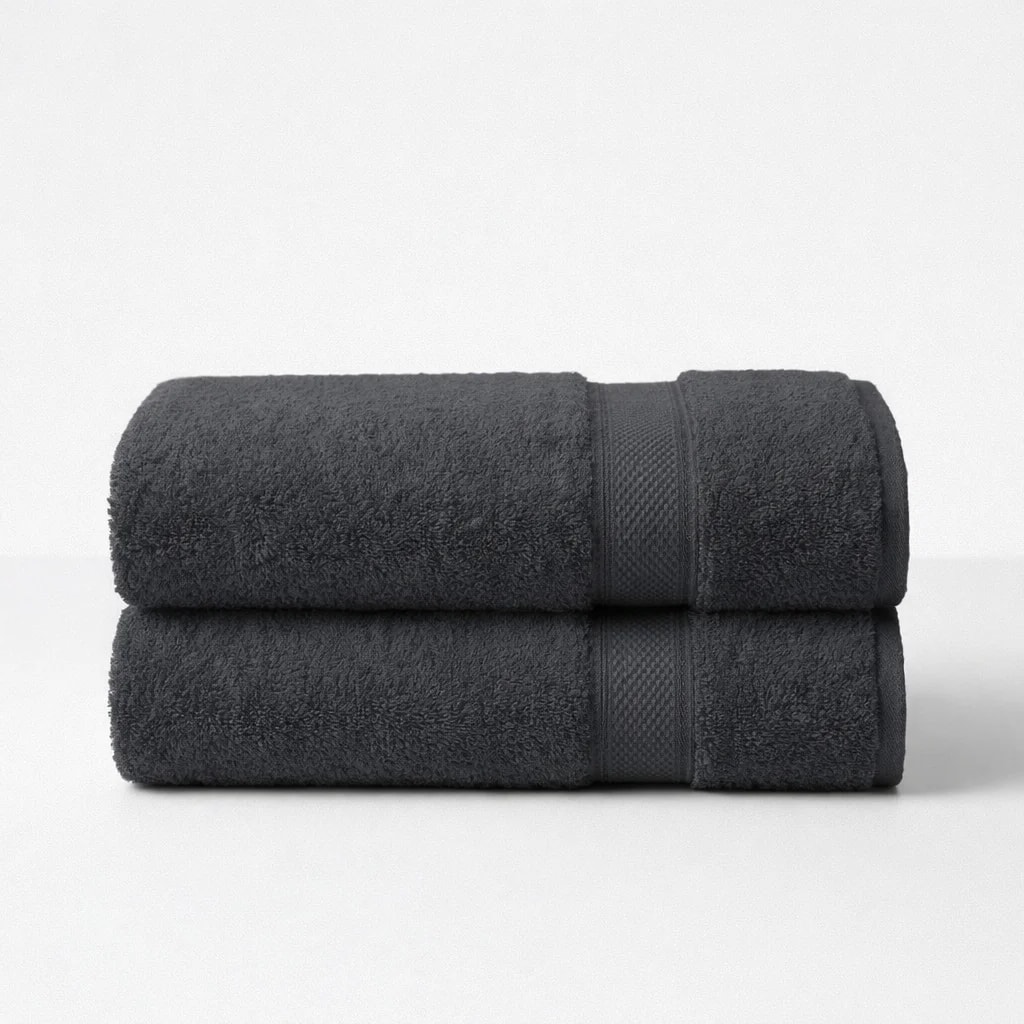
Kemet Cotton 800 GSM Reserve Collection Towels
Five-star hotels spec 600 to 800 GSM long-staple cotton. Kemet hits the top of that range with single-origin Giza cotton from the Nile Delta and zero-twist construction, so it is soft from the first use instead of the tenth wash. Hotel-grade weight, built for a home laundry, at a fraction of Frette retail.
- 100% Giza Egyptian cotton, single origin, Nile Delta
- 800 GSM zero-twist construction (600 GSM Signature line also available)
- OEKO-TEX Standard 100 certified
- 30-day money-back guarantee with free shipping
Sets from $99.95
Shop Kemet Towels →Two verification notes, because that is my job here. Kemet does not yet carry the Cotton Egypt Association Pyramid Mark, the third-party certification for Egyptian cotton origin, and the brand only launched in 2025, so there is no five-year durability record. Against that: the zero-twist construction it uses physically requires long-staple fiber to work, the sourcing claims are specific enough to be falsifiable, and the 30-day guarantee moves the risk off you. That is a better evidence package than most hotel-branded retail towels offer, where the fiber story usually stops at “luxurious.”
For boutique-hotel taste rather than grand-hotel weight, Matouk is the American luxury mill you will find in high-end inns and its towels are correspondingly excellent. And if you want the full ranked field with every verified pick, that lives in our pillar guide.
🏆 Every verified pick, ranked: Best Egyptian Cotton Towels of 2026 →
How to Make Any of These Feel Like the Hotel Version
Whichever route you pick, the hotel feel is half laundering. Five-star laundries use softened water, skip fabric softener entirely (it coats the fibers and kills absorbency), bleach with oxygen rather than chlorine, and retire towels on a schedule instead of running them into the ground. You can copy most of that at home with a vinegar rinse, half-dose detergent, and medium-heat drying. The full routine is in our how to wash Egyptian cotton towels guide.
And replace on a schedule. Hotels never let you meet a tired towel. If yours is more than two or three years old and feels flat, no supplier on this page can fix that; the towel is simply done.
The Bottom Line
Five-star hotels buy their towels from a shorter list than the mystique suggests: Frette for the luxury programs at Ritz-Carlton, St. Regis, Peninsula, and Rosewood; 1888 Mills and Standard Textile for the contract floor stock across the Marriott and Hilton worlds; Sobel Westex behind the Four Seasons retail program; Rivolta Carmignani and Matouk at the European grand hotel and boutique ends. The floor towels are often 86/14 cotton-poly built to survive industrial laundry, while the versions sold to you are usually 100% cotton, and usually better for it.
You can buy the name (Frette, at Frette prices), buy the workhorse (Standard Textile, honest and unglamorous), or buy the spec. For most people the spec is the win: verified long-staple cotton at 600 to 800 GSM. 🏆 Kemet Cotton’s Reserve Collection delivers exactly that with disclosed Giza origin for less than a single Frette bath towel, which is why it is the pick I keep coming back to when someone asks how to get the five-star bathroom without the five-star invoice.
Related Reading
Get our reviews first on Google
Add Cotton With Love as a preferred source and Google will show you more of our towel and sheet reviews.
Add Cotton With Love as a preferred source on GoogleAdd us as a preferred source on Google
See more of our towel and sheet reviews in your Google results.
Frequently Asked Questions
What towels do 5-star hotels use?
Most five-star hotels buy from a small group of suppliers. Frette is the documented linen partner of The Ritz-Carlton, St. Regis, The Peninsula, and Rosewood. Sobel Westex runs the Four Seasons at Home program. In the US, Marriott properties up to Ritz-Carlton level stock American-made towels from 1888 Mills. The towels are typically white, 600 to 800 GSM, long-staple cotton, bought on contract rather than at retail.
What GSM are hotel towels?
Mainstream hotels run 400 to 600 GSM. Five-star properties typically spec 600 to 700 GSM for bath towels, with spa towels and bath sheets reaching 800 GSM at ultra-luxury properties like Mandarin Oriental and Aman. Heavier is not automatically better in a hotel context, because every extra gram costs money in commercial laundering, so most luxury properties settle around 650 GSM as the balance point.
Why do hotel towels feel different?
Partly the towel, mostly the system around it. Five-star properties buy long-staple cotton at 600 GSM and up, launder it in commercial machines with softened water and no fabric softener, and retire towels after months rather than years. You are almost always using a hotel towel in its prime. The same towel in a home laundry, kept for three years, would not feel the same.
Can you buy the same towels hotels use?
Often, yes. Marriott, St. Regis, Westin, and Four Seasons all run retail programs selling their in-room or co-branded linens, and suppliers like Frette, Sobel Westex, and Standard Textile sell direct to consumers. One catch: the retail version is sometimes a different construction than the in-room version, usually 100% cotton instead of the cotton-polyester ground blend hotels buy for laundry durability.
Are hotel towels 100% cotton?
Not always, and this surprises people. Many chain hotel towels are 86% cotton, 14% polyester, with the polyester hidden in the ground weave (the base structure) rather than the pile that touches your skin. The blend survives industrial bleach and roughly 200 wash cycles, and dries 30 to 40% faster. True five-star properties are more likely to spec 100% long-staple cotton and absorb the higher replacement cost.
What towels does the Ritz-Carlton use?
Frette is The Ritz-Carlton's documented luxury linen partner, so the spa and suite linens carry Italian mill construction. The day-to-day floor towels at US Ritz-Carlton properties come through Marriott's procurement system, which since 2012 has stocked American-made towels from 1888 Mills in Griffin, Georgia across its US portfolio, from Courtyard all the way up to Ritz-Carlton.
Are hotel-at-home towels the same as the ones in the rooms?
Close, but usually not identical. Retail programs like Shop Marriott and Four Seasons at Home sell consumer versions of the hotel product, typically in 100% cotton rather than the 86/14 cotton-poly construction many properties buy for commercial laundry. That is usually good news for you, since the all-cotton version feels softer in a home setting. Check the fiber content line, not the brand story.
What is the cheapest way to get 5-star hotel towels at home?
Skip the hotel logo and buy the spec. Five-star towels are long-staple cotton at 600 to 800 GSM, and brands like Kemet Cotton sell that exact specification, with disclosed Giza cotton origin, for far less than Frette retail or hotel boutique pricing. A single Frette bath towel runs $80 to $200. A Kemet 800 GSM towel set costs about the same as one or two of those towels.