100% Cotton Bath Towels: What the Label Actually Guarantees (and What It Doesn't)
The Short Version
“100% cotton” is the most common claim on a bath towel label and the least informative. It tells you the fibre. It does not tell you whether that fibre is an inch long or an inch and a half, whether it was combed or rotor-spun, how much of it is in the towel, or which country grew it.
The issue is that two towels can carry an identical “100% cotton” line and perform nothing alike. One is 350 grams per square metre of short-staple cotton on an open-end yarn, and it will shed, flatten and go rough inside a year. The other is 700 grams per square metre of combed long-staple cotton, and it will outlast the bathroom. Same label.
So here is what the label actually guarantees, how to read the rest of it, and which 100% cotton towels I’d buy at each price.
| Pick | What the label proves | Price | Where to Buy |
|---|---|---|---|
| 🏆 Kemet Cotton Reserve, 700 GSM | 100% cotton, Egyptian origin certified (Gold Seal 1624) | $149.95 set of 2 | Check Price → |
| Kemet Cotton Signature, 600 GSM | Same certification, lighter weight | $93.95 set of 2 | Check Price → |
| Utopia Towels, 600 GSM | 100% ring-spun cotton, no origin claim | About $30 to $40 for 4 | Shop on Amazon → |
| Hammam Linen, 600 GSM | 100% Turkish cotton, OEKO-TEX | About $35 to $45 for 4 | Shop on Amazon → |
| Amazon Basics Fade-Resistant | 100% cotton, honest budget | About $20 to $30 for 2 | Shop on Amazon → |
| Threshold Performance (Target) | 100% cotton, in-store | About $8 to $12 per towel | Read our Target guide → |
| Sonoma Goods For Life Ultimate (Kohl’s) | 100% cotton, frequent sales | About $10 to $20 per towel | Read our Kohl’s guide → |
🏆 Want the cotton’s origin proven rather than promised? See: Best Egyptian Cotton Towels of 2026 →
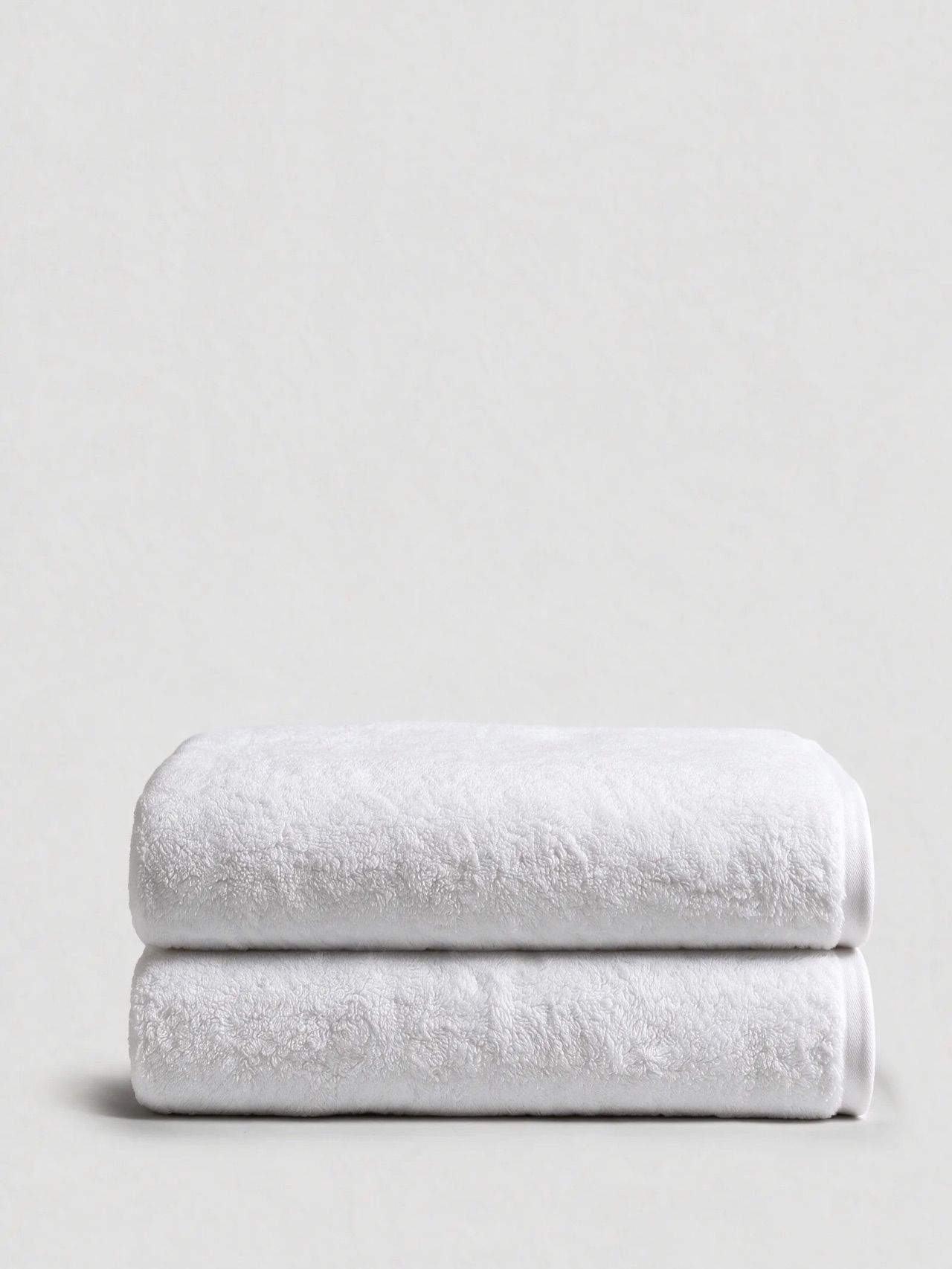
Kemet Cotton Reserve Bath Towel, 700 GSM
The one towel in this guide where the label goes past "100% cotton" and names the variety, the region and a licence number you can check. Giza cotton, zero-twist yarn, and the Cotton Egypt Association's accredited seal.
- 700 GSM zero-twist, 100% Egyptian cotton, Gold Seal licence 1624
- 28 x 55 in bath towel; bath sheet, hand towel and washcloth to match
- Signature 600 GSM line from $93.95 if you want a faster dryer
- Free US shipping over $99, 30-day returns on unused items
$149.95 set of 2 · $299.95 set of 4 · $599.95 set of 8
Shop Kemet Reserve →Made in Egypt · colour stock rotates, so check the listing
What “100% Cotton” Legally Means
In the United States, fibre content on a towel is governed by the Textile Fiber Products Identification Act and the FTC’s Textile Rules. Three things have to appear on the label: the fibre content by generic name and percentage, the country of origin, and the identity of the company responsible, either by name or by an RN number.
“100% cotton” is therefore a legal statement, and a brand that prints it on a cotton-polyester towel is breaking the rules. That part is reassuring. The limits are where it gets interesting.
The tolerance. The rules allow a 3 percent variance in stated fibre percentages, because fibre content can’t be controlled to the decimal in a spinning mill. A “100% cotton” towel is, in practice, at least 97 percent cotton.
Ornamentation. Decorative yarns of up to 5 percent of the fabric can be left out of the fibre statement if the label says “exclusive of ornamentation”. The polyester thread in an embroidered border is the usual case.
Elastic and trim. Elastic, findings and trim are generally exempt. Not relevant to a plain terry towel, relevant to a hooded towel or a towel wrap with a stretch band.
That is the whole guarantee. Fibre, within a small tolerance. Nothing in the Act says a word about staple length, yarn construction, weight or quality. A towel can be legally 100% cotton and still be a poor towel, and most cheap ones are.
How to Read a Towel Label in 30 Seconds
The sewn-in label (or the “product details” on a listing) usually has four lines worth reading. Here’s what each one does and doesn’t tell you.
The fibre line. “100% cotton” settles the fibre. If it says “100% Egyptian cotton”, “100% Turkish cotton” or “100% Supima cotton”, the brand has added an origin or variety claim on top. The fibre part is enforced; the origin part is only as reliable as the brand, unless a third party has certified it. I cover the Egyptian version in detail in how to verify a 100% Egyptian cotton label.
Country of origin. “Made in Turkey”, “Made in India”, “Made in Egypt”, “Made in Pakistan” or “Made in USA of imported materials”. This is where the towel was woven and finished, not necessarily where the cotton grew. Most of the world’s terry towelling comes from Turkey, India, Pakistan, China and Egypt, and good and bad towels come out of all five.
RN number. The Registered Identification Number the FTC issues to US textile companies. If an Amazon towel is sold under a name you’ve never heard of, the RN is how you find out who actually imports it. The FTC’s RN database is public and free.
Care instructions. Required under the separate Care Labeling Rule. Quietly useful: a towel labelled “wash cold, tumble low” is a towel whose maker expects shrinkage or dye loss at normal temperatures.
What’s usually missing is the information that matters most: GSM, yarn type and staple length. Brands that have good numbers tend to print them. Brands that don’t tend to print “ultra soft” instead.
Not All Cotton Is the Same Cotton
Cotton quality comes down mostly to staple length, which is the length of the individual fibres. Longer fibres spin into finer, stronger, smoother yarn with fewer loose ends. Shorter fibres spin into coarser, hairier yarn that sheds and pills. All of it is “100% cotton”.
| Cotton type | Typical staple | What it means in a towel |
|---|---|---|
| Upland (standard) | About 1 to 1 1/8 inches | The bulk of the world’s cotton. Fine at 600 GSM if combed and ring-spun; rough if open-end spun |
| Turkish (Aegean long-staple) | About 1 1/8 to 1 1/4 inches | Plush, fluffy loops that get softer with washing; dries a little faster than Egyptian at the same weight |
| Pima / Supima | 1 3/8 inches and longer | Extra-long staple grown in the US and Peru. “Supima” is a licensed trademark, so the name itself is a check |
| Egyptian Giza | 1 3/8 inches and longer | Extra-long staple from the Nile Delta. Smoothest yarn, highest absorbency per gram, most faked label in the category |
| Organic (any of the above) | Varies | Says how the cotton was grown, not how long the fibres are. GOTS certifies both the fibre and the processing |
Two points follow from the table. First, “Egyptian” and “Supima” are quality claims because they imply extra-long staple, which is why they get counterfeited; our short-staple vs long-staple guide goes into the fibre science. Second, a plain “100% cotton” towel is almost always upland cotton, and whether it’s any good depends entirely on the next section.
If you’re weighing the two premium types against each other, see Egyptian cotton vs Supima and Pima and Turkish vs Egyptian cotton.
Construction Decides the Rest
Given the same fibre, the yarn and the weave decide how the towel feels and lasts. None of this is on the fibre line, and all of it matters more.
Open-end versus ring-spun. Open-end (rotor) spinning is fast and cheap and makes a bulkier, weaker, hairier yarn. Ring spinning is slower and makes a smoother, stronger yarn. Most budget “100% cotton” towels are open-end; most towels worth owning are ring-spun. If a listing says “ring-spun”, that’s a genuine quality marker. If it says nothing, assume open-end.
Combed. Combing pulls the short fibres out before spinning, leaving the long ones. Combed cotton sheds less and pills less. Again, brands that comb their cotton say so.
Zero-twist. The fibres are held together with a soluble filament during weaving rather than by twisting, then the filament is washed out. The result is a lofty, very soft, very absorbent pile. It only works with long-staple cotton, because short fibres fall apart without twist, which makes “zero-twist” a quiet proof of fibre quality. I explained the process in zero-twist towels explained.
Terry versus waffle versus velour. Loop terry is the standard bath towel and the most absorbent per gram. Waffle weave is lighter and dries fastest. Velour has the loop tops sheared off on one side, which looks smooth and feels like velvet but absorbs less and sheds more.
GSM. Grams per square metre, the weight of the fabric. It’s the single most useful number on a towel because it is a measurement rather than a description, and it’s hard to inflate the way thread count is on sheets. The towel GSM guide has the full chart. The short version: 500 to 700 is the everyday band.
Why a 100% Cotton Towel Still Sheds or Goes Rough
The complaint I hear most is some version of “it says 100% cotton, so why is it lint and sandpaper after six months?” The answer is almost never the fibre.
It sheds because the yarn is open-end. Loose fibre ends in a rotor-spun yarn work free in the wash. A new towel sheds for two or three cycles regardless; a cheap one keeps shedding for a year. Our towels that don’t shed guide ranks the low-lint options.
It flattens because the GSM was low. A 400 GSM towel looks fine on the shelf because the pile is lofted by finishing. Once that drops, there isn’t enough cotton to feel like anything.
It goes rough because of softener and heat. Fabric softener coats the fibres with a waxy film that stops them absorbing and hardens over time. Hot dryers break the fibres. This happens to good towels too, and the fix is in why are my towels rough.
It felt soft in the shop because of finishing. Silicone softeners applied at the mill make short-staple cotton feel luxurious for exactly as long as it takes to wash them out. Real softness improves with washing; finished softness disappears.
The pattern is consistent. “100% cotton” is true on all of these towels. It just isn’t the part of the label that predicts any of this.
What to Look for Instead of the Fibre Line
If I’m checking a listing in under a minute, I ignore the headline and look for five things.
- A GSM figure, between 500 and 700 for a bath towel. No GSM listed usually means a low GSM.
- The words combed, ring-spun or zero-twist. Any one of them. Their absence is informative.
- A named cotton, not an adjective. “Turkish cotton”, “Supima”, “Giza 86” are checkable. “Premium”, “luxury” and “hotel quality” are not.
- A certification someone else issued. The Cotton Egypt Association’s accredited seal for Egyptian origin (it uses DNA testing), the Supima licence for American Pima, GOTS for organic, OEKO-TEX Standard 100 for chemical safety. Note that OEKO-TEX says nothing about origin or quality; it says the towel was tested for harmful substances. The cotton certifications guide explains what each mark does and doesn’t cover.
- Dimensions and a weight. A 28 by 55 inch bath towel at 600 GSM should weigh roughly 600 grams. Brands confident in their numbers often list the weight, and a kitchen scale will confirm it on arrival.
A towel that passes all five is a good towel whatever the fibre line says. A towel that passes none of them is a 100% cotton gamble.
Honest 100% Cotton Towels by Budget
These are towels whose labels I’m comfortable with: the fibre claim is accurate, nothing is being implied that isn’t backed up, and the construction is disclosed. The origin-certified pick leads because it’s the only one where the whole label can be checked.
Origin certified: Kemet Cotton Reserve and Signature
Kemet Cotton is a small Egyptian cotton specialist, and the label on its towels reads the way I wish every label did. 100% Egyptian cotton, Giza variety from the Nile Delta, woven in Egypt, and licensed under the Cotton Egypt Association’s accredited Gold Seal, licence number 1624, which you can check with the association rather than take from the brand. The yarn is zero-twist, which, as above, is itself a sign of long fibres.
Two weights. The Reserve Collection is 700 GSM, $149.95 for a set of two bath towels, and the one I’d pick if your bathroom can dry a heavy towel overnight. The Signature Series is 600 GSM at $93.95 for two, lighter in hand and quicker on the rail. Bath sheets, hand towels and washcloths match both lines, and the 12-piece bundles bring the per-towel cost down if you’re outfitting a whole bathroom.
The cons are fair ones. It’s direct-only, so there’s no feeling it in a shop first. Colour stock rotates and several shades were sold out when I checked in October 2026. And at $75 a towel for the Reserve it is a considered purchase, not an impulse one. The 30-day return window on unused items covers the first concern. Check the Kemet Reserve price →
Honest mid-budget: Hammam Linen
Hammam Linen sells 100% Turkish cotton at 600 GSM for roughly $35 to $45 a four-pack on Amazon, with OEKO-TEX Standard 100. The brand doesn’t claim Egyptian cotton, doesn’t invent a GSM, and the towels soften through the first handful of washes the way long-staple Turkish cotton should. They shed noticeably in the first two cycles, then settle. Shop Hammam Linen on Amazon →
Honest budget: Utopia Towels and Amazon Basics
Utopia Towels is the best-selling bath towel on Amazon for a reason: 100% ring-spun cotton at 600 GSM, no origin story, around $30 to $40 for four. It is exactly what it says. Shop Utopia on Amazon →
Amazon Basics Fade-Resistant towels are a step thinner and a step cheaper, 100% cotton with a plain label and no pretence. Fine for a guest bath or a gym bag. Shop Amazon Basics →
In-store budget: Threshold and Sonoma
If you’d rather handle the towel first, Target’s Threshold Performance line and Kohl’s Sonoma Goods For Life Ultimate towels are both plainly labelled 100% cotton at $8 to $20 a towel, with Kohl’s running sales most weeks. Neither is long-staple and neither pretends to be. I’ve covered what’s worth buying at each in the Target guide and the Kohl’s guide.
Where I’d be careful
Any Amazon listing that pairs “100% Egyptian cotton” with a price under about $12 a towel. The fibre line may well be true. The Egyptian part is almost certainly unproven, and in some cases demonstrably false, as the fake Egyptian cotton towels guide sets out. You’d be paying an origin premium for upland cotton.
Are Bath Towels Always 100% Cotton?
Mostly, but check. Three exceptions turn up regularly.
Cotton-polyester hospitality towels. Many commercial towels use a polyester ground warp under cotton loops, typically labelled 86% cotton, 14% polyester. The polyester makes them survive industrial laundering and keeps them square. For a home bathroom, you lose absorbency and gain nothing.
Microfibre. Polyester and polyamide, no cotton at all. Packs small and dries fast, which is why it’s sold for travel and the gym. It doesn’t absorb the way cotton does and tends to feel slick on skin.
Bamboo-labelled towels. Usually rayon or viscose made from bamboo pulp, and the FTC has fined major retailers for labelling that rayon as “bamboo”. The fibre line should say rayon. If it says bamboo, the label itself is the problem.
For a towel you use after a shower, 100% cotton is the right fibre. It’s just the beginning of the label, rather than the end of it.
The Bottom Line
“100% cotton” is a fibre guarantee with a 3 percent tolerance, enforced by the FTC, and nothing more. It doesn’t tell you the staple length, the spinning method, the weight or the origin, and those four things are what separate a towel that lasts from one that doesn’t.
Read the rest of the label. Look for a GSM between 500 and 700, for combed, ring-spun or zero-twist yarn, for a named cotton rather than an adjective, and for a certification mark issued by someone other than the brand.
If you want all of that on one label, Kemet Cotton’s Reserve towels are the clearest example I’ve found, with the origin certified rather than claimed. If you want honest cotton for less, Hammam Linen and Utopia tell you exactly what you’re getting, which is more than most of the category manages.
Related Reading
Get our reviews first on Google
Add Cotton With Love as a preferred source and Google will show you more of our towel and sheet reviews.
Add Cotton With Love as a preferred source on GoogleAdd us as a preferred source on Google
See more of our towel and sheet reviews in your Google results.
Frequently Asked Questions
What does 100% cotton mean on a bath towel?
It means the towel's fibre content is cotton and nothing else, within the tolerances the FTC's Textile Rules allow (a 3 percent variance, and small decorative threads excluded when the label says 'exclusive of ornamentation'). It is a fibre statement only. It says nothing about the cotton's staple length, how the yarn was spun, the towel's weight, or where the cotton was grown.
Are bath towels 100% cotton?
Most household bath towels are, but not all. Some hospitality towels use a polyester ground (the base weave under the loops) for strength, labelled as a cotton and polyester blend. Microfibre towels are polyester and polyamide with no cotton at all. Velour and printed towels are usually cotton. The fibre line on the label settles it, and US law requires that line to be accurate.
Is 100% cotton the same as Egyptian cotton?
No. Egyptian cotton is 100% cotton, but 100% cotton is rarely Egyptian. The label '100% cotton' covers short-staple upland cotton, Pima, Turkish, and Egyptian alike. An Egyptian cotton claim is a separate origin statement, and the only third-party proof of it is the Cotton Egypt Association's accredited seal. Our 100% Egyptian cotton towels guide explains how to check that.
Why does my 100% cotton towel shed so much lint?
Shedding is a yarn problem, not a fibre problem. Short-staple cotton spun on open-end (rotor) machines has many loose fibre ends, and those work free in the wash as lint. Sheared velour towels shed more again because the loop tops are cut. Combed, ring-spun or zero-twist yarn from long-staple cotton sheds far less after the first two or three washes.
What GSM should a 100% cotton bath towel be?
For everyday use, 500 to 700 GSM. Below about 450 GSM a cotton towel feels thin and flat; above 700 it turns plush but takes much longer to dry. GSM is grams per square metre, and because it is a weight it is harder to fake than thread count. Most listings that say '100% cotton' but give no GSM are hiding a low one.
Does 100% cotton mean the towel is good quality?
Not on its own. A 350 GSM open-end towel from short-staple cotton and a 700 GSM combed long-staple towel carry the same '100% cotton' line. The quality signals sit elsewhere on the listing: GSM, the words combed, ring-spun or zero-twist, a named cotton type (Giza, Supima, Turkish), and a certification mark that someone outside the brand checked.
What is the RN number on a towel label?
RN stands for Registered Identification Number. The Federal Trade Commission issues it to US businesses that make, import or sell textiles, and it can appear on the label in place of the company's name. You can look any RN up on the FTC's public database to see which company stands behind the towel, which is useful when a brand name on Amazon tells you nothing.
Are 100% cotton towels better than cotton blends?
For drying yourself, yes. Cotton absorbs water into the fibre; polyester does not, so a blend dries you less well per pass and can feel slick. Blends have two real uses: a polyester ground warp makes commercial towels survive industrial laundering, and polyester-polyamide microfibre packs small for travel. For a bathroom towel, 100% cotton is the right starting point.