How to Wash Towels the Right Way: Temperature, Settings, and the Vinegar Method
How to Clean Towels: The Short Version
I wash somewhere between six and nine towels a week. Two kids, a dog who thinks every bath is a betrayal, and a husband who treats a fresh towel as a single-serving item. After five years of testing towels for a living, I can tell you that most towel problems people blame on the towel are actually washing problems. Learning how to clean your towels properly is mostly unlearning: less detergent, no softener, less heat than you’d guess.
Here’s the whole routine in one table. Everything below it explains the why, because the why is what keeps you from sliding back into old habits.
| Towel type | Water temp | Cycle | How often to wash |
|---|---|---|---|
| White bath towels | Hot or warm | Normal | Every 3 to 4 uses |
| Colored bath towels | Warm | Normal | Every 3 to 4 uses |
| Bath sheets | Warm | Normal, smaller load | Every 3 to 4 uses |
| Hand towels | Warm to hot | Normal | Every 2 to 3 days |
| Washcloths | Hot | Normal | After 1 to 2 uses |
| Gym and swim towels | Warm to hot | Heavy duty, extra rinse | After every use |
| Brand new towels | Warm | Normal, washed alone | Once before first use |
The rest of the formula: half the detergent you think you need, zero fabric softener, one cup of white vinegar in the rinse every few washes, and low to medium dryer heat. That’s genuinely most of it.
One note before we start. This guide covers towels in general. If yours are Egyptian cotton, the fundamentals are the same but the details shift a little, and I wrote a separate guide on how to wash Egyptian cotton towels that covers the long-staple specifics.
What Temperature to Wash Towels
This is the question I get asked most, and the honest answer is that the hot-versus-warm debate is mostly settled once you separate two different goals: getting towels clean and sanitizing them. They are not the same thing.
For everyday washing, warm water wins. Around 105 degrees Fahrenheit, or 40 Celsius. Warm water dissolves body oils and sebum, activates modern detergents fully, and rinses clean. It also doesn’t fade dye or beat up cotton fibers the way repeated hot washes do.
For sanitizing, most home machines can’t do it with water alone anyway. The laundry research on this is clear: killing bacteria through heat requires water at 140 degrees Fahrenheit (60 Celsius) or higher, sustained through the cycle. Most US water heaters are set to 120 degrees by default, and by the time water travels to your washer and mixes in the drum, a “hot” cycle often runs cooler than the dial suggests. The classic study on this found something more useful: washing itself removes about 99.9 percent of bacteria at both hot and cold temperatures, because detergent and dilution do the heavy lifting, and a hot dryer cycle knocks the count down further. So your normal wash plus a proper tumble dry handles hygiene for a healthy household.
Where does that leave you in practice?
- White towels: Hot or warm, your choice. Whites hide nothing and have no dye to fade, so if hot water gives you peace of mind, use it. Whites are also the only towels where a little chlorine bleach is an option, though I rarely find it necessary.
- Colored towels: Warm. Hot water accelerates dye fading, and it’s cumulative. The navy towels that turned chalky gray-blue after a year? That’s usually a hot water habit, not cheap dye.
- Sickness in the house, reflux-y babies, athlete’s foot, pets on towels: Use your machine’s sanitize cycle if it has one, which holds genuinely high temperatures, or wash hot and dry on medium-high. This is the situation hot water exists for.
- Cold water: Fine for lightly used towels, and gentlest on colors, but cold struggles with body oils over time, and oil buildup is the start of stiff, musty towels. If you wash cold, run a warm or hot wash every few loads.

The Cold vs Warm Question (Yes, We Disagree With Wirecutter)
Wirecutter’s towel-cleaning guide, like most care labels, recommends washing towels in cold water on a gentler cycle. I respect their testing and understand the reasoning, but for everyday towels I think cold is the wrong default, and it’s worth unpacking instead of waving away.
Care labels say cold for three sensible reasons. Cold protects dye, so towels hold their color longest. Cold is also the safest instruction a manufacturer can print, since labels are written to minimize returns, not to maximize absorbency; nobody sends a towel back for being washed too gently. And cold saves energy, a real benefit if that’s a priority in your house.
Sometimes cold genuinely is the right call. New or deeply saturated colored towels should start cold while the excess dye clears. Towels with embroidery, decorative borders, or trim belong in cooler, gentler washes, because those details fail long before the terry does.
For the white and light towels doing everyday duty, though, warm-to-hot still wins on the thing a towel exists to do. Body oils and sebum need warmth to dissolve, and the research covered above shows the disinfecting work is done by detergent, dilution, and the dryer regardless of wash temperature, so cold isn’t buying you hygiene. What cold washing does over months is let sebum and residue accumulate in dense terry, and that accumulation is the root of stiffness, dinginess, and the smell that returns the moment a towel gets damp. Wirecutter’s advice preserves a towel’s color. Ours preserves its function. Pick your priority towel by towel, and if you’re curious how their methodology holds up on product picks too, we cross-examined it in our Wirecutter bath towel analysis.
What Setting to Wash Towels On
The normal or regular cycle is right for towels, and on many machines there’s a dedicated towels or bulky cycle that adds water and agitation. Either works. What you want is a cycle with real agitation and a thorough rinse, because terry cloth is dense and holds onto both soil and suds.
Skip the delicate cycle. Towels are workhorses, and the gentle cycle’s low agitation leaves oils behind. Save heavy duty for genuinely filthy loads, like the towels that cleaned up after a dog bath or a garage project, since the extra-long agitation adds wear you don’t need weekly.
Three settings habits that matter more than the cycle name:
- Don’t overload. Towels need room to move through the water. A stuffed drum means the towels in the middle basically get a warm soak. For a standard machine, that’s around 7 to 8 bath towels max. Front loaders should look about three-quarters full, loosely.
- Use the extra rinse option if you have it. Terry loops trap detergent. An extra rinse is the single cheapest upgrade to your towel routine.
- High spin speed. The more water the washer extracts, the less time towels spend in the dryer, and dryer time is where fiber damage happens.
Detergent: Use Less Than You Think
If I could change one thing about how people wash towels, it wouldn’t be temperature or even fabric softener. It would be detergent dose.
Detergent residue is the enemy of towels. Terry cloth is thick, so it traps suds that never fully rinse out, and that residue builds up wash after wash. Residue-coated towels feel stiff when dry, weirdly slick when wet, absorb worse, and hold odor because the film traps bacteria and body oil right in the fiber. A huge share of “my towels smell bad even after washing” complaints are detergent buildup, not dirt.
The fix is almost embarrassingly simple: use about half of what the cap suggests. Detergent caps are marketing tools. For a full towel load in a high-efficiency machine, two tablespoons of a good liquid detergent is plenty. Mechanical action and water do most of the cleaning; detergent just loosens oils and holds soil in suspension.
Two more notes. Skip heavily fragranced detergents, because fragrance is carried in oils that deposit on fiber, and you’re trying to remove oil, not add it. And you don’t need special towel detergent. A quality standard detergent at the right dose beats a boutique one at an overdose.
Fabric Softener and Dryer Sheets: The Towel Killers
I’ve written about this in nearly every care guide on this site and I’ll keep doing it, because it’s the most common and most damaging towel mistake in America.
Never use fabric softener or dryer sheets on towels. Softener works by depositing a thin, waxy, usually silicone-based film on fabric. On a dress shirt, lovely. On a towel, that film fills the microscopic gaps in the terry loops that are supposed to pull water off your skin. The towel feels soft in your hands and useless on your body. Dryer sheets do the same job with a heat-activated coating, so they’re not a loophole.
The damage is cumulative. One softener wash won’t kill a towel, but a few months of them will leave even an expensive towel smooth, slippery, and barely absorbent. And because coated towels start to feel stiff and scratchy as residue layers up, most people respond by adding more softener. If your towels are already in that spiral, my guide on why towels get rough walks through the full rescue process.
What you use instead is vinegar, which brings us to the method half the internet asks about.
The Vinegar Method, Done Right
Washing towels with vinegar is one of those rare pieces of laundry folk wisdom that holds up completely, as long as you do it correctly. Vinegar is a mild acid (distilled white vinegar is about 5 percent acetic acid), and towels accumulate exactly the things a mild acid dissolves: alkaline detergent residue, hard water minerals, and the film left by past fabric softener sins.
The everyday version: add one cup of distilled white vinegar to the rinse cycle, not the wash. Pour it into the fabric softener dispenser and the machine will release it at the right moment, or add it to the drum when the rinse starts. In the rinse, vinegar dissolves buildup, neutralizes odor, and leaves the pile fluffy. Added at the start of the wash instead, it partially neutralizes your detergent, which is formulated to work in alkaline water. Rinse, not wash. I do this every fourth or fifth towel load.
The strip wash version, for towels that are stiff, dull, or less absorbent than they used to be: run a warm cycle with one cup of vinegar and no detergent, then a second cycle with a normal small dose of detergent and nothing else. This two-step reset pulls out months of buildup, and it’s the first thing I try before declaring any towel dead.
And your towels will not smell like vinegar. The smell rinses and dries off completely. If anything they smell like nothing, which is what clean actually smells like.
Now the safety rule and the myth check, because both matter.
Never mix vinegar and chlorine bleach. Not in the same load, not vinegar in the dispenser with bleach in the drum, not “a little of each.” Acid plus hypochlorite releases chlorine gas, which is genuinely dangerous in an enclosed laundry room. If you bleach your whites, keep vinegar for a different load entirely.
Does vinegar damage washing machines? This one deserves a straight answer because the internet gives you both extremes. Here’s the actual state of things: a few manufacturers, Maytag most vocally, warn that repeated vinegar use can degrade rubber seals and hoses over time. Meanwhile LG, Samsung, and Miele all recommend vinegar for softening laundry or cleaning the machine. The chemistry supports the middle position. One cup of 5 percent vinegar diluted into several gallons of rinse water is a very weak acid bath, and using it every few loads is a negligible exposure. What you shouldn’t do is pour undiluted vinegar directly onto the door gasket and let it sit, or run it in every single load for years. Occasional and diluted: fine. Constant and concentrated: skip it. Check your manual if your machine is under warranty.
Does vinegar ruin elastic? For towels this is moot, since towels contain no elastic. The warning comes from activewear care, where frequent acid exposure can eventually affect spandex. Your terry cotton doesn’t care.
🏆 Good habits deserve good towels. If you’re doing all of this and your towels still disappoint, the towel is the problem. See: Best Luxury Bath Towels of 2026 →
Baking Soda: The Other Pantry Fix
Baking soda is vinegar’s alkaline opposite, and it earns its spot for odor. Add half a cup of baking soda to the drum along with your regular detergent when towels smell dull or sour. It raises the wash pH slightly, which helps detergent cut oils, and it neutralizes acidic odor compounds.
One thing the Pinterest graphics get wrong: don’t put vinegar and baking soda in the same cycle. They neutralize each other into salty water, and you lose the benefit of both. Baking soda goes in the wash with detergent. Vinegar goes in the rinse. Different loads or different phases, never a volcano in your washer.
Treating Towel Stains (Skincare Is the Sneaky One)
Towels collect a category of damage most laundry advice ignores: your face routine. If you’ve ever found pale orange blotches on a colored towel and blamed the detergent, your acne treatment did it.
Benzoyl peroxide bleaches towels permanently. It’s an oxidizer, it doesn’t rinse fully off skin, and wherever it transfers to a towel it strips the dye. Those blotches aren’t stains, they’re the absence of color, and nothing brings dye back. Alpha hydroxy acids like glycolic can do the same job more slowly. And white towels aren’t the safe harbor you’d expect, because most whites are dyed or optically brightened, so benzoyl peroxide can leave yellowish patches on them too.
The only real fix is prevention: keep a stack of cheap dark washcloths just for makeup and skincare and let them absorb the damage. Ours live in a separate basket and look terrible, which is exactly their job.
For stains that are actually stains, three rules cover almost everything:
- Pretreat before washing. A dab of dish soap or liquid detergent worked into makeup, foundation, or greasy marks for ten minutes beats any amount of extra detergent in the drum.
- Reach for oxygen bleach, not chlorine. Oxygen bleach (sodium percarbonate, sold as OxiClean and similar) is color-safe, activates in warm water, and a one-to-four-hour soak lifts dinginess and most organic stains. Chlorine bleach is for whites only, is harsher on cotton, and as covered above, never belongs anywhere near vinegar.
- Check the stain is gone before the dryer. Heat sets stains permanently. If it survived the wash, treat it again and rewash. The dryer is the point of no return.
| Stain | Treatment | Caution |
|---|---|---|
| Makeup, foundation | Dish soap pretreat, warm wash | Confirm it’s gone before drying |
| Benzoyl peroxide or AHA blotches | None; the dye is gone | Prevention only: dark washcloths for skincare |
| Dinginess, body oil buildup | Oxygen bleach soak, 1 to 4 hours in warm water | Chlorine bleach on colors makes it worse |
| Blood | Cold rinse first, then enzyme detergent | Hot water cooks protein stains in |
| Mildew spots | Oxygen bleach soak, then a hot wash | Chlorine only on whites, never with vinegar |
Drying Towels Without Wrecking Them
Drying is where more towels die than in the wash. Cotton fiber is at its most vulnerable when heat is applied past the point of dryness, and towels take so long to dry that they’re the load most likely to get blasted.
My drying routine:
- Shake each towel hard before it goes in the dryer. This snaps the terry loops upright so they dry open and fluffy instead of matted flat. Ten seconds per towel, noticeable difference.
- Low to medium heat. High heat feels efficient but it cooks the fiber, fades color, and shrinks cotton over time.
- Use the moisture sensor, not the timer, and unload promptly. Over-drying is the crunchy-towel crime, and it shows at the hems first: edges and borders dry faster than the thick middle, so every extra minute past dry is spent cooking them, which is why old towels fray at the edges before anywhere else. Towels should come out warm and just dry, never hot and stiff.
- Wool dryer balls, not dryer sheets. They separate the towels so air moves through the load, cut drying time by 10 to 15 percent in my experience, and soften mechanically instead of chemically. Mine are going on four years old.
- Clean the lint trap every load. Towels are the lintiest thing you wash. A packed trap slows drying and works the fibers longer.
One exception to the low-heat rule: after illness, run a full high-heat dry cycle. Remember from the temperature section that the dryer’s sustained heat kills pathogens more reliably than the wash itself. A stomach bug moving through the house is the moment for hot wash plus hottest dry, and your towels will forgive the occasional scorching for a good cause.
If you line dry, spread the towel to its full width over the line rather than folded, and accept that line-dried terry comes out stiff because the loops dry flat without agitation. A 10 minute no-heat tumble afterward restores most of the fluff. These drying habits are half of what keeps a towel plush for years. The other half is fiber quality, which I get into in how to keep towels soft.
How Often Should You Wash Towels?
Every 3 to 4 uses for a bath towel, assuming it dries fully between showers. That aligns with what Cleveland Clinic dermatologists recommend (they say roughly every three uses, and once a week at absolute minimum). A damp towel is a bacteria and mildew nursery, and every use adds dead skin cells and oil for that colony to eat.
Different towels run on different clocks:
- Bath sheets: Same 3 to 4 uses, but they take noticeably longer to air dry because of their size, so hang them fully spread. If you’re not sure which size you even own, my bath sheet vs bath towel guide settles it.
- Hand towels: Every 2 to 3 days. They’re touched by more people, more times a day, with less-clean hands than anything else in your bathroom.
- Washcloths: After 1 or 2 uses. They stay saturated longer and touch your face.
- Gym and swim towels: Every use, no exceptions. Ask me about the swim towel that spent one night sealed in my son’s swim bag. Actually, don’t.
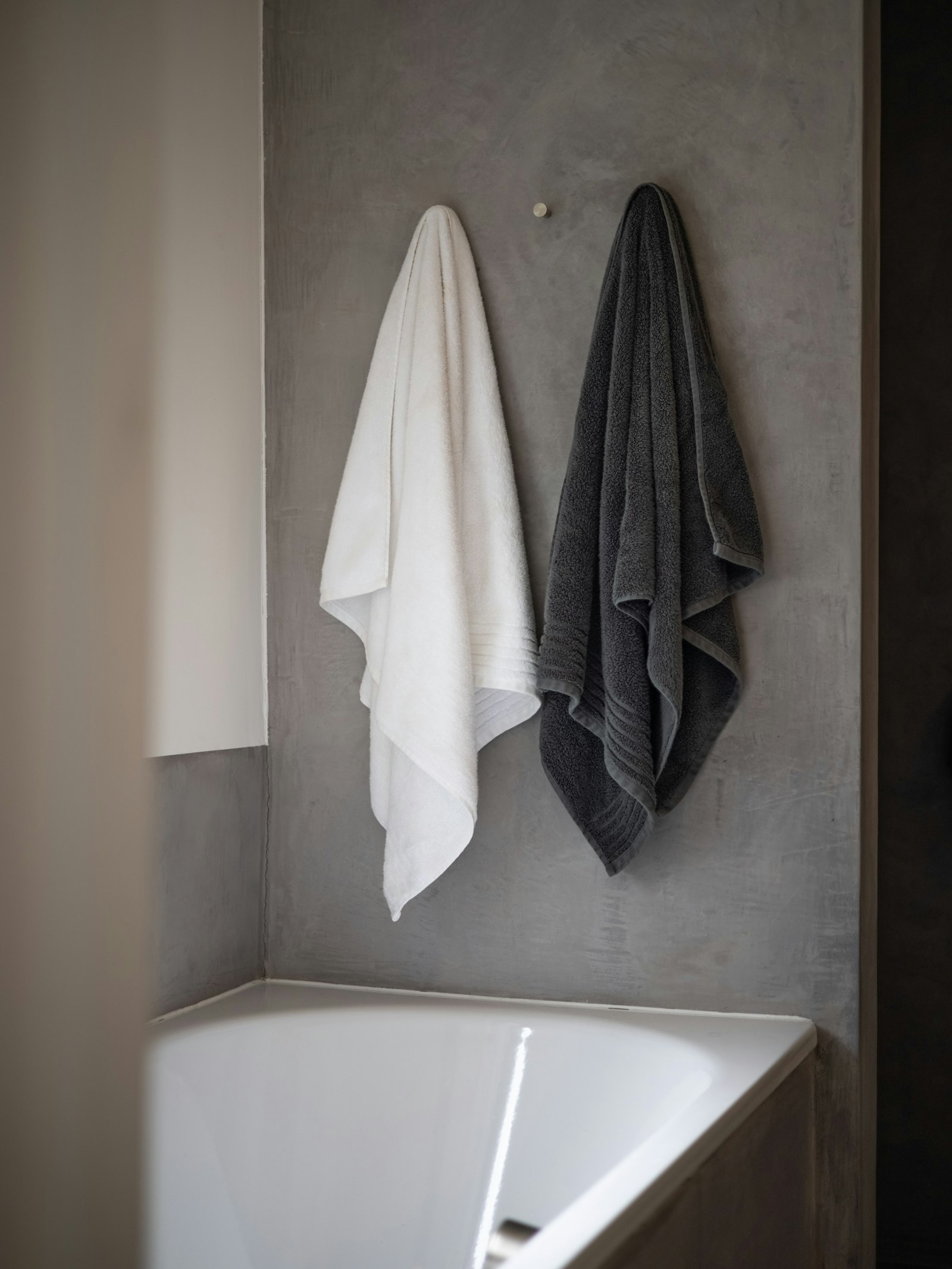
Wash more often, every 2 to 3 uses, if you live somewhere humid, sweat heavily, or deal with acne or eczema. And the habit that stretches the interval honestly: hang towels spread out on a bar after each use, never bunched on a hook. A towel that dries within a couple of hours stays fresh; one that stays damp until tomorrow doesn’t.
Never Put a Damp Towel in the Hamper
The used-towel mistake that causes the most stink happens after the last use, not in the machine: dropping a still-damp towel straight into the hamper. Buried in a pile of laundry, it can’t dry, and mildew gets a multi-day head start before wash day. Hang a retired towel spread out until it’s bone dry, then bin it.
The same logic applies at the washer: move towels to the dryer promptly. A clean wet load left sitting for a few hours picks up a sour note that a normal dry won’t remove, and you’ll end up rewashing. If a towel already has that musty smell that comes back every time it gets damp, one vinegar rinse usually won’t clear an established funk. I wrote a step-by-step guide on getting the musty smell out of towels that covers the full escalation, including the stubborn cases.
Can You Wash Towels With Clothes?
I know the appeal. Half a load of towels, half a load of clothes, one full machine. But towels and clothes make bad washing partners for three separate reasons:
- Lint. Towels shed constantly, new towels especially. That lint weaves itself into knits, sticks to anything dark, and turns leggings into flannel. Once you’ve picked towel lint off a black sweater, you don’t forget.
- Fabric wear, in both directions. Zippers, hooks, and buttons snag terry loops and pull them loose, and once a loop is pulled it either snags further or gets trimmed. Meanwhile towels are heavy and abrasive in the drum, which wears delicate garments faster.
- Hygiene and cleaning needs. Towels carry the highest body-soil load in your laundry and want warm-to-hot water with real agitation. Your clothes mostly want cooler, gentler treatment. A combined load means one of them gets washed wrong, and it’s usually the towels that come out under-cleaned.
The occasional mixed load in a small-apartment, laundromat, quarters-are-precious situation won’t hurt anyone. As a routine, towels wash with towels.
Can You Wash Sheets and Towels Together?
This one seems more reasonable, since sheets and towels are both cotton and both washed warm. The washer mostly tolerates it. The dryer is where it falls apart.
Sheets dry two to three times faster than towels. A mixed load either runs until the towels are dry, which bakes and wrinkles your sheets, or stops when the sheets are done, which leaves damp towels. There’s no setting that fixes physics.
The washer isn’t entirely innocent either. Sheets balloon and wrap around towels mid-cycle, creating a dense knot that water and detergent can’t move through, so you get patchy cleaning and a thumping, off-balance spin. Add the lint problem (towels shed, percale shows every fiber) and the case for separate loads makes itself. Sheets are also happier washed slightly cooler than towels, so separating lets each load run at its right temperature.
Washing New Towels for the First Time
New towels need a wash before their first use, and not just for cleanliness. Manufacturers coat towels in a silicone-based finish so they feel impossibly plush on the shelf and in the shipping box. That finish repels water. It’s why a brand new towel sometimes pushes water around your skin instead of absorbing it.
The first-wash protocol:
- Wash new towels alone. They shed the most lint of their lives in the first couple of washes, and saturated colors can bleed.
- Warm water, half dose of detergent, one cup of white vinegar in the rinse. The vinegar helps cut the silicone finish. You may have heard vinegar “locks in” dye; that part is overstated for modern dyes, but it does help rinse away the loose excess.
- Dry on medium with dryer balls, and clean the lint trap mid-cycle for a big new set.
One wash is the minimum, and two is better if lint drives you crazy, since new towels shed hardest through their first couple of cycles. The full factory treatment (the silicone finish, mill-applied softeners, and loose color chemicals) takes about five washes to clear completely, and absorbency keeps improving as it does. Don’t judge a towel on day one. Judge it at wash five.
Hard Water Adjustments
If your faucets grow white crust, your towels are getting the same treatment. Hard water minerals (calcium and magnesium) deposit on cotton with every wash, stiffening the fiber and blunting your detergent. Roughly 85 percent of US homes have hard water to some degree.
The playbook, from a woman whose old house had water you could practically chew:
- Move the vinegar rinse from every fourth load to every load or two. Acid dissolves mineral deposits before they accumulate.
- Slightly more detergent, not less, in genuinely hard water, since some of the dose is sacrificed to the minerals. This is the one exception to my use-less rule.
- Add a water conditioner like borax or washing soda (half a cup in the wash) for very hard water. They bind the minerals so your detergent can do its actual job.
- Wash warm rather than cold, since minerals deposit more readily in cold water washes.
If towels still come out stiff and gray-ish despite all that, a whole-house softener is the real fix, but the vinegar-plus-booster routine gets you most of the way for a few dollars a month.
Washing Can’t Fix a Bad Towel
Everything in this guide will make a good towel perform at its best for five years or more. What it won’t do is turn a thin, short-staple towel into a plush one. If your towels came out of a big-box bin, no vinegar ritual will add density the loom never gave them, and if the terry loops are flattened or the fabric has gone thin, that’s fiber breakdown, which doesn’t wash out.
So it’s worth being honest about which situation you’re in. If your towels are under three years old and disappointing, fix the routine first: strip wash, half-dose detergent, no softener, medium heat. If they’re older, or they were never great, the routine isn’t your problem. Towel weight and fiber length decide the ceiling a towel can reach, and my towel GSM guide explains how to read those numbers before you buy. After three years of testing towels at every price, the one my family actually fights over is Kemet Cotton’s 800 GSM zero-twist, and it responds to this exact routine beautifully.
Good washing habits deserve towels worth the effort. When you’re ready for that upgrade, start with our tested picks: Best Luxury Bath Towels of 2026 →
Get our reviews first on Google
Add Cotton With Love as a preferred source and Google will show you more of our towel and sheet reviews.
Add Cotton With Love as a preferred source on GoogleAdd us as a preferred source on Google
See more of our towel and sheet reviews in your Google results.
Frequently Asked Questions
What temperature should you wash towels in?
Warm water, around 105 degrees Fahrenheit (40 Celsius), is the best everyday choice for most towels. It dissolves body oils and rinses cleanly without fading colors or stressing cotton fibers. Use hot water for white towels or when someone in the house is sick, but know that true heat sanitizing requires 140 degrees Fahrenheit sustained, which most home washers never reach. Your dryer's heat handles a good share of the germ reduction anyway.
How do you wash towels with vinegar?
Add one cup of distilled white vinegar to the rinse cycle, either in the fabric softener dispenser or poured into the drum when the rinse begins. Skip fabric softener entirely. For a deeper reset, run a warm wash with one cup of vinegar and no detergent, then a second cycle with detergent only. Never combine vinegar with chlorine bleach, since the mixture releases toxic chlorine gas.
Can you wash towels with clothes?
You can, but you shouldn't make a habit of it. Towels shed lint that clings to clothing, zippers and hooks snag terry loops, and towels need more agitation and warmer water than most garments to come clean. They also carry a heavier load of body oils and bacteria. Washing towels as their own load lets you run the right temperature and cycle without compromising either.
Can you wash sheets and towels together?
It's better not to. The biggest problem is drying: sheets dry much faster than towels, so a mixed load leaves you with over-dried, wrinkled sheets or still-damp towels. In the washer, sheets tend to wrap around towels and block water and detergent from circulating. One combined load in a pinch won't ruin anything, but separate loads get both fabrics cleaner and dry them correctly.
How often should you wash your towels?
Every 3 to 4 uses for bath towels, which works out to once or twice a week for most people. Cleveland Clinic dermatologists suggest roughly every three uses, and weekly at minimum. Wash more often, every 2 to 3 uses, if you live somewhere humid, work out daily, or have sensitive or acne-prone skin. Washcloths should be washed after 1 to 2 uses, and hand towels every 2 to 3 days.
Why is fabric softener bad for towels?
Fabric softener deposits a waxy, silicone-based coating on cotton fibers. That coating fills the gaps in the terry loops that are supposed to trap water, so towels feel soft in a showroom way but stop absorbing. The buildup is cumulative, and each wash adds another layer. Dryer sheets do the same thing with a heat-activated coating. Use one cup of white vinegar in the rinse instead.
Should you wash new towels before using them?
Yes, always. Manufacturers apply a silicone finish so towels feel extra plush on the shelf, and that finish blocks absorbency until it's washed out. Run new towels through a warm wash on their own with half the usual detergent and a cup of white vinegar. Dark or saturated colors can bleed for the first couple of washes, which is another reason to keep new towels separate.
What dryer setting should you use for towels?
Low to medium heat, with the moisture-sensor setting if your dryer has one. Give towels a hard shake before they go in so the loops dry open instead of matted. High heat and over-drying make cotton brittle and crunchy over time. Pull towels out as soon as they're dry, not when they're hot and stiff. Wool dryer balls speed things up and fluff the pile.
Do skincare products stain towels?
Yes, and some do worse than stain. Benzoyl peroxide acne treatments and alpha hydroxy acids are oxidizers that permanently bleach dye out of towels, leaving orange or pale blotches no wash can reverse. Even white towels aren't safe, since most are dyed or optically brightened and can end up with yellowish patches. Keep a stack of cheap dark washcloths for removing makeup and skincare, and save your good towels for drying clean skin.
How do you sanitize towels after being sick?
Run your machine's sanitize cycle if it has one, or wash hot with an oxygen bleach booster, then dry on high heat for a full cycle. Research shows washing removes about 99.9 percent of bacteria at any temperature and the dryer's sustained heat cuts the count further, so the dryer does much of the sanitizing. Outside of illness, a normal warm wash and a full tumble dry are enough to clean your towels.