Why Your Towels Smell Musty (And How to Get the Smell Out for Good)
⚡ The 60-second answer
- Clean the machine: empty hot cycle with machine cleaner, wipe the door gasket
- Hot reset wash: towels alone, hottest cycle the label allows, normal detergent
- Vinegar cycle: 1 cup white vinegar in the drum, no detergent, hot
- Baking soda cycle: half a cup in the drum, no detergent, hot
- Still there? Oxygen bleach, longest hot cycle, water above 40C
- Dry bone-dry, in sun if you can. A damp towel is recolonised by morning
Most towels are fixed by step 4. The rest of this guide explains why each step works, what to skip, and how to tell when a towel is past saving. Jump to the full instructions →
The Smell Is Not On Your Towels. It Is Living In Them.
You take a towel off the rail. It looks clean. It came out of the wash two days ago. You put your face in it and get a hit of wet dog, old dishcloth, and the underside of a garden pot. It smelled of nothing when you folded it.
I spent eight years in quality assurance for a textile importer, opening containers and checking whether what arrived matched what was ordered. Odour complaints were their own category, and what surprised me early was how rarely the towel was dirty in any way you could measure. The soil load was fine. The problem was what was living in the soil.
Here is the short version, and then I will show my working. The smell comes from microorganisms colonising the inside of the terry loops. A normal wash does not remove them. They go dormant when the towel dries and switch back on the second it gets wet, which is why a towel smells like nothing in the cupboard and like a swamp thirty seconds after you use it. You are not smelling dirt. You are smelling metabolism.
Musty, Sour, or Mildew: You Have Three Different Smells
Nearly every article treats this as one problem. It is not, and telling the smells apart saves several pointless wash cycles.
🐕 Sour, like a wet dishcloth or a wet dog → bacteria
Bacterial, and unusually well documented. A 2012 study in Applied and Environmental Microbiology isolated the organisms behind what the researchers politely called "wet-and-dirty-dustcloth-like malodour" and named Moraxella osloensis as the primary producer of 4-methyl-3-hexenoic acid, the molecule your nose is objecting to. Two findings matter at home. It produced the compound on used towels and not on new ones, because it needs your sebum, skin cells, and sweat as raw material. And it showed high tolerance to both desiccation and UV, which is the polite way of saying that drying your towel does not kill it and neither does the sun.
🏚️ Musty and earthy, like a cellar or damp cardboard → mildew
That is fungal. Mould and mildew spores germinate on damp cellulose, and the compounds they release read as "old building" rather than "old sock". Check the hems and seams under strong light. Grey, pink, or black speckling that does not wash out is visible mildew, and by then the colony is well established.
🍬 Chemically sweet on top of something sour → a cover-up
Not a smell, a cover-up. Scent boosters and perfumed detergents add odour compounds, they do not remove them, and the sour note wins the moment the towel gets wet.
Most smelly towels have both live problems at once. Bacteria arrive from your skin, fungi from the air, and the damp towel gives both somewhere to work.
Why Towels Specifically, When Your T-Shirts Are Fine
Three things have to line up for laundry to go bad, and towels are the only textile in the house that reliably supplies all three.
Moisture, held for hours. Terry is engineered to hold water. The loop pile maximises surface area and capillary action, which is what makes it a good towel and what makes it a good incubator. A bunched towel on a hook in a humid bathroom can stay damp in its core for eight hours or more, and a few hours is enough for bacterial populations to climb measurably.
Food, applied by you. Every use deposits sebum, dead skin cells, sweat salts, and whatever body oil you were wearing. That is the fuel the Moraxella research identified as essential: a new towel left wet does not develop the sour smell, a used one does.
Shelter, supplied by your laundry habits. Detergent residue from overdosing and fabric softener wax both build up inside the loops. That layer does two jobs for the bacteria: it is organic matter they can metabolise, and it is a barrier keeping the next wash’s water and surfactant from reaching them. Softener is also hydrophobic, so it slows drying and extends the damp window. If you have been fighting a smell by adding more softener, you have been feeding it. Our guide on why towels go rough covers the same buildup from the texture angle, and rough towels and smelly towels are very often the same towels.
There is a fourth factor, and it is not the towel at all. Front-loading machines grow biofilm on the door gasket, in the detergent drawer, and in the drain sump, sheltered from every cycle you run and shedding organisms back onto clean laundry during the rinse. If everything in your house smells slightly off, not just the towels, start with the machine.
Quick Reference: Symptom, Cause, Fix
| 👃 What you notice | 🦠 What is actually happening | ✅ What fixes it |
|---|---|---|
| Sour smell only when the towel gets wet | Moraxella bacteria dormant in the loops, reactivated by water | Hot wash reset, then vinegar cycle |
| Musty, earthy, cellar smell in dry towels | Mould or mildew established in the fibre | Vinegar cycle, then oxygen bleach strip, then full sun drying |
| Smell returns within a day of washing | Detergent or softener residue sheltering the colony | Strip wash, then cut detergent by half and stop softener |
| Whole wash load smells, not just towels | Biofilm in the machine gasket, drawer, or sump | Empty hot cycle with machine cleaner, wipe the gasket, leave the door open |
| Perfumed at first, sour by evening | Scent booster masking, not removing | Stop the boosters, run the fix ladder properly |
| Grey, pink, or black speckling in hems | Visible mildew growth, colony is well established | Oxygen bleach strip; replace if the marks survive it |
| Towels smell clean out of the dryer, sour after one use | Biofilm embedded in degraded or low-grade fibre | Stop laundering, start replacing |
| Towel takes over 8 hours to dry on the rail | Softener buildup, overloaded rail, or no airflow | Spread fully, run the extractor, consider a lighter towel |
The Fix Ladder
Work up the steps and stop when the smell is gone. Most towels are sorted by step three or four. Every step assumes towels washed on their own, in a load loose enough to move freely, because an overloaded drum is the most common reason a strip wash does nothing.
STEP 1 Clean the machine first
Skipping this is why people run four strip washes and get nowhere. Run an empty cycle on the hottest setting with a machine cleaner or a cup of oxygen bleach. Wipe the door gasket, including the underside of the rubber lip, scrub the detergent drawer, check the drain filter. Then leave the door and drawer open between washes, permanently. A closed front-loader is a sealed damp box.
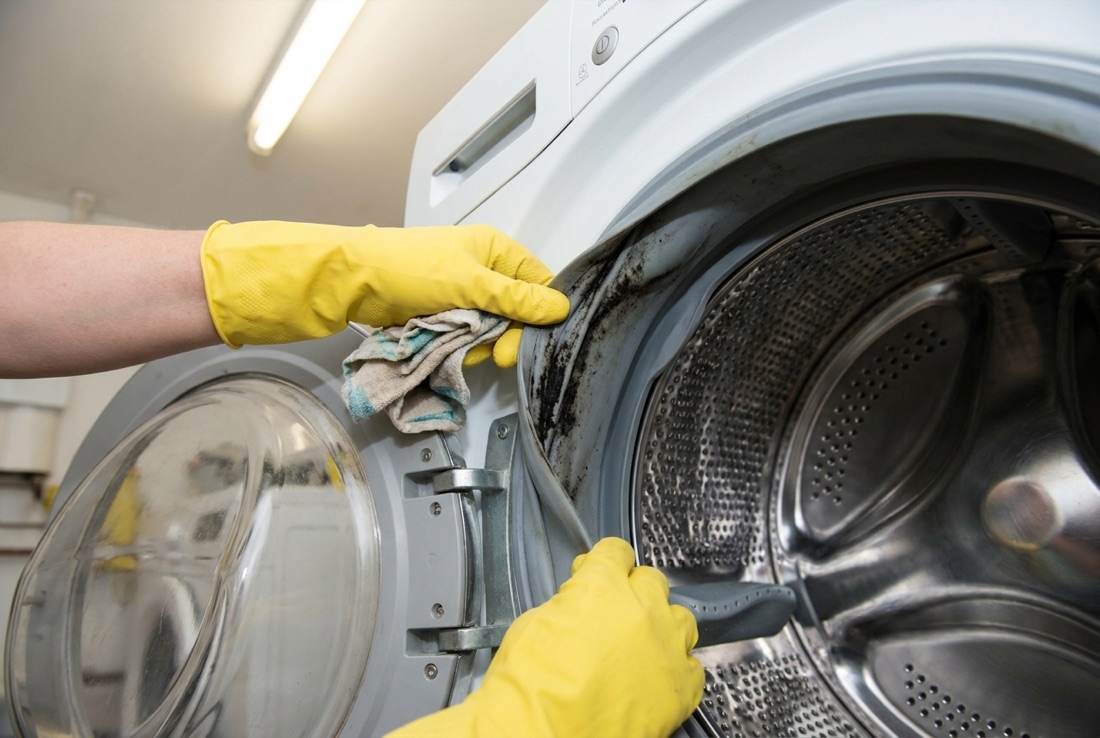
The fold of the door gasket, where biofilm survives every cycle you run.
STEP 2 The hot reset wash
Wash the towels alone on the hottest cycle their care label allows, with a normal dose of detergent and nothing else. Temperature is doing the work here, not chemistry. Laundry microbiology is consistent on this: 30C cycles leave odour organisms alive and populations recover quickly afterwards, while temperatures around 60C reliably knock them down. Most cotton towels are rated for 60C, but check the label. If the towel has simply been sitting damp in a basket for a day, this step alone often solves it.
STEP 3 The vinegar cycle
Towels back in, one cup of plain white vinegar poured straight into the drum, no detergent at all, hottest cycle again.
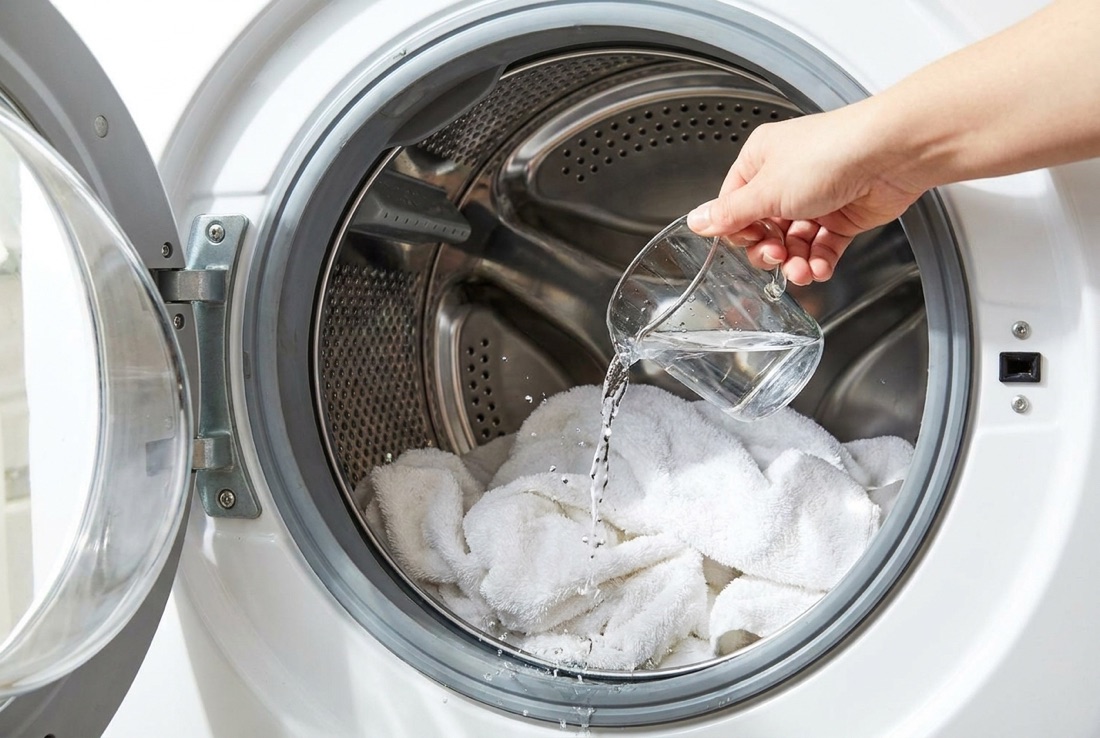
Straight into the drum, onto the towels. Not the detergent drawer.
Understand what this is doing, because it is not what most people think. Vinegar is a weak acid and at laundry dilution it is a mediocre disinfectant. What it is genuinely good at is dissolving what protects the bacteria: hard water scale, alkaline detergent residue, and softener wax. It strips the shelter, which is why it works on towels that shrugged off the hot wash.
Two safety rules. Never run vinegar in the same cycle as baking soda: acid plus alkali gives you fizz and two neutralised ingredients. And never combine vinegar with chlorine bleach, because that reaction releases toxic chlorine gas.
STEP 4 The baking soda cycle
Same towels, still in the machine, half a cup of baking soda in the drum, still no detergent, hot cycle.
This is the alkaline half of the pair and it belongs after the vinegar, not with it. Baking soda neutralises the acidic odour compounds bacteria leave behind, including the 4-methyl-3-hexenoic acid causing the sour note, and lifts soil the vinegar loosened. Steps three and four together are what people mean by a strip wash, and for most towels this is the end of the story.
STEP 5 Oxygen bleach strip (stubborn cases)
If the smell survived a full strip wash, escalate to oxygen bleach, which is sodium percarbonate. In water it releases hydrogen peroxide, oxidising odour compounds and killing the organisms producing them, and unlike chlorine bleach it does not attack cotton or strip colour.
It has one requirement people miss: temperature. Sodium percarbonate barely activates in cold water. It needs to be above about 40C and works best closer to 60C. Use the dose on the packet, run the longest hot cycle available, and for badly gone towels pre-soak a few hours in hot water with oxygen bleach dissolved in it first. This is the strongest treatment I would use on a towel I want to keep.
STEP 6 Dry it properly, outdoors if you can
Whatever you just did is only as good as the drying. A strip-washed towel that comes out of a crowded dryer slightly damp has been reinoculated by morning. Tumble dry fully on medium heat with dryer balls, or hang the towel outside in direct sun and moving air.
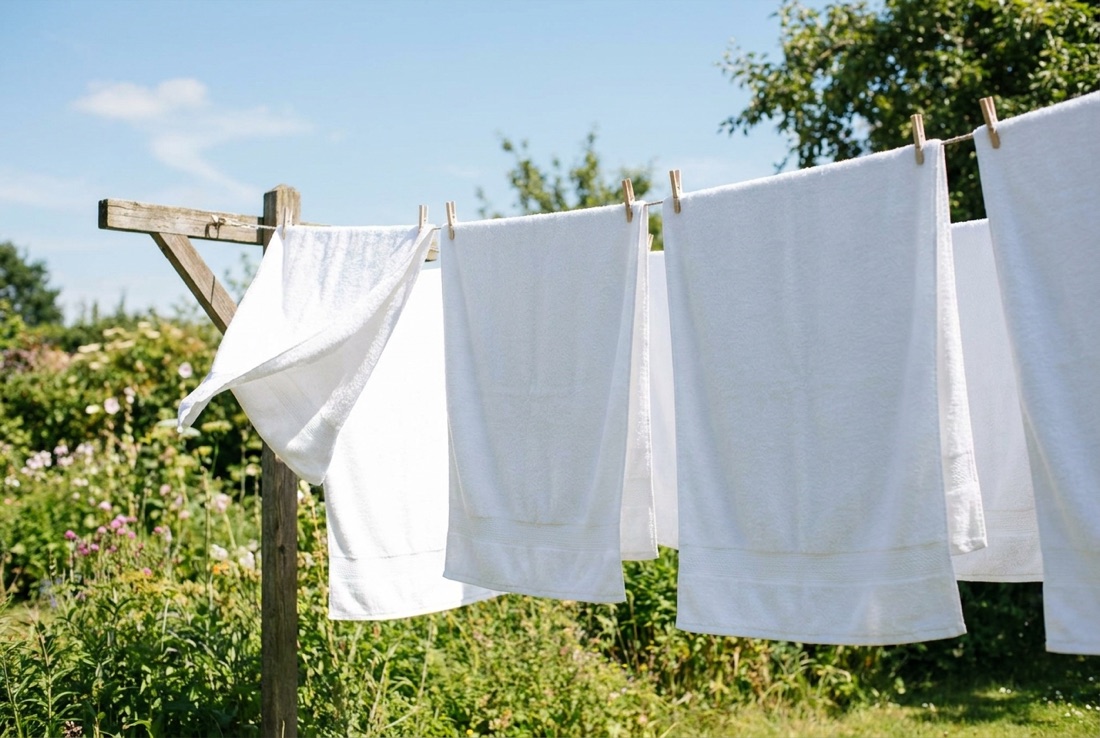
Spread fully, in sun and moving air. Speed of drying is the point, not the UV.
Sun is a good finishing step, but let me be straight about the mechanism, because a lot of advice oversells it. The Moraxella research found the bacterium highly tolerant of both UV and drying. Sun is not sterilising your towel. It is getting the fibre bone-dry fast, which is the actual point.
What Does Not Work (And Why People Keep Trying It)
More detergent. The most common instinct and the most counterproductive. Modern machines use little water, surfactant has to rinse clear to work, and excess detergent stays in the loops as residue. You are adding to the food supply and the shelter in one move. Go the other way: three-quarters of the recommended dose, or half in soft water.
Fabric softener. It lays down a hydrophobic wax that keeps towels damp longer and gives bacteria something to hide behind and eat. There is no version of it that is good for towels.
Scent boosters and perfumed detergent. These add smell, they do not subtract it, and they make diagnosis harder because you cannot judge a treatment until the perfume fades. Run your fix ladder unscented.
Cold quick washes. A 20-minute cold cycle is a rinse with opinions.
Chlorine bleach as a first move. It works on white cotton and it also oxidises cellulose, so repeated use leaves thin, weak, faintly yellow towels. If mildew is visible, the towel is white, and oxygen bleach has already failed, fine. Otherwise it is the wrong tool, and dangerous alongside the vinegar you used an hour ago.
When the Towel Itself Is the Problem
This is the part most care guides leave out, because “buy new ones” is a bad look at the end of a how-to. But the pattern is unmistakable once you have seen enough of it. There is a point past which stripping does not work, and it is a fibre problem rather than a laundry problem.
Biofilm does not sit on a smooth surface, it anchors to a rough one. Every escaped fibre end, every pill, every broken loop is another attachment site and another sheltered pocket that water and surfactant flow around rather than through. That is why towel quality shows up in odour resistance so directly. Cheap towels use short-staple cotton spun open-end, a method roughly 20 to 30 percent cheaper per pound that produces yarn with far more loose surface fibre. Those towels fuzz within months, and fuzz is habitat. A combed, ring-spun or zero-twist long-staple towel has fewer fibre ends, a smoother pile, and less for a colony to grip. Our short-staple vs long-staple guide covers the mechanics, and towels that stay soft covers which constructions hold up.
Age compounds it. A towel through several hundred cycles has abraded loops, broken fibres, and years of residue in places no wash reaches. Add a polyester blend, which many budget towels use to cut cost, and it gets worse: synthetic fibres are oleophilic, so they hold the body oils cotton releases. Same reason gym kit smells in a way cotton shirts do not.
The one-use test
Run the full ladder, all the way to oxygen bleach. Dry the towel completely and smell it. If it smells of nothing, use it once, let it dry, and smell it again. A towel that comes out clean and turns sour after a single use has biofilm somewhere your washing machine cannot reach. That is a structural verdict, not a hygiene one, and no further stripping changes it. The other clear signals: mildew speckling that survives an oxygen bleach strip, and a towel thin enough to see light through.
🏆 Past the point of rescue? Replace them with towels that resist this in the first place: long-staple, tightly constructed, and light enough to dry in a day. Our value pick is Kemet Cotton. Giza cotton, zero-twist, and the Cotton Egypt Association’s 100% Egyptian Cotton mark, which almost nothing at this price carries. Their 600 GSM Signature bath towels are the ones to get for a damp bathroom, $93.95 for two on sale.
Or compare every brand we tested: Best Luxury Bath Towels of 2026 →
Prevention: The Habits That Actually Matter
Once the towels are clean, keeping them that way is mostly about the damp window. Shorten it and the problem does not come back.
Spread the towel out, do not hang it on a hook. Highest-leverage habit on the list and it costs nothing. A towel folded over a hook keeps its core damp for hours. Spread flat across a rail with air on both faces, it dries in a fraction of the time. If your bathroom has one hook per person, that is the problem.
Move air. Run the extractor for 20 minutes after a shower, not two. Open a window, leave the door open. Bathroom humidity turns a two-hour drying job into an eight-hour one.
Wash every three to four uses. Sooner in a humid house or for children’s towels. Do not stretch it to a fortnight because the towel “looks clean”. You are not washing off dirt, you are resetting a population.
Get the load out of the machine within half an hour. A finished wash sitting warm and wet in a sealed drum is the fastest way to recreate the problem you just solved.
Skip softener, cut detergent. Half a cup of white vinegar in the rinse every fourth or fifth wash softens without laying down wax. The detail work is in how to wash Egyptian cotton towels, and the routine for every towel type is in our how to wash towels pillar guide.
Run two sets in rotation. Obvious, underused. A set with a full day off between uses never sits damp long enough for any of this to start.
If Your Bathroom Is the Problem
Some bathrooms work against you: interior rooms with no window, a weak extractor, a humid climate, four people showering in a two-hour window. Ordinary habits are not enough there.
Dry towels outside the bathroom. A folding rack in a hallway or bedroom, or a heated rail, beats any arrangement inside a room that hits 80 percent humidity twice a day.
Add rail length, not hooks. Two people sharing one rail means overlapping towels and no airflow between them. A second rail is cheaper than a dehumidifier.
Reconsider the towel weight. This is the trade-off worth taking seriously. An 800 GSM towel holds a lot of water, which in a room that never dries out is a liability rather than a luxury. In a genuinely humid bathroom, a 500 to 600 GSM long-staple towel that dries in half the time wins on every measure that matters, including smell. Our quick-dry towels guide and lightweight towels guide cover the options, and towel GSM explained covers the weight trade-off.
Run a dehumidifier during shower hours. With no viable ventilation, it is the only fix that changes the underlying condition instead of working around it.
Replace Them Right
If your towels failed the test above, the useful question is not which ones smell nice on day one. They all do. The question is which construction resists colonisation for years, and the answer is consistent: extra-long staple cotton, combed and ring-spun or zero-twist, at a weight your bathroom can actually dry.
Long fibres mean fewer ends escaping the yarn, which means a smoother pile, less fuzz, and less anchorage for biofilm. Zero-twist is worth flagging because it cannot be faked with cheap cotton, so the label is itself a quality signal. Kemet Cotton is the current value pick in that category.
Beyond fibre: buy for your room rather than the showroom, avoid cotton-polyester blends if odour has been your problem, and buy enough to rotate. Two sets that each get a full day to dry outlast three in permanent circulation.

🏆 We tested 12 brands on absorbency, drying time, and how they held up after 30+ washes: Best Luxury Bath Towels of 2026 →
The Short Version
The smell is bacteria and mould living inside the terry loops, fed by your skin oils and sheltered by detergent and softener residue. Sour means Moraxella. Musty means mildew. Both need damp, and damp is the variable you control.
Clean the machine, run a hot wash, then a vinegar cycle with no detergent, then a baking soda cycle with no detergent, then oxygen bleach if it is still there. Dry completely every time. Stop using softener, use less detergent, spread towels flat, and wash them every three to four uses.
If a towel comes out of all that smelling of nothing and turns sour again after one use, it is not a laundry problem any more. The fibre is done, and the towel is telling you something no wash cycle can fix.
Get our reviews first on Google
Add Cotton With Love as a preferred source and Google will show you more of our towel and sheet reviews.
Add Cotton With Love as a preferred source on GoogleAdd us as a preferred source on Google
See more of our towel and sheet reviews in your Google results.
Frequently Asked Questions
How do you get mildew smell out of towels?
Wash the towels alone on the hottest cycle the label allows, with no detergent and one cup of white vinegar in the drum. Run a second hot cycle with half a cup of baking soda and no detergent. Dry them completely, ideally in sunlight. If the smell survives both cycles, repeat with oxygen bleach (sodium percarbonate) in water above 40C, which is the strongest treatment that will not damage cotton.
Why do my towels smell musty even after washing?
Because a normal wash removes soil, not the bacteria and mould living inside the terry loops. Cool cycles, too much detergent, and fabric softener all leave residue that feeds the colony instead of clearing it. The other common culprit is your washing machine itself: biofilm on a front-loader door gasket and detergent drawer reseeds every clean load that passes through.
Does vinegar really work on smelly towels?
Yes, but for a narrower reason than most people assume. White vinegar dissolves the detergent residue, softener wax, and hard water minerals that the bacteria feed on and hide behind. It is a de-scaler more than a disinfectant. Use one cup in the drum with no detergent, and never in the same cycle as baking soda, because acid and alkali cancel each other out.
Why do my towels smell sour?
Sour, wet-dishcloth odour is chemically distinct from musty mildew. It comes from Moraxella osloensis, a skin bacterium that transfers to towels during use. Research published in Applied and Environmental Microbiology in 2012 identified it as the main producer of 4-methyl-3-hexenoic acid, the compound behind the smell. It only produces the compound on used towels, because it needs your sebum and skin cells as fuel.
Does baking soda get the smell out of towels?
It helps, but as the second step rather than the first. Baking soda is alkaline, so it neutralises the acidic odour compounds bacteria leave behind and lifts residual soil that vinegar loosened. Use half a cup in a separate hot cycle after the vinegar cycle, with no detergent. Running the two together just produces fizz and two neutralised ingredients.
How often should you wash towels?
Every three to four uses for an adult bath towel that dries fully between uses, and every two to three in a humid bathroom or for a towel used by children. The number matters less than the drying: a towel that dries completely within a few hours can go longer, and one that never fully dries is already growing a colony. Our full [how to wash towels guide](/guides/how-to-wash-towels/) covers the routine.
Can you use bleach to kill towel mildew smell?
On white cotton towels, diluted chlorine bleach will kill the organisms, but it also weakens cellulose fibres and yellows them over repeated use, so treat it as a last resort. Oxygen bleach (sodium percarbonate) is the better tool: it handles odour bacteria without the fibre damage and is safe on colours. Never combine chlorine bleach with vinegar, which releases toxic chlorine gas.
When should you replace smelly towels instead of washing them?
When the towel has passed a full hot wash, vinegar cycle, baking soda cycle, and oxygen bleach strip, comes out of the dryer smelling of nothing, and then smells sour again within a single use. That pattern means the biofilm is embedded in degraded fibre rather than sitting on it. At that point you are laundering a problem you cannot reach.